Skip to content

Painting

Painting remains the beating heart of Pakistani art, from the bazaar truck art tradition to oil and acrylic works hanging in the country's leading galleries. PakistaniArt covers the painters reinterpreting landscape, portraiture, and abstraction for a new generation, carrying forward a centuries-old craft while pushing it into unexpected territory.
Related —ArtExhibitionsPhotographySculptureCalligraphyStreet ArtDigital ArtMiniature

Latest in Painting

PaintingSEP 14, 2026

Sotheby's Auctions $90M Hedreen Works to Fund Seattle University Museum

Kamil Daad
The image features a split focus between historical portraiture and a contemporary portrait: in the background, a large, gilt-framed oil painting depicts a young, aristocratic 18th-century gentleman with powdered hair, a high cravat, a dark tailcoat with bright buttons, and tan breeches, gesturing toward a dramatic, overcast landscape; standing prominently in the right foreground is an elderly Caucasian man with short, neat white hair, thin-framed glasses, and a subtle smile, dressed formally in a sharp blue suit jacket, a white collared dress shirt, and a solid red tie.
ExhibitionsSEP 8, 2026

61 Artists Descend for Sienna Creative House's Debut Group Exhibition

Awais Shaukat
Vibrant abstract artwork featured on an exhibition flyer. Sienna Creative House hosted its debut art exhibition, showcasing an unfiltered and unbiased collection of contemporary Pakistani artwork. The event, held at House 79A in Islamabad, Pakistan, gathered diverse creators from across the country to give local artists a dedicated, shared platform in the nation's capital. Featuring a mix of modern styles and vision, the exhibition opened its doors from 4:00 pm to 8:00 pm on September 12, 2026, offering accessible entry to art enthusiasts looking to experience the fresh strengths of the regional creative community.
ExhibitionsSEP 4, 2026

Five Painters Rethink the Landscape in 'Second Nature' at Lahore's ZQ Gallery

Awais Shaukat
An art gallery invitation card for an exhibition titled "Second Nature" is superimposed over a textured painting of an expansive desert landscape. The background artwork is rendered in horizontal bands of warm earthy tones, transitioning from deep ochres and browns at the bottom to lighter sandy yellows and muted blues in the upper sky region. The landscape features faint, sketchy outlines of sparse desert vegetation and bare trees on the right side. Cutting vertically down the middle and left portions of the composition are sharp, stylized geometric structures that resemble thin rectangular pillars or overlapping transparent glass panels, adding a modern, abstract contrast to the natural terrain. A small, dark blue silhouette of a bird is perched delicately on a thin horizontal line near the upper center.The text elements are aligned down the center of the card in a clean, white sans-serif font. At the very top, the gallery logo reads "ZQ Gallery" with a stylized leaf or flame motif inside the letter "O". Directly below the bird silhouette, the main exhibition title "SECOND NATURE" is written in large capital letters. Below the title, a smaller line states "Curated by Aasim Akhtar". In the middle section, five featured artists are listed vertically: "Zahra Jewanjee", "Yawar Abbas", "Aqsa Shahir", "Naqsh Raj", and "Abu Hanzla". The lower section details the event information, starting with "Opening Reception" followed by the date "Saturday, September 5, 2026" and the time "5–8 pm". At the absolute bottom of the card, the venue address and contact information are printed in a small, compact line: "ZQ Gallery | 19-A, Jail Road, Lahore | +92 326 495 8860".
PaintingAUG 16, 2026

20 Famous Pakistani Painters Who Shaped a Nation's Visual Identity

Zarvan Zeshan
A complex, monochromatic sepia and gold digital collage is layered with historical South Asian and Mughal-inspired fine art imagery, dominated by the large, stylized text "PAKISTAN PAINTERS" stretching horizontally across the center in a mix of bold block letters and dark, fluidly script-like font overlays. The background and figures are rendered with a distinct halftone dot pattern and weathered print textures. In the upper-left quadrant, a group of three women in traditional, flowing garments and ornate jewelry are depicted in profile and semi-profile, with one holding a paintbrush, while next to them stands a large ceramic vase illustrated with delicate figures. The lower half of the composition highlights a woman seated cross-legged, gracefully playing a traditional multi-stringed lute or rubab, surrounded by intricate linework and sweeping drapery. Intricate mandalas, decorative shield patterns, and a faintly visible, stylized elephant form on the upper right emerge through the dense layers of transparency, blending classical artistry with modern graphic design techniques to evoke a rich narrative of cultural heritage.
ExhibitionsAUG 15, 2026

NCA & PUCAD Stage Their First Joint Exhibition

Kamil Dad
A vibrant indoor art exhibition features a diverse group of attendees gathered in a brightly lit, white-walled gallery space with high ceilings and traditional architectural balconies in the background. On the far left, a large, colorful, abstract painting filled with dense blue, orange, and green hues serves as a focal point. Several people, including a woman in a purple outfit and an older gentleman in a white shalwar kameez wearing a green scarf, stand in front of the artwork, actively engaged in a conversation while viewing the display. Other individuals, wearing formal attire or blazers, observe the gallery pieces under an overhead string of spotlights.
PaintingJUL 28, 2026

Why Your Oil Painting Dries Dull and Patchy, and How to Actually Fix It

Zarvan Zeshan
A side-by-side comparison shows an antique oil painting before and after restoration, housed in an ornate, rectangular gilt-wood frame. The artwork depicts a classical portrait of a dark-haired woman sitting with two young children dressed in white gowns against a backdrop of a red drape and a distant landscape. The left image represents the "before" state, where the canvas and frame appear significantly darkened, yellowed, and obscured by a thick layer of aged varnish and grime. The right image represents the "after" state, revealing dramatically brightened colors, crisp details, a vivid red curtain, luminous skin tones, and a cleaned, gleaming gold frame.
ArtJUL 22, 2026

Why the Internet Thinks Every Painting Is a Crime Scene and the Truth Is Stranger

Awais Shaukat
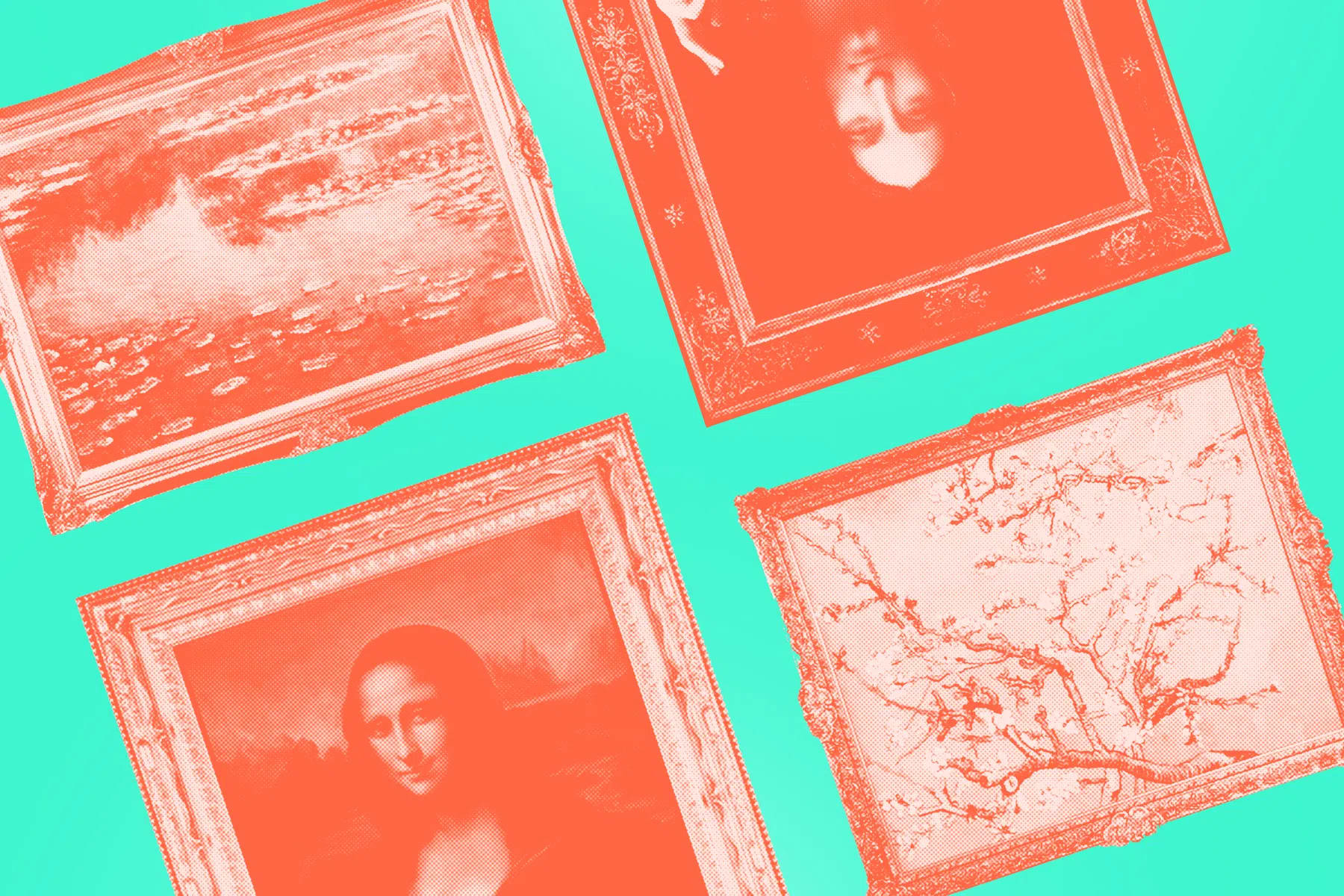
An ornate and visually striking duotone graphic is presented in a bold palette of bright orange and vibrant teal, arranged with a dynamic composition that features four classical artworks tilted at various angles across a flat teal background. The entire image is layered with a distinct halftone dot pattern, simulating a vintage screen-printed or comic-book matrix texture that unifies the classical subjects with a modern, pop-art aesthetic. In the upper-left quadrant, a horizontally oriented, rectangular ornate frame encloses a rendition of Claude Monet’s Water Lilies, capturing the dappled light and impressionistic textures of a pond surface. Positioned in the lower-left area is an iconic portrait of Leonardo da Vinci’s Mona Lisa, framed in a heavily detailed border, her famous enigmatic smile and serene posture clearly identifiable despite the stylized monochromatic rendering. Moving to the lower right, a large rectangular frame showcases Vincent van Gogh’s Almond Blossoms, where the intricate, twisting branches and delicate floral buds extend across the space in a Japanese-woodblock-inspired composition. In the upper-right section, oriented completely upside down, is a framed portrait showcasing a closely cropped human face with prominent features, reminiscent of a surrealist figure or a classical portrait inverted for a disorienting, contemporary twist. Each of these four paintings—along with their highly decorative, Baroque-style frames containing scrolls, filigree, and corner moldings—is rendered in a single, saturated shade of orange, creating an intense, complementary color contrast against the smooth, solid teal field that fills the negative space. Image copyright to "Awais Shaukat for PakistaniArt".
PaintingJUL 9, 2026

Oregon Family Sues Four Buyers Over Chinese Scrolls Sold for $45 at Estate Sale

Kamil Dad
"Six Galloping Horses," painted in 1942, is one of the most iconic ink-wash masterpieces by the late Chinese master Xu Beihong. Seamlessly merging traditional Chinese brushwork with Western techniques of perspective and anatomy, the painting is permanently housed at the Xu Beihong Memorial Museum in Beijing.Historical Significance:Patriotic Symbolism: Created during World War II, Xu's horses were meant to embody unyielding boldness, resilience, and the untamed spirit of the Chinese people during the War of Resistance Against Japanese Aggression.Brushwork & Style: The piece captures horses in full flight utilizing strong, simple, and vigorous brush strokes with minimal outlines to depict nuanced postures and vivid expressions.Where to Experience His Art in Beijing:Xu Beihong Memorial Museum (located in Beijing): The primary institution dedicated to his life and works. The museum occasionally rotates its collection and offers commemorative merchandise and displays of his personal calligraphy and seals.Special Exhibitions: Curated exhibits featuring this masterpiece and other works are intermittently hosted at notable local galleries and cultural venues across the city, such as recent displays at the Financial Street Shopping Center.
PaintingJUN 25, 2026

Sotheby's Record-Breaking London Night Anchored by Joe Lewis Collection and a $63.9 Million Modigliani

Kamil Dad
image
PaintingJUN 25, 2026

Marc Dalessio Wins the Kramer Portrait Award 2026 at London's National Portrait Gallery

Kamil Dad
Jean-Denis (2025) is an award-winning oil-on-linen portrait by American painter Marc Dalessio, which won the prestigious £35,000 First Prize at the National Portrait Gallery's 2026 Herbert Smith Freehills Kramer Portrait Award.The BackstoryThe painting depicts Dalessio’s neighbor, Jean-Denis, in southwest France. After focusing exclusively on plein-air landscape painting for over a decade, Dalessio recently returned to portraiture. While testing the lighting in his newly renovated studio, his neighbor unexpectedly arrived on his doorstep and requested a portrait. The final piece was completed over six sittings. Because Jean-Denis found posing boring, Dalessio had to play podcasts to keep his subject entertained and awake.Technical ExecutionDimensions: 650mm x 500mm.Method: Dalessio utilized the academic sight-size method, standing at a distance to observe the canvas and the sitter side-by-side to guarantee perfect spatial proportions.Color Palette: In line with traditional atelier training, the painting relies on a limited historic four-color palette consisting of white, ochre, red, and black oils.Composition: Jean-Denis is captured unsmiling against a warm, mustard-yellow background. He wears an elegant black coat and scarf, with a tiny, intentional sliver of his white shirt showing underneath.Critical AcclaimThe judging panel at the National Portrait Gallery highly praised the work's economical and restrained use of paint, stating that the minimalist execution provides an immense emotional immediacy. The judges specifically highlighted the small peak of the white shirt, noting that it perfectly balances and activates the entire composition, giving the subject a regal yet understated presence.
PaintingJUN 25, 2026

A Stolen Picasso Found Among Cannabis and Couture in the Paris Suburbs

Kamil Dad
Pablo Picasso was a legendary Spanish painter, sculptor, printmaker, ceramicist, and stage designer who became one of the most influential and dominant figures of 20th-century modern art. Born in Málaga, Spain, in 1881, he spent most of his adult life working in France. Alongside French artist Georges Braque, Picasso famously co-founded the Cubist movement, an artistic style that completely dismantled traditional perspective by breaking down subjects into multi-angled geometric shapes. Over his exceptionally long 76-year career, he produced an estimated 20,000 to 50,000 distinct pieces of art.
Street ArtJUN 21, 2026

Robert Wyland's $25 Million Lawsuit Puts Public Art Rights at the Center of the World Cup Stage

Kamil Dad
Laguna Beach artist, Wyland, one of the best-known marine-life painters in the country, recreates the first of his 100 whaling walls on a giant canvas adjacent to his gallery in Laguna Beach on Monday, July 15, 2019, 38 years after he first painted the mural on the Hotel Laguna. (Photo by Leonard Ortiz, Orange County Register/SCNG)
PaintingJUN 16, 2026

Njideka Akunyili Crosby Paints the First Official Joint Portrait of Barack and Michelle Obama

Kamil Dad
Barack and Michelle Obama have unveiled a new joint portrait, "The Obamas: Springing Forth" (2026), commissioned by the Obama Foundation and created by Njideka Akunyili Crosby for the Obama Presidential Center in Chicago. The painting, which the Obamas personally previewed on June 14, 2026, will be permanently displayed in the center's public Hope and Change Lobby.
Digital ArtJUN 14, 2026

How David Hockney Brought the iPad Into Fine Art?

Kamil Dad
A close-up, slightly high-angle shot captures the influential British artist David Hockney seated at a light-colored wooden table, intently focused on creating digital art. Hockney, an elderly man with short white hair and yellow-rimmed eyeglasses, leans forward while wearing a black corduroy jacket adorned with a small "LOVE LIFE" pin on the lapel, layered over a colorful shirt and a patterned red tie. In his right hand, he holds a white stylus, carefully drawing vibrant green and pink brushstroke patterns across the glowing, deep purple screen of an iPad propped up on the table in front of him. On his left wrist, a distinctive square-faced wristwatch with a visible skeleton dial is prominent as his hand rests near his lap. The warm, softly blurred indoor background reveals a cozy studio or living space, featuring a tan armchair with a white hat resting on its back, a grey cushioned chair to his right, and a nearby table holding a white coffee mug and a patterned teacup.
ArtJUN 12, 2026

David Hockney's Death Reframes the Aching Stillness of "A Bigger Splash"

Awais Shaukat
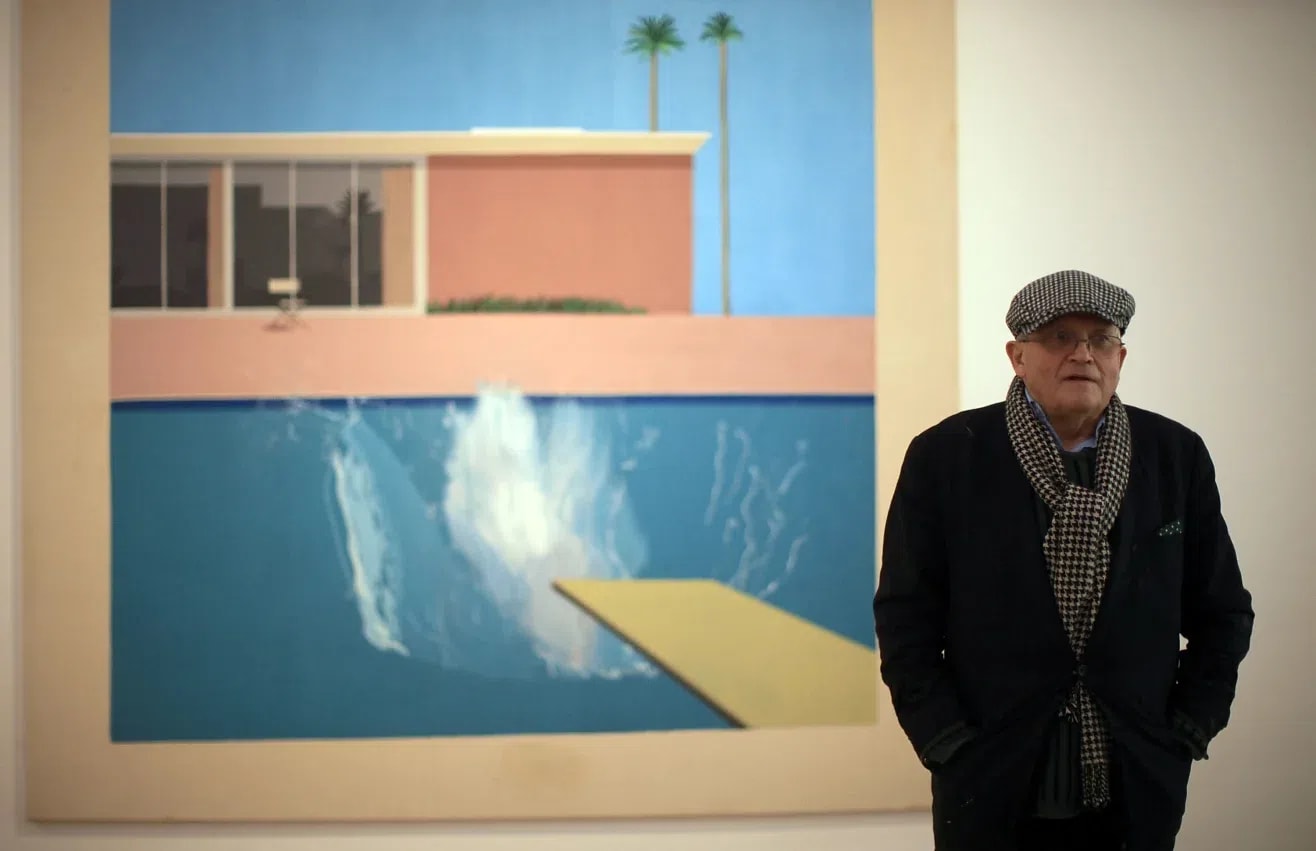
A wide, eye-level shot captures British artist David Hockney standing to the right of his famous large-scale pop art painting, A Bigger Splash (1967), which is mounted on a plain white gallery wall. The painting itself takes up the majority of the left and center portions of the frame. It depicts a modernist, flat-roofed house with floor-to-ceiling glass windows under a bright, clear blue sky, flanked by two tall, thin palm trees. In the foreground, a yellow diving board extends from the bottom right into a swimming pool of turquoise water, where a massive, chaotic splash of white and light blue water erupts, indicating someone has just dived in. The entire painting is bordered by a wide, unpainted canvas margin. To the right, David Hockney stands in a three-quarter view, looking slightly past the camera to the left. He is an elderly man with glasses, wearing a dark navy blazer, a black and white houndstooth scarf draped around his neck, and a matching houndstooth flat cap. His hands are tucked into his pockets, and his expression is neutral and contemplative. The lighting is soft and even, typical of a gallery setting, casting subtle shadows behind him.

PakistaniArt uses cookies to remember your preferences, keep the site running smoothly, and understand which stories our readers care about most. We never sell your data. See our Cookie Policy for exactly what we collect and why.