
English painter, draughtsman, printmaker, stage designer and photographer, David Hockney died peacefully at home on 11 June 2026, one month before his 89th birthday. No cause of death was announced. He is seen as one of the most significant British artists of the 20th and 21st centuries, partly due to his strong role in the Pop Art movement of the 1960s. His death has immediately caused a renewed focus on one particular painting above all others.
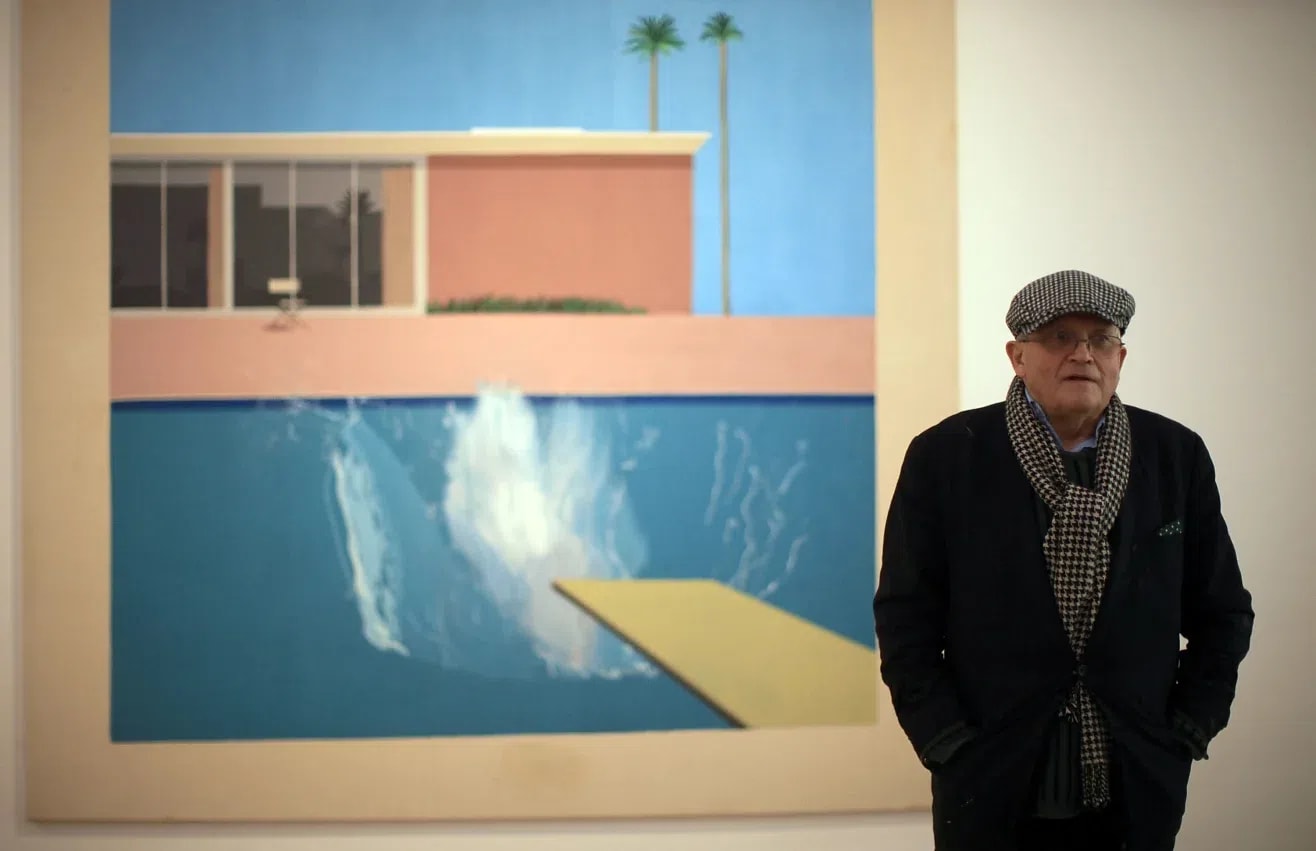
"A Bigger Splash," painted in 1967, is perhaps David Hockney's best-known artwork. Measuring 242.5 by 243.9 centimetres, it depicts a swimming pool beside a modern house, disturbed by a large splash created by an unseen figure who has apparently just jumped in from a diving board. It was painted in California between April and June 1967, when Hockney was teaching at the University of California, Berkeley.
The canvas holds a tension that feels freshly charged now. Almost a perfect square, it is dominated by strong vertical and horizontal lines of trees, building, and pool edge. The rectilinear composition is broken by the oblique thrust of the diving board. The calmness of the overall composition contrasts with the violent explosion of water caused by the diver.
What makes the work so conceptually loaded is how it was made. The painting was executed using acrylic Liquitex on white cotton duck canvas, with no underdrawing, using a limited palette including cobalt blue, ultramarine blue, raw sienna, and titanium white. Apart from the splash itself, the canvas was finished very evenly and flat with a paint roller, in two or three layers. The central splash was heavily worked over a period of about two weeks using a variety of small brushes.
Hockney spoke plainly about the paradox at the work's core. "I loved the idea of painting this thing that lasts for two seconds; it takes me two weeks to paint this event that lasts two seconds. Everyone knows a splash can't be frozen in time, so when you see it like that in a painting it's even more striking than in a photograph."
That appraisal, based on a printmaking monograph from 1984, feels lighter for the context it was made in. The picture is now seen as an important stopgap in Hockney’s time‑ponderings, between his earlier "Picture Emphasising Stillness" and his later "joiners" portraits, produced by piecing together many photographs of the same model taken over hours. It’s a piece that always knew what it was doing: bridging the gap between a moment and its evidence.
The painting shows a swimming pool basking in LA sunshine. Behind it, a pink modernist building and an empty chair. A large window mirroring silhouetted neighboring buildings. Two lanky palms and a tidy bed of grass hint at some carefully kept gardens. Far less common in his work of the time is the absence of people, and an almost complete stillness.
A critic made out of self‑portraiture in this rendering of "undiluted pleasure and satisfaction," seeing the subject as both a disappearance and an immersion. It hits a different note now. The diver who disappears before we can actually see them, leaving only the evidence of their entrance, has always been an evocative use of projection. And with Hockney gone, that invitation feels newly open.
Born in Bradford in 1937, Hockney emerged from the fringes of Pop Art in the 1960s, before finding international fame after moving to Los Angeles. The city's bright sunlight, modern architecture, and swimming pools became recurring subjects in some of his most celebrated works. Having grown up under the northern skies of industrial Bradford, he was enthralled by the light and freedoms of 1960s California. As an openly gay man at a time when homosexuality was still illegal in England, he enthusiastically embraced the opportunity to explore his sexuality.
Over more than six decades, he worked across painting, drawing, photography, printmaking, stage design, and digital media, often challenging conventional ideas about perspective and visual representation. Later in life, Hockney returned to Europe and found inspiration in the hills of his native Yorkshire and the trees of France's Normandy region.
Tributes followed quickly. Fellow artist Tracey Emin said she felt privileged to have known Hockney, calling him "a great artist and a wonderful man, who with the power of art changed the perception of Britishness. A proud chain-smoking homosexual, who flew the flag higher than any other British artist." A statement from Downing Street said: "The loss to the art world is immense: David's passing brings to a close an extraordinary body of work characterised by reinvention."
"A Bigger Splash" is currently on display at Tate Britain, London. It is difficult to imagine standing before it now without hearing the silence differently. The splash stays frozen. The board stays empty. Only the viewer changes.
Check topics and authors from this story to see more stories like this in your personalized feed and receive updates when new work is published.


