Every so often, a case lands in a county courthouse that rattles the unwritten rules of the secondary art market.
A lawsuit filed this week in Clackamas County Circuit Court by John E. Moody claims Marble Road Estate Sales dramatically undervalued a cache of Chinese artworks discovered while clearing out his late mother's home near Lake Oswego. Dozens of Chinese scrolls and rubbings were sold for as little as `$45 apiece after the company allegedly relied on Google Image Search to set prices. The scrolls were apparently a last-minute find, tucked away and never placed on the formal inventory list.
Moody says the works were acquired by his late father, Robert Behymer Moody, while serving as a U.S. diplomat in China during the 1940s. He knew his father was a collector of Chinese scroll paintings and that these particular pieces had been favorites the elder Moody spoke of admiringly throughout his life. Among the cache, one scroll could be the work of Xu Beihong, a master painter whose Cultivation on the Peaceful Land sold in 2011 for $`41.9 million.
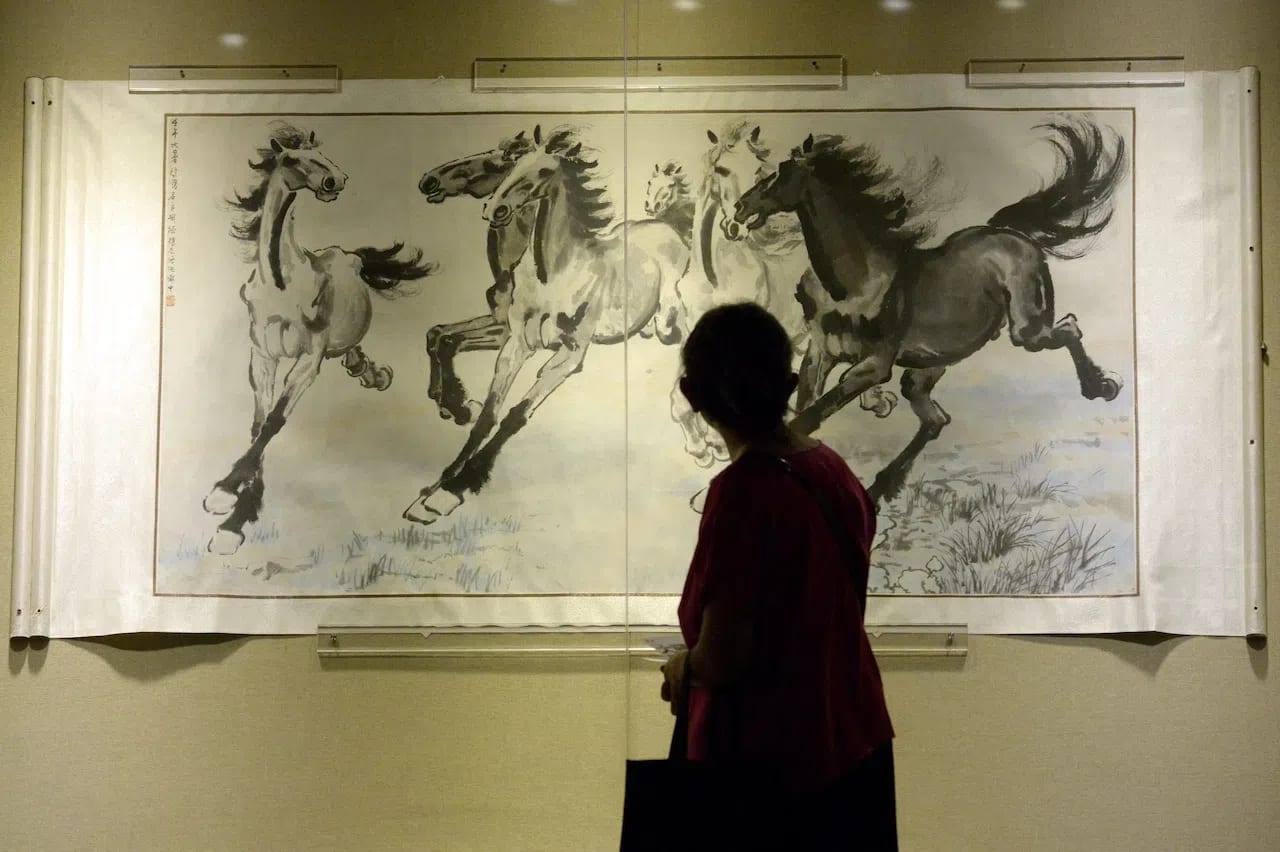
 A man standing in from of Galloping Horse by Xu Beihong during the 2012 Poly Spring Auction Exhibition in Beijing, China. A similar work by Xu sold at Sotheby's Hong Kong for more than $650,000 in 2020. Lintao Zhang/Getty Images
Xu Beihong (1895–1953) was a pioneer of twentieth-century Chinese art, celebrated for his traditional ink-and-wash paintings of horses and birds. Trained at the École des Beaux-Arts in Paris during the 1920s, he returned to China in 1927 and eventually became president of the Central Academy of Fine Arts after the founding of the People's Republic. His paintings have sold at auction for hundreds of thousands of dollars, with his top five works fetching between $3.9 million and $9.2 million according to ARTDAI data reviewed by ARTnews.
Rather than seeking damages from the estate sale company, Moody is asking a judge to order the buyers to return the artworks. The four defendants are Changning "Charlie" Huang, Juncheng "JP" Peng, Yong Li, and Muguang "Daniel" Wang. The complaint alleges several purchasers were knowledgeable collectors or dealers in Chinese art who recognized the potential significance of the scrolls and quietly bought as many as they could. Moody claims he witnessed the four holding scrolls so other buyers could not see them, huddling together and speaking Chinese.
Huang, for his part, pushed back publicly. "If you buy something from the store and then they say, 'Sorry, we marked it the wrong price. You have to give it back,' I say, 'No way,'" he told the Oregonian.
The case cuts to the heart of a long-standing tension. Estate sales are built on the idea that hidden treasures still exist; buyers comb through boxes and basements precisely because every so often someone misses something. Moody's attorney argues that if the buyers were experts who knew the true value and acted "deceitfully or unconscionably," the court may compel them to return the pieces.
Should a judge agree, the ruling could chill the very thrill of discovery that keeps weekend pickers lining up before dawn.
Check topics and authors from this story to see more stories like this in your personalized feed and receive updates when new work is published.


