For most of their shared history in Lahore, Pakistan's two most prominent art schools have operated in polite parallel. That changes this August.
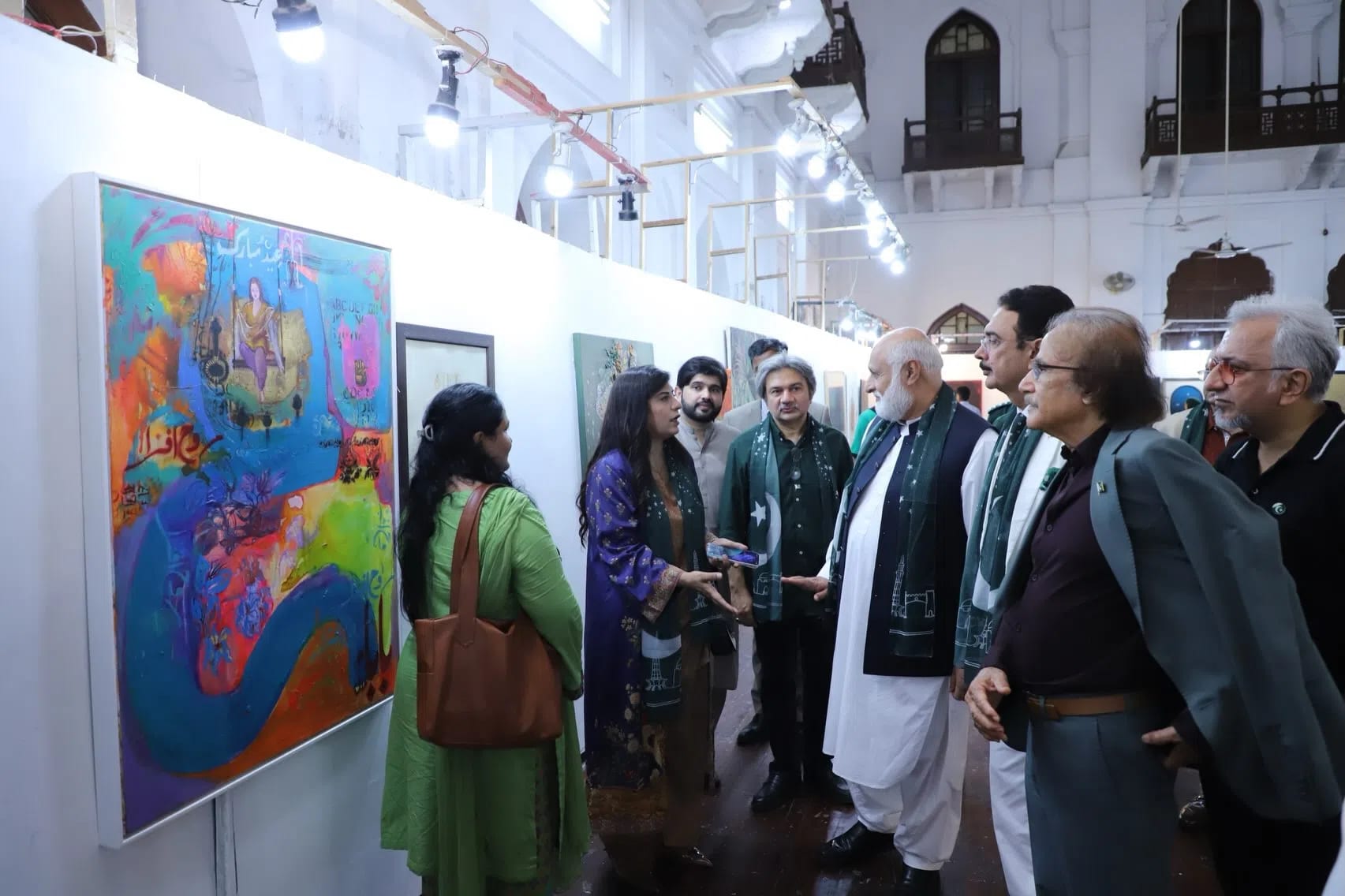
The National College of Arts, a leading art and design institution in Pakistan founded in 1875 as the Mayo School of Industrial Art, and the Punjab University College of Art and Design have opened Ra'naai-e-Khayal-o-Khat, their first collaborative exhibition.
The show launched on August 14 to coincide with Pakistan's Independence Day and runs through September 3 across both the NCA campus and Punjab University's Old Campus.

A Historic Institutional Pairing
The significance here is structural, not just aesthetic.
NCA is the oldest art school in Pakistan and the second oldest in South Asia. Its founding principal was John Lockwood Kipling, Rudyard Kipling's father. During the tenure of Shakir Ali as principal from 1961 to 1969, NCA became an incubator of modernism in West Pakistan.
PUCAD carries its own legacy. At Punjab University, expressionist painter Anna Molka Ahmed became the head of the Department of Fine Arts and held the post for many years, organising numerous exhibitions during the 1950s. The college has operated from the historic Senate Hall area of Punjab University's Old Campus and built a strong reputation in calligraphy and traditional arts. Both institutions sit within Lahore's dense cultural core, minutes apart on the map but long separated by differing pedagogies, bureaucratic affiliations, and quiet rivalry.

That two schools with such entrenched identities have agreed to share a single exhibition title is, by itself, notable. That the show also spans both physical campuses is even more so.
What's on View
The exhibition title translates loosely to "the beauty of thought and line." It is a phrase that gestures toward both the conceptual and the material. Calligraphy sits at the heart of the show, which is fitting.
PUCAD organized the international conference Sarir-e-Khama: Art of the Pen in 2022, featuring research papers, talks, practical demonstrations of various calligraphy styles, and a curated calligraphy exhibition.
NCA, for its part, has long maintained programs in miniature painting, printmaking, and design that push traditional South Asian forms into contemporary territory.

Visitors moving between the two campuses will encounter work in a range of media. Traditional calligraphic practice and miniature painting share space with modern and mixed-media installations. Student work and faculty contributions are both represented.
The curatorial logic seems less about flattening differences than laying them beside each other, letting the two institutional vocabularies speak across the same room.
The Inauguration
Prof. Dr. Niaz Ahmad Akhtar was appointed Chairman of the Higher Education Commission in February 2026.
He inaugurated the exhibition as chief guest. The choice carries a specific resonance. Akhtar previously served as Vice Chancellor of Punjab University, and also led Quaid-i-Azam University in Islamabad, where he earned recognition for promoting research excellence and institutional reforms.
NCA itself is affiliated with HEC and recognized as a degree-awarding institution. Having the commission's chairman bridge the gap between two schools he has institutional ties to sends a clear signal about inter-university cooperation.

Akhtar received the Sitara-i-Imtiaz from the Government of Pakistan in 2015 for his contributions to education. His stated vision for HEC focuses on strengthening quality assurance, fostering research through global partnerships, and enhancing faculty development.
An arts exhibition may seem peripheral to that engineering-and-sciences agenda. But formal recognition from HEC's top official lends weight to a project that could otherwise be dismissed as a campus event.
Why This Matters for Lahore's Art Scene
Lahore already claims one of the densest art ecosystems in South Asia.
Institutions including the Alhamra Arts Council have operated in the city for decades. The Zahoor ul Akhlaq Gallery at NCA, established in 1993, has built its own permanent collection of works by Pakistani painters, sculptors, designers, and printmakers. Private galleries and commercial spaces have multiplied across the city in recent years, and annual events like the Lahore Biennale have drawn international attention.
What has been missing is meaningful collaboration between Lahore's academic art institutions. NCA operates under a federal charter. Punjab University is provincial. Their administrative structures rarely align, and joint programming has not been part of the tradition.

Ra'naai-e-Khayal-o-Khat is a direct challenge to that pattern.
The timing is deliberate. Launching on Independence Day wraps the exhibition in national symbolism, but the practical subtext is about institutional willingness to share audiences, resources, and reputational capital.
If it works, it could open a template.
Looking Ahead
The show closes on September 3.
Three weeks is a modest run for an event carrying this much institutional weight. Whether this collaboration extends beyond a single exhibition will depend on factors well outside the gallery walls, including funding, faculty politics, and bureaucratic appetite for repetition.

Still, the precedent is set. NCA, despite its comparative renown, has been scantily represented in contemporary scholarship. PUCAD, strong in calligraphy and traditional practice, has often been overshadowed by NCA's international profile. Bringing the two together does not erase those asymmetries, but it does make them harder to ignore.
For now, the work is on the walls. Anyone in Lahore through the end of August has a rare opportunity to walk both campuses and see what happens when two schools that have spent 150 years looking in slightly different directions finally turn and face each other.
Gallery hours and full artist lists are available through HEC and both participating institutions.
Check topics and authors from this story to see more stories like this in your personalized feed and receive updates when new work is published.


