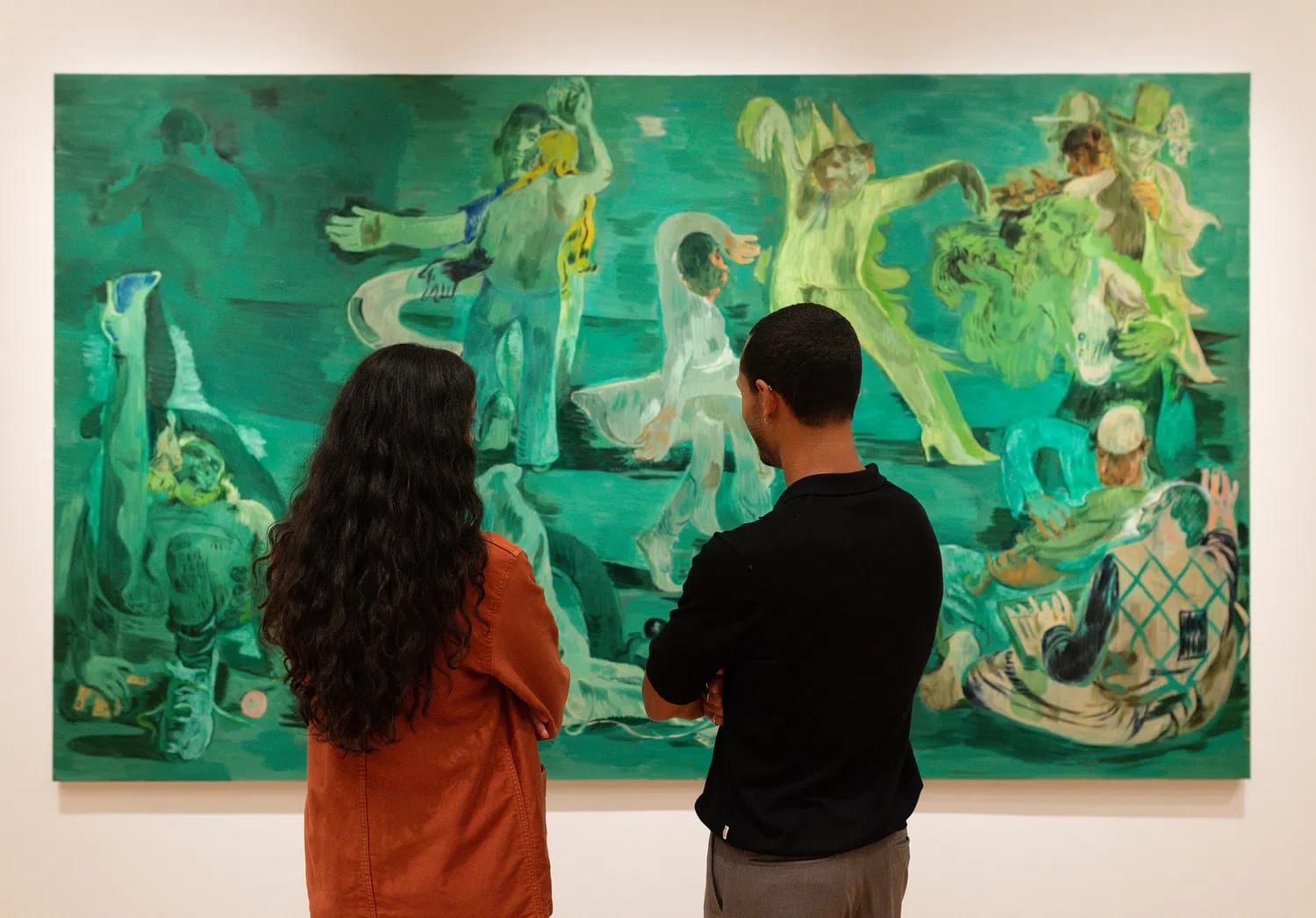

On October 2, Salman Toor: Someone Like You opened at the Courtauld Gallery in London. It is the first solo exhibition in Europe by the Lahore-born, New York-based painter, and it runs until 10 January 2027.
The Courtauld has gathered 19 paintings, none previously shown in Britain, that depict friendship and love alongside solitude and alienation. A companion display in the Butler Drawings Gallery shows how his works in ink, charcoal, and gouache feed his painting.
The institutional language around the show is warm and careful, centred on belonging, intimacy and dialogue with the Old Masters. The sharper fact sits just behind it. The UK Home Office records that consensual same-sex acts are criminalized for men in Pakistan under Section 377 of the Penal Code, with penalties from two years to life imprisonment.
That is the tension this article is built around. The most internationally celebrated Pakistani-born painter of his generation is a gay man from Lahore. His subject is the tenderness, appetite, and loneliness of brown queer men, and his birthplace treats that subject as a crime.
I think this is not a footnote to the work. It is the reason the work has its particular charge.
How Salman Toor Went from Lahore to Ohio to Brooklyn
Salman Toor was born in Lahore in 1983 into a middle-class Muslim family. Just to avoid his sporty schoolmates, he took refuge in the art department of the city's elite Aitchison College. He began making pictures as a child, drawing imaginary friends and fantastical scenarios as an escape from his conservative surroundings.

At the age of 20, he moved to the United States in 2002 to study painting and drawing at Ohio Wesleyan University on an international student scholarship. He had never visited the country before, and he felt isolated in Columbus, Ohio, until he moved into a hippie commune with “the dreadlocked, blue-haired art kids.”
After postgraduate study at the Pratt Institute in New York in 2009, he stayed, and the city has shaped his work and his life since. His earlier work wasn’t invisible in Pakistan, as he had shows, like a 2012 show at the Drawing Room Gallery in Lahore, a 2013 show at Rohtas II in Lahore, and a place in the 2018 Lahore Biennale.
His earlier career did not make him famous; the decisive change came in 2019. Toor has described the encounter with Manet as helping him paint his way into a community in NY, and as something like coming out through painting.
Many institutions followed quickly because of his art. The Whitney Museum of American Art gave him his first museum solo show, Salman Toor: How Will I Know, in 2020–21. Next came a Baltimore Museum of Art solo show, Salman Toor: No Ordinary Love, which ran from May 22 to October 23, 2022.
In November 2022, Salman Toor’s painting Four Friends sold for $1.2m at Sotheby's. He has toured a solo exhibition to four museums, taken part in the Venice Biennale, and sold out a two-part gallery show. Luhring Augustine's gallery site lists the two-part Wish Maker in New York from May 2 to July 25, 2025.
On September 17, 2026, TIME named him to its TIME100 Art list of the most influential people in art. Its entry describes a Pakistani American painter of young brown men in states of convergence and of isolation. The label is accurate, as he received US citizenship in 2019.
But "Pakistani American" understates how much of the work is about the gap between the two words.
The Green That Lies - Salman Toor’s Signature
Everyone who writes about Salman Toor writes about green, and obviously with good reason. Green is his most recognizable signature and his most easily misread.
The Whitney’s essay says Toor made his first green painting in early 2019 and realized he could use the color to depict “a space of self; for enhancing the self.” The shades range from emerald to viridian, which gives his art a distinct identity within the community.
Karen Wilkin records him calling the color "inviting, glamorous, and poisonous," and judges that the bar paintings are at once verdant, otherworldly, and toxic. In the Met's Fag Puddle with Candle, Shoe, and Flag, the greens are eerie and absinthe-like, shades the artist finds "velvety, nocturnal, and comforting."

These descriptions need to be read together because green is where Toor’s figures can be unguarded. It’s also the color of the night they have had to learn to move through. Adding such a color gives an atmospheric quality, like a forest at night beckoning you deeper, while glamour and danger share the same pigment.
What makes his color thinking sophisticated is that he can switch it off. In Man with Face Creams and Phone Plug (2019), the warm emerald is replaced by muted browns and greys. The green color survives only in the man's beard, shirt, earring, and nail polish, and at the edges of the canvas.
The picture shows a man awaiting a customs inspection. The sanctuary of green does not travel through the airport. His humanity survives in small details while the official's gaze drains the rest. His handling is deliberately casual.
He paints elongated, exposed bodies in interiors, working from memory and imagination in short, sketch-like strokes that make limbs tubular and entangled. In the Baltimore show, I found the casual air of an illustrator in a sketchbook applied to references from classical painting.
His paintings form a map of where he belongs. His rich figurative oils echo and subvert European old masters and Indian Mughal miniatures. The Courtauld places him alongside Manet, Lorenzo Lotto, Bruegel and Velázquez, and also South Asian artists such as Anwar Saeed, Bhupen Khakhar, and Sunil Gupta.
He has said he drew inspiration from Pakistani advertisements while growing up. A painter who borrows from Dutch tavern scenes and Pakistani billboards in the same picture is not decorating. He is claiming an inheritance.
The Bar on East 13th: coming out on a Manet
The painting that best explains the show is also its sly centerpiece. The Bar on East 13th (2019) revisits the Courtauld's own A Bar at the Folies-Bergère (1882) by Édouard Manet. The gallery says it was directly inspired by a visit Toor made to the Courtauld in 2017.

The transposition is witty and loaded. Toor relocates Manet's masterpiece to New York's East Village, where queer couples kiss, and a brown barman with nail polish and braided hair replaces the melancholy French barmaid. The adorned bartender draws on 17th-century Dutch tavern scenes while directly recalling Manet.
The Guardian interview records his mixed feelings in retrospect. It was a time of self-love, he says, but also one in which he received threatening messages online, which he links to coming from a very conservative country. The painting is a celebration with a threat at its margin. It is a love letter to art history, written by a man who knew the reply might arrive as abuse.
This is where much of the Western commentary is most comfortable and where it misses the most. It is easy to read the painting as a clever Manet riff. It is harder, and more truthful, to read it as the picture in which a Pakistani painter takes the barmaid's gaze for himself and dares the canon to look back.
Fag Puddles: Owning the Slur
If the Manet is the show’s charm, then the Fag Puddle paintings are its argument. Toor takes a word he was once targeted with and makes it the name of a still-life genre. BmoreArt sees the overflowing abundance of the Rococo in these green-washed jumbles of limp limbs, rags, feather boas, shoes, black trash bags and clown noses.
In the Met's Fag Puddle with Candle, Shoe, and Flag (2022), a feather boa intertwines with a retro striped schoolboy tie, a tombstone in the traditional mosque shape crowns the heap, and parts of sculptures or bodies join a museum-like vitrine.
The BmoreArt review adds that Toor made the picture in direct response to a painting by Anthony van Dyck. The mosque-shaped tombstone is the most unsettling detail, because it sets religion and mortality on top of everything the boy was told to be ashamed of.
The pile is not an act of self-pity. The heaps seem to be a collection of 'sissy things' he loves and was made to feel ashamed of while growing up. Design Pataki reads the work as a reckoning with South Asian conservatism toward the slur. He turns the shame into material, builds a heap from it and hangs the result in a museum.
The Courtauld has made its own commitment to the series. Fag Puddle in Vitrine (2021), shown in the drawings display, was acquired by the Courtauld in 2024. A London institution holding a work with that title is not a small act. One London reviewer admitted the fag puddles were uncomfortable and that he was not sure what was going on in them.
Borders, Oaths, and a Mullah on Cross Street
The exhibition of Toor’s art doesn’t argue only about human desires, but it discusses who gets across lines. The Courtauld describes a series begun in 2019 on immigrants at border control, informed by Toor's personal experience.
A London reviewer singled out a portrait of a South Asian traveller with his belongings spread out, which puts the viewer in the position of the immigration officer. The same review notes paintings of people taking the US citizenship oath with hands on their hearts. Toor's biography runs through these pictures because he took that oath himself.
Then there is Cross Street, the one London picture that grew out of a scene glimpsed from Tayyabs in Whitechapel: buff skaters by a street sign as a mullah passes. Toor was struck by the proximity of two kinds of men, the school bullies and the religious figure, which together made up the masculinities that intimidated him growing up.
I think this picture is the clearest statement of what the show is about. Pakistan, for Toor, is not an abstraction or a statute. It is two kinds of men on one pavement, neither looking at him the way he wants to be looked at.
The largest work is the quietest on the theme. Ghost Ball (2023), from the Pinault Collection, measures 190.8 by 323.2cm. It is among his largest paintings and was inspired by the 18th-century Indian work Dancing Villagers. A huge canvas about dancing, structured on South Asian painting rather than a European master, puts Toor on his own cultural ground.
What Pakistan Has Seen, and What It Hasn't
A popular framing says Toor's work cannot be shown at home.
The record is more mixed than that. Artsy lists exhibitions in London, New Delhi, Los Angeles, Lahore, Karachi, and New York.
The Lahore shows of 2012 and 2013, and the 2018 Biennale appear in his published exhibition history. The early work was, in other words, visible in Pakistan. The openly queer paintings that define the Courtauld show are another matter. Published exhibition histories list no Pakistani showing of the work made since 2019.
I draw no conclusion from that beyond the obvious: the pictures came out in New York, and Pakistan has not yet answered them in public. The pattern is a familiar one, in which a country tolerates difficult art most easily when it is private, expensive, and abroad.
The reception Toor describes is personal. In TIME, he says the reaction in his home country was “a sense of shock and betrayal,” which he links to straddling two cultures. The Queen's Journal, in an older profile, notes that homosexuality is a punishable offence in Pakistan and that behaviour implying it can be dangerous even where the law is not strictly applied.
A Canadian immigration-board summary from around 2012 reported that the provisions were rarely enforced and were instead used to threaten and blackmail people. That source is dated, and conditions may have shifted, but it explains why a family might feel exposed by a painting long before a prosecutor takes any interest.
I’d Proudly Say a Gay Man Paints a Nation
After years of being demonized and erased, he says it is crucial that brown figures take center stage, and that their stories are the main story rather than a gay side story in a family saga.
I want to push that statement further. Salman Toor is a gay man painting his own desires while following the rule of free will. He paints the flirtation at the bar, the body in the bed, the hand reaching across a taxi seat. I would not call it a side project; I would call it the engine.
I admit that the Courtauld speaks of human connection and belonging, but the vocabulary can soften the point. His paintings picture desire, and a desire that the state of his birth has criminalized.
He has said as much himself. Of his 2019 green paintings, he explained that he was using painting to be “out,” and to “tell stories I had censored for years.” At the same time, he is painting Pakistan, even though the settings are New York.

His family members are fine with the work but would like to see fewer "willies" in it. A nation appears on these canvases as a set of looks, pressures, and silences rather than a map. That is a more accurate portrait than an official one would be, and it is painted by someone who has paid for the privilege of seeing it clearly.
Toor’s canvases are one of the few places where queer Pakistani life is visible to the world, and that visibility has a price. He names it himself, speaking of the “daily costs associated with visibility.” I would rather read a painter who admits those costs than one who sells the fantasy.
The Guardian places him in a surge of South Asian and Middle Eastern energy in New York, boosted by the election of mayor Zohran Mamdani, and records Toor saying that Western audiences should get used to visible, fearless brown men.
The remark was about politicians as much as painting, but it frames the Courtauld show neatly as part of a larger argument about who is allowed to be central. Toor, characteristically, answers that argument with a bar scene.
Visiting the Exhibition
-
Dates: October 2, 2026 to January 10, 2027, roughly three months.
-
Where: The Courtauld Gallery, Somerset House, London, in the Denise Coates Exhibition Galleries on Floor 3.
-
Hours: 10:00 to 18:00, last entry 17:15, with Friday late openings until 20:00 on November 6, December 4, and January 8.
-
Tickets: £16 standard (includes access to both the temporary exhibition and the Permanent Collection), £7 for students, and free for ages 18 and under. Courtauld Members go free.
-
Catalogue: The Courtauld sells an official exhibition catalogue. It includes an essay by Aziz Sohail.
A good route is to look at Manet's bar in the permanent collection first, then walk up to see what Toor did with it. You will likely leave thinking about a bar that never existed, and about the country that made it necessary to imagine one.
Frequently Asked Questions
Where is the Salman Toor exhibition and when does it close?
Salman Toor: Someone Like You is located at The Courtauld Gallery in London, displayed within the Denise Coates Exhibition Galleries on Floor 3. The exhibition opened on October 2, 2026, and closes on January 10, 2027.
How much are tickets for Salman Toor at the Courtauld?
Standard admission tickets cost £16, which grants access to both the temporary exhibition and the permanent collection. Student tickets are priced at £7, while Courtauld Members and visitors aged 18 and under enter for free.
Is homosexuality illegal in Pakistan?
Yes, consensual same-sex acts for men are criminalized in Pakistan under Section 377 of the Penal Code. Convictions carry penalties ranging from two years to life imprisonment, though provisions are frequently used for harassment or blackmail.
Has Salman Toor's work ever been shown in Pakistan?
Yes, Toor’s earlier artwork was exhibited in Pakistan, including solo shows in Lahore in 2012 and 2013, as well as the 2018 Lahore Biennale. However, his openly queer paintings produced since 2019 have not been publicly displayed there.
What is The Bar on East 13th and how does it relate to Manet?
The Bar on East 13th (2019) is a painting by Salman Toor directly inspired by Édouard Manet’s A Bar at the Folies-Bergère. Toor reimagines the 1882 masterpiece in New York’s East Village, replacing Manet’s barmaid with a brown bartender amidst queer couples.
What are the "Fag Puddles" paintings?
The Fag Puddles series comprises still-life paintings featuring overflowing piles of items—such as feather boas, shoes, and mosque-shaped tombstones—associated with queer identity. Toor reclaims a derogatory slur from his youth, transforming personal shame and South Asian conservatism into museum art.
How much do Salman Toor's paintings sell for?
Salman Toor’s paintings have reached significant financial value on the art market. Notably, his 2019 painting Four Friends was sold at Sotheby’s in November 2022 for $1.2 million.
Check topics and authors from this story to see more stories like this in your personalized feed and receive updates when new work is published.


