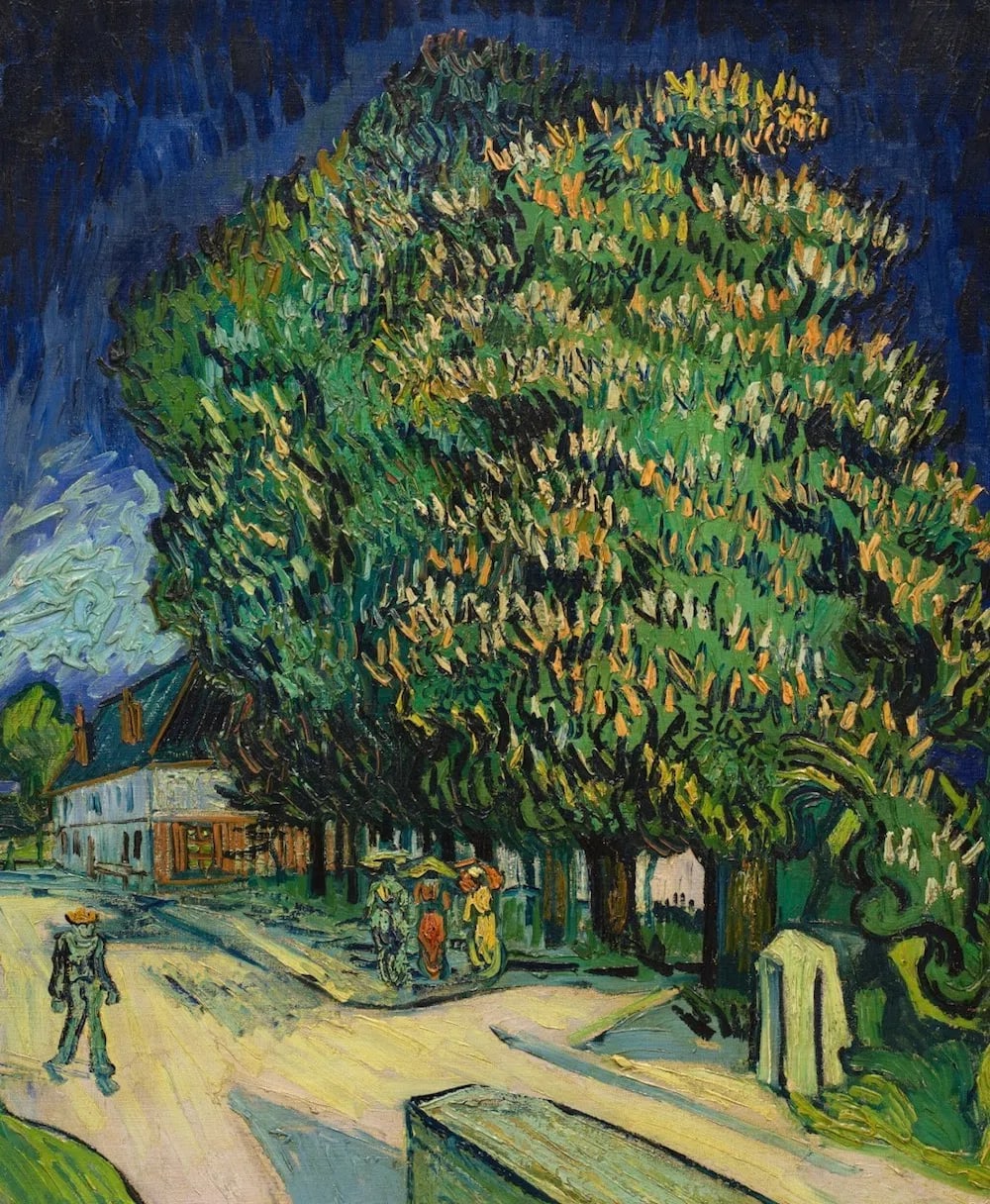

Autumn sale season usually brings one headline lot, and this year it's a painting almost nobody has seen.
Sotheby's will sell Vincent van Gogh's Blossoming Chestnut Trees in New York on 18 November. The estimate comes to $207 million with fees, built on a hammer price of around $180 million. The hammer price is the winning bid before the buyer's premium is added.
That would flatten the auction record for the artist. Christie's New York set it in 2022, when Orchard with Cypresses made $117 million including fees.
Sotheby's has also guaranteed the lot for an undisclosed sum. In practice, the house has promised the sellers a minimum price, whatever happens in the room. Bidding that stalls would leave Sotheby's holding the difference, which is why a sale is close to certain. A guarantee secures a sale, not a number, and the floor stays private. Still, the estimate makes a record look likely.
Van Gogh painted it in May 1890 at Auvers-sur-Oise, a village about 30 kilometres northwest of Paris. Days earlier, he had left the asylum at Saint-Rémy-de-Provence. A letter dated 25 May to his brother Theo van Gogh mentions "a study of chestnut trees."
These were among the last months of a painting career that lasted barely a decade.
The colour is loud. A deep blue sky sits over white blossom, and three women with Japanese-style parasols gather beneath the trees. Martin Bailey, a Van Gogh specialist writing in The Art Newspaper, identifies the far building as a bar. It still operates as one, now called Le Balto. Bailey also reads the figure in blue and a straw hat as a possible nod to the artist himself.
Helena Newman, Sotheby's head of Impressionist and modern art, links its mood to the artist's new freedom. The picture captures an "explosion of energy and vitality," she told the Associated Press.
Bailey notes the weather turned stormy within hours of the canvas being finished. That may explain why the artist next gathered branches to paint a still life, Blossoming Chestnut Branches. It now sits on long-term loan at Kunsthaus Zurich.

Rarity does the rest. Of Van Gogh's roughly 50 Auvers landscapes, only eight remain in private hands. Colour images of it have been poor for decades. It last went on show in 1964, at the Solomon R. Guggenheim Museum in New York. That is about to change.
The route to Argentina was long. After the artist's death on 29 July 1890, the canvas reached Jo Bonger, the widow of his brother. Bonger sold it through a dealer in 1905 to the fourth Prince de Wagram. Publisher Samuel Fischer in Berlin bought it four years later and left it to his daughter in 1934. Next came the Paris couple Henriette and Marcel Kapferer. Later owners included the songwriter George Gard de Sylva and the New York collector Harriet Harris-Jonas. It reached Buenos Aires in 1975.
Fischer's family was persecuted for its Jewish heritage. Sotheby's says recent research shows the family could always sell the painting freely, a spokesperson told The Art Newspaper.
The collection was assembled by Nelly Arrieta de Blaquier, who died in 2020, and her separated husband, Carlos Pedro Blaquier. Their wealth came from an Argentine sugar business. Carlos Pedro Blaquier was indicted in 2012 over unlawful detentions of left-wing activists in 1976, according to BBC reporting. The alleged detentions took place under military rule. He denied wrongdoing and died in 2023, before any trial.
More recent trouble was administrative. In 2023, Argentine customs fined the heirs over exporting paintings, this one included, to Luxembourg. The penalty was waived in July, clearing the way for the sale.
It led to the Blaquier-Arrieta sale of 12 pictures worth around $450 million, including Paul Cézanne's Arlequin, estimated at $120 million. Philip Hook, a former Sotheby's auctioneer, told AP the group "really is the stuff of legend." The family didn't lend to exhibitions, so almost nobody knew what hung on its walls.
Newman expects bidders ranging from American tech billionaires to Middle Eastern institutions, plus private collectors in Europe and Asia. Uncertain times, she argues, are pushing collectors toward proven, unquestionably great work.
Before the sale, it visits Taipei on 5 and 6 October and Hong Kong from 13 to 15 October. New York follows from 7 to 17 November. Bailey reads the two Asian stops as a sign of Asia's growing weight among Van Gogh buyers.

A recent private deal shows the appetite. Christie's sold the family's Seated Zouave in November 2025 for a reported $190 million, probably including fees. Bailey says it possibly went to a buyer in Qatar. Private sales sit outside auction records, so that deal left the benchmark untouched.
After 18 November, the question shifts from price to access. Nobody knows yet who will own the painting, or whether they will lend it. For now, the public gets viewings in three cities, which is more than it has had in six decades.
Check topics and authors from this story to see more stories like this in your personalized feed and receive updates when new work is published.


