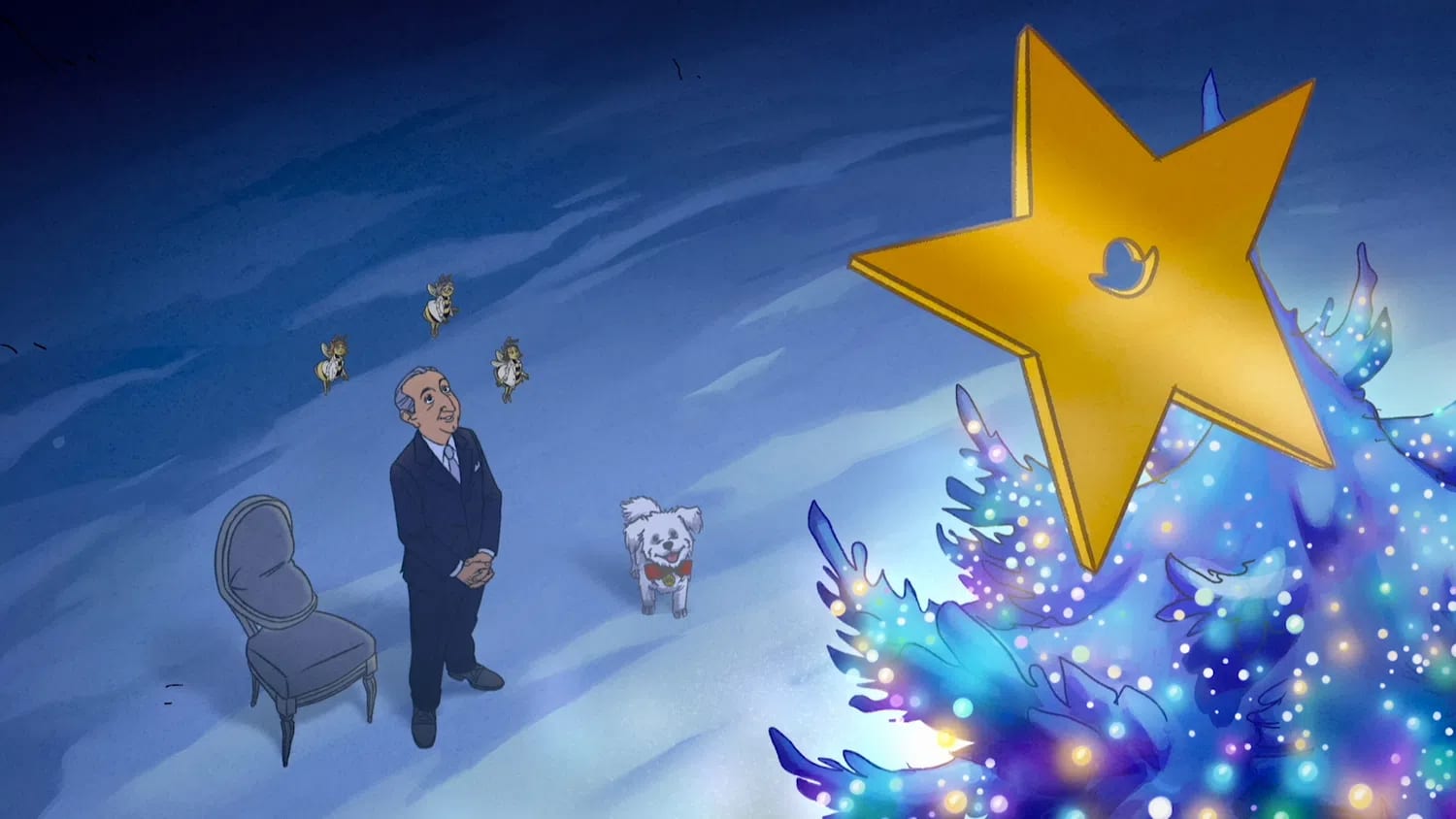

This is the season luxury fashion decided hand-drawn was the ultimate flex.
Prada rolled out pencil animation with a veteran Disney artist. Levi's leaned into stop-motion claymation and bragged about the hours it took. Then Dior released a six-minute animated short called Christian Dior's Night in Color, directed by Sylvain Chomet, and the internet started counting fingers.
Literally. Within hours of its release, an extra half-digit on one character quickly became one of the most talked-about details, with viewers pointing to it as a familiar AI-generated image error. Social media users also flagged warped lettering, unstable facial details, unusual hand anatomy, and fingers that appeared to change or disappear. Then there was the dog. An apparent spelling mistake on the tag worn by Dior's dog also attracted attention.
The film itself is a love letter to the house's own mythology.
Set in a snowy Paris in 1949, the six-minute film imagines a Christmas adventure at 30 Avenue Montaigne, inspired by Christian Dior's friendship with Hollywood actress Marlene Dietrich. The voice cast reads like a junket lineup.

Robert Pattinson narrates the film, while Rihanna lends her voice to the House's emblematic Lucky Star, with Camille Cottin voicing Dietrich, and Louis Garrel, Josh O'Connor, LaKeith Stanfield, Greta Lee, Nine d'Urso and Nadia Tereszkiewicz also joining the ensemble.
Chomet, the director behind The Triplets of Belleville and The Illusionist, worked under the creative direction of Jonathan Anderson, Dior's menswear and womenswear chief.
Here's the thing. Nobody has proof this is AI. What they have is suspicion, and Dior's own messaging keeps feeding it.
Anderson put a stake in the ground early, describing the project in a statement as "all hand-drawn," while Chomet said its production followed techniques associated with the 1940s, with characters animated individually before being combined with their backgrounds. Producer Aton Soumache went further, telling one outlet that Chomet created this short film entirely by hand, one drawing at a time, as if he were the last of the Mohicans. Soumache added a detail that now reads differently in hindsight. He said at first, the teams at Dior even thought the drawings were too visible, that it looked very artisanal.
That's the pitch. A house famous for haute couture wanted a film that looked like it took forever to make, because that's supposed to be the point of luxury.
Except the behind-the-scenes footage didn't calm anyone down. It did the opposite. Animator Ben Wild posted a breakdown alleging that two people who claimed to have worked on the production reached out to him after his video spread online.
According to Wild's account, posted publicly and reported by Glossy, Ben Wild has also alleged that its behind-the-scenes film shows artists pretending to animate. Wild's own framing was blunter. He asked whether Dior made a fake behind-the-scenes film to pretend their AI ad was real animation.
That allegation is unverified. Dior has not addressed it directly. But it lands at the worst possible moment, because the house's entire marketing thesis for this film rests on the idea that what you're watching is irreplaceable human labor.
Even skeptics who don't buy the full AI theory see a messier middle ground.

One commenter watching frame by frame speculated that some of it IS hand-drawn, possibly even most of the keyframes, but then they used AI for digital in-betweens and some of the movements, since things move and blur in ways that a human wouldn't do, but a computer would.
In-betweening, the process of drawing the frames that connect one key pose to the next, has historically been some of animation's most tedious and lowest-paid work. It's also exactly the kind of repetitive task generative tools are built to automate.
Dior has said nothing to settle any of it. Business of Fashion confirmed Dior said its winter campaign, 'Christian Dior's Night in Colour,' was fully hand-illustrated, but online commenters have questioned whether the campaign used AI in its development. Glossy's reporting was more direct about the silence. The outlet noted plainly that Dior was contacted for comment. No response followed.

A French outlet asked too.
Dior n'a pas réagi à ces accusations, meaning Dior has not responded to the accusations, RTBF reported.
That non-answer is the actual story now. Nobody outside the production can say with certainty whether generative tools touched a single frame. What's verifiable is that a brand built its entire seasonal pitch around the word hand, then went quiet the moment people asked what hand actually meant.
Compare that to Prada, which spent this same week doing the opposite. Its Drawing Prada: Animated by Hand campaign paired Disney veteran John Pomeroy with a cast including Sadie Sink and Maya Hawke, and Pomeroy gave interviews explaining his process in granular detail.
He told press, "I learnt my craft with pencil and paper, through traditional, analogue drawing. We've remained faithful to that approach and want to pass it on to future generations." Levi's did something similar with its claymation spot, reportedly logging around 2,000 hours to complete a one-minute film, and its global CMO Kenny Mitchell framed it publicly as a tribute to craft.

Transparency was the whole point for both of those campaigns.
Dior chose the opposite path, and animators online have noticed the contrast. One widely shared comment urged the house to be more like Prada Group and protect artists at all costs. Another online reaction was less measured. A viewer wrote that Dior could rot in a ditch for not disclosing they resorted to AI-slop. Someone else tied the two campaigns together directly.
The comment read, "After the Prada commercial, its so easy to see its AI. Its so sad to see many good artists put their names behind this."
Not everyone is convinced this is even about artificial intelligence. A French animation outlet, Catsuka, took a more wounded tone than an accusatory one. It wrote that the possible use of AI now seemed obvious, and expressed regret at the prospect in the case of an animator like Chomet. That's a different kind of criticism. It's disappointment from inside the industry, aimed at a director people assumed was above the shortcut.
Dior has an exhibition space in Paris currently displaying hand-drawn sketches from the production, according to Glossy's reporting on the broader trend. That's a tangible artifact. It's also not an answer to the specific question being asked, which is whether generative tools entered the pipeline anywhere between those sketches and the finished frames.
Until Dior says something concrete, the frames will keep circulating, the fingers will keep getting counted, and the silence will keep doing more damage than any admission could. In a year when luxury marketing decided visible human effort was the premium, saying nothing is its own kind of answer.
I need to research real search questions people are asking about the Dior Christmas film AI controversy before building the FAQ.
Frequently Asked Questions
Is the Dior Christmas film AI generated?
No confirmed evidence shows generative AI created or altered Christian Dior's Night in Color. Viewers flagged anomalies like extra fingers and warped details as typical AI tells. Dior and its team have described the short as fully hand-drawn using 1940s techniques.
Why are people saying the Dior ad has six fingers?
Viewers spotted malformed hands and an apparent extra finger or half-digit on characters including the animated Marlene Dietrich. These anatomy glitches match common generative AI image errors. Similar issues appeared with unstable faces and changing finger counts across frames.
Has Dior responded to the AI accusations?
Dior has not answered direct requests for comment from outlets including Business of Fashion and Glossy. French reports noted the house offered no reaction to the claims. The silence itself has become a central part of the story.
What did Jonathan Anderson say about the animation?
Jonathan Anderson described the project as all hand-drawn and made with techniques that go back to the 1940s. Producer Aton Soumache added that Sylvain Chomet created it entirely by hand, one drawing at a time. Chomet himself referenced classic cut-out and separate character animation methods.
Did Dior use AI just for the in-between frames?
Some animators and commenters speculate key drawings could be handmade while AI handled digital in-betweens and smoother transitions. In-betweening is traditionally tedious work that generative tools can automate. No official confirmation exists either way.
How does the Dior film compare to Prada's holiday campaign?
Prada released Drawing Prada: Animated by Hand with Disney veteran John Pomeroy and openly detailed the traditional pencil process. Levi's highlighted thousands of hours of claymation craft. Dior's lack of similar transparency has drawn sharp contrast and criticism from artists online.
Is the behind-the-scenes video for the Dior ad real?
Animator Ben Wild alleged the making-of footage shows people pretending to animate and that contacts claimed AI played a larger role. The claim remains unverified. Dior has not addressed the specific BTS questions.
Check topics and authors from this story to see more stories like this in your personalized feed and receive updates when new work is published.


