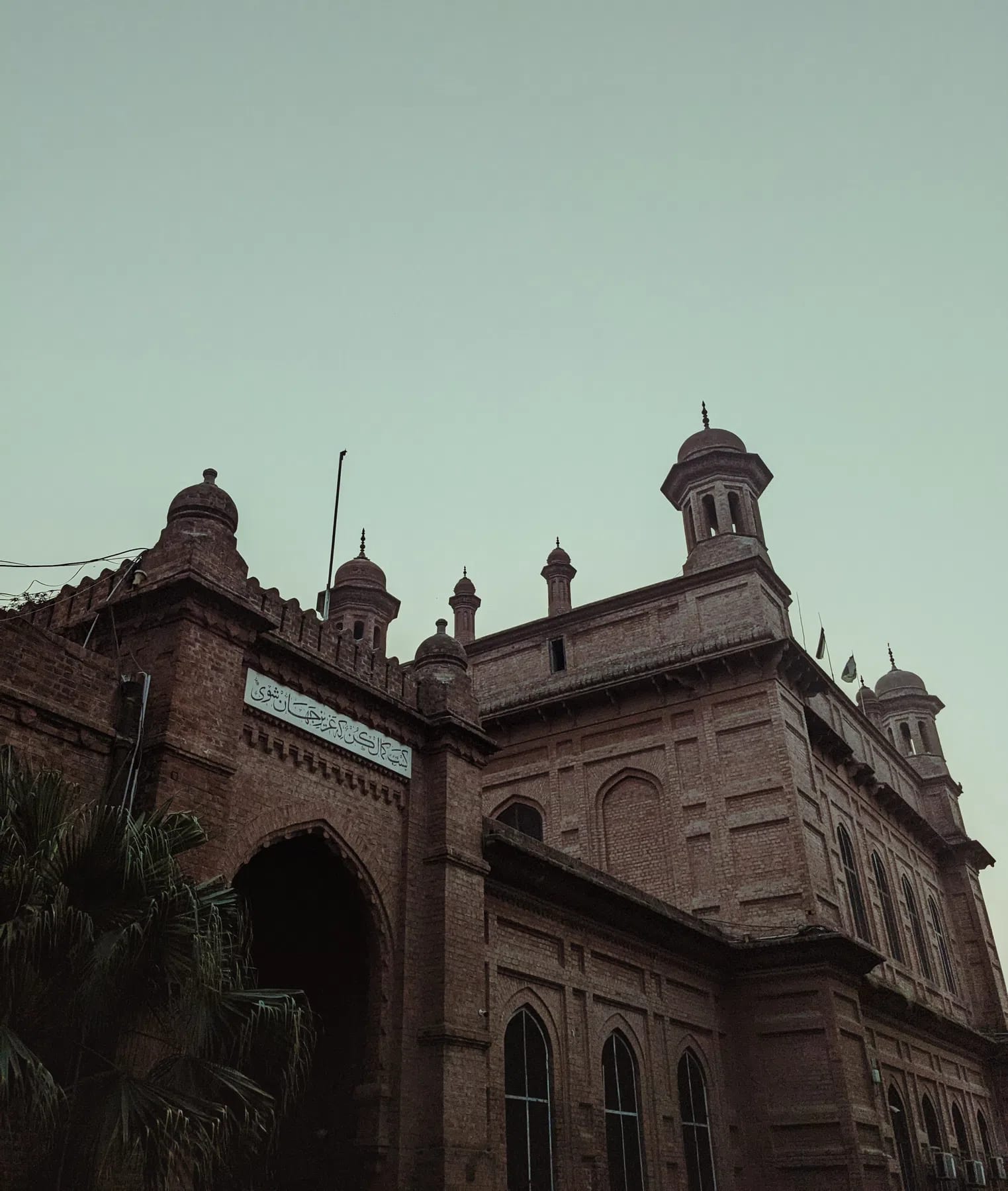

It’s my last semester of Fine Arts at the National College of Arts, and frankly, I’m still wondering how I got here.
I remember my drawing test in 2022 like it happened last week. They dropped a pile of broomsticks on the floor and told us to draw. That was it. No dramatic still life, no fruit bowl, no plaster bust staring back at us. Just broomsticks, scattered on the floor, and a room full of nervous applicants trying to figure out what the examiners actually wanted.
They were not checking whether I could render shadow perfectly. They were watching how I thought.
The Myth Everyone Still Believes
There is a story that refuses to die about NCA admissions. It goes like this: bring your best technical drawing, prove you can copy reality with precision, and the panel will be impressed. I believed it too, before I sat the test myself.
That is not how it works anymore, if it ever fully did. The drawing test now leans hard into creativity over classical rendering. The year after mine, they poured water on the floor and asked candidates to draw that instead. The year after that, it was a figure, and drawing academies across Lahore immediately adjusted their coaching to match.
That reaction from the academies tells you something important. NCA keeps changing the test precisely because outside institutes keep trying to predict it. The moment a formula gets cracked, the exam moves again.
What matters in that room is not whether your lines are clean. It is whether you can look at something ordinary and see an idea in it. A broomstick is not just a broomstick to someone thinking creatively. It is a shape, a rhythm, a small composition waiting to be noticed.
What the Interview Is Actually Like
This is the part that surprises almost everyone. The interview at NCA is not an interrogation. It is barely even intimidating.
I got asked where I was from, what my hometown is known for, and why I'm coming into Fine Arts; however, I'm doing design work. Someone asked why I wanted to study at NCA specifically, and someone else asked why I picked my department over the others. None of it was designed to trap me.
My honest advice, the one thing I would tell any nervous applicant walking in, is simple. Do not lie. If you do not know something, say so. The panel is not looking for a rehearsed answer. They are looking for someone real, and the room is far more relaxed than the rumors suggest.
The Academies Selling You a Shortcut
Here is where I want to be blunt, because nobody was blunt with me before I applied.
Around Lahore and other cities, there are art academies and coaching institutes that advertise heavily around admission season, promising to prepare you for NCA, PUCAD, BNU, PIFD, IVS, and similar institutions. Some of them genuinely teach well. A few are excellent, honestly better resourced than certain government-run options.
But most of them charge far more than NCA itself ever will, and that is not even the biggest problem.
Every serious artist develops a style, a set of habits and preferences that show up in their teaching. When you train under one instructor for months, you start absorbing that style without realizing it. Your linework starts looking like theirs. Your compositional choices start echoing theirs.
That is exactly what NCA's panel is trained to spot. If your portfolio or your test reads as an imitation of some academy's house style, and the panel figures out where you trained, rejection becomes very likely. I have watched it happen to genuinely talented people who could draw circles around me technically. They got flagged the moment an interviewer recognized the hand of a particular teacher in their work.
If you are going to take a preparation course, treat it as a way to sharpen your own instincts, not to adopt someone else's visual voice. The moment your work stops looking like you, you have already lost the thing NCA is actually testing for.
The Numbers You Actually Need
Now for the part that will not change no matter how many personal stories I tell you.
Admissions for the undergraduate degree programmes at NCA are currently open, and the last date to apply is 27th July 2026. Applications for admission in NCA Lahore and Rawalpindi campuses are invited against reserved seats for domiciled quota Open Merit, Self Finance, and Self Support Scheme, covering Punjab, Gilgit Baltistan, Azad Jammu and Kashmir, Sindh, Khyber Pakhtunkhwa, and Balochistan.
Eligibility is straightforward on paper. A candidate seeking admission to the degree must have twelve years of education, F.A., F.Sc., A-Level, or equivalent, with a minimum of 45 percent marks. There is no age limit for applicants, and no age limit applies to anyone considering this path, regardless of when they finished school. Beyond the paperwork, every candidate must pass the college's aptitude test and interview.
Both campuses offer a serious range of programmes. Lahore runs a five-year Bachelor of Architecture, a four-year Bachelor of Fine Arts, a four-year Bachelor of Design covering Visual Communication (VCD), Textile, Product, and Ceramic Design, plus programmes in Music, Film and Television, Cultural Studies, and Multimedia Art. Rawalpindi offers Architecture, Fine Arts, Design in Visual Communication and Textile, and Multimedia Art.
On the financial side, the prospectus itself comes with a processing fee, alongside a smaller courier charge if you are applying from outside the city. Additional programme applications carry their own extra processing cost, so factor that in if you are applying to more than one department. For those on the Self Finance or Self Support scheme, tuition runs into the hundreds of thousands of rupees over the length of the degree, with architecture and film-related programmes sitting at the higher end compared to fine arts, design, and music. Exact figures shift slightly year to year, so check the official fee structure before you commit to anything.
Required documents include attested copies of your Secondary School Certificate and Higher Secondary Certificate. If your qualification came from outside the standard system, you will need an equivalence certificate before you can even register.
A Full Life, Not Just a Degree
None of this paperwork explains why NCA feels different once you are actually inside it.
It is not just a college. It is a full lifestyle, one you will not find replicated anywhere else in Pakistan. The corridors, the studios, the way people argue about ideas over chai at odd hours, none of that shows up on an admission form.
If you are preparing to apply this year, focus less on perfecting a technique and more on trusting how you already see things. Skip the panic about lying your way through an interview. Skip the expensive academy promising a shortcut into somebody else's style.
Just bring your own eyes to the table, even if all they hand you is a broomstick.
If you have any further questions, feel free to connect with me on Instagram.
Frequently Asked Questions
How hard is it to get admission to NCA Lahore?
Admission is highly competitive. NCA accepts a limited number of students and selection prioritizes creativity, portfolio/test performance, and interview over grades. Strong original work, consistent practice, and clear motivation significantly improve your chances.
What is the NCA entrance test pattern?
The NTS-based entrance evaluates creative aptitude: multiple-choice questions (general knowledge/visual reasoning), a drawing/design test, and a subjective or viva component. Architecture applicants additionally face a Mathematics exam and architecture-specific drawing/aptitude tasks.
Do I need drawing skills to get into NCA?
Yes for some departments. Fine Arts, Design, and Architecture require solid observational and creative drawing ability. Departments like Film & TV, Music, or Cultural Studies place more weight on storytelling, conceptual thinking, or audio-visual skills rather than fine drawing.
What documents and academic requirements are needed for NCA admission?
You must meet minimum eligibility (typically 45% in HSSC or equivalent) and submit attested SSC and HSSC certificates. If your qualification is non-Pakistani or non-standard, include an equivalence certificate. Keep original transcripts and ID ready for verification.
Is a portfolio required for NCA and what should it include?
Portfolio requirements vary by year and department. When required, include 8–15 strong, original pieces showing range (observational drawing, design experiments, mixed media, photography, short films or storyboards for Film). Prioritize creativity and personal voice over technical polish.
How do I apply for NCA admission online?
Apply through the National Testing Service (NTS) portal when the admission cycle opens. Register for the relevant NTS test, pay fees, and submit required documents and choices for departments. Always confirm deadlines on the NTS listing and NCA notices.
What are the NCA admission fees and financial categories (2026)?
Fees include application/prospectus charges, NTS test fees (varies by number of departments), and tuition under different schemes (Self Finance/Self Support). Exact amounts change annually, check the latest NCA prospectus or NTS announcement for 2026 rates.
Are there reserved seats, quotas, or age limits at NCA?
Yes, provincial quotas exist for Punjab, Sindh, Balochistan, KPK, GB, and AJK alongside open merit. There is typically no upper age limit for undergraduate programmes. Verify current quota rules in the prospectus since allocations can shift.
Should I join a coaching academy to prepare for NCA?
Coaching can strengthen fundamentals and test technique, but over-reliance on one academy’s visual style can hurt. Use coaching for practice, not imitation, develop original work and personal concepts to stand out in the test and interview.
What happens in the NCA interview and what questions are asked?
Interviews are usually informal: expect questions about your background, interests, why you chose the department, and influences. Be prepared to discuss pieces in your portfolio and explain your creative process and motivations honestly.
Check topics and authors from this story to see more stories like this in your personalized feed and receive updates when new work is published.


