Salman Toor
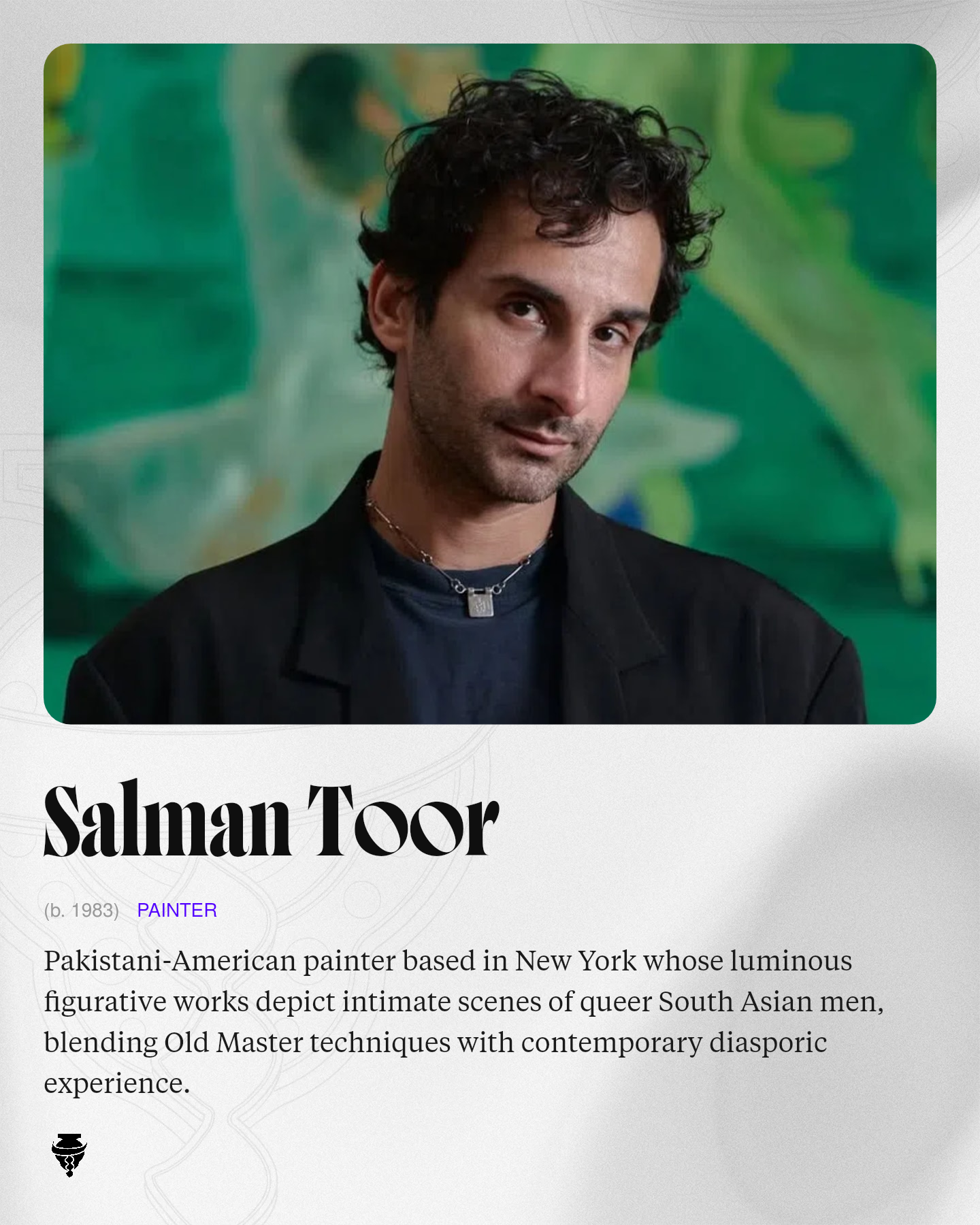
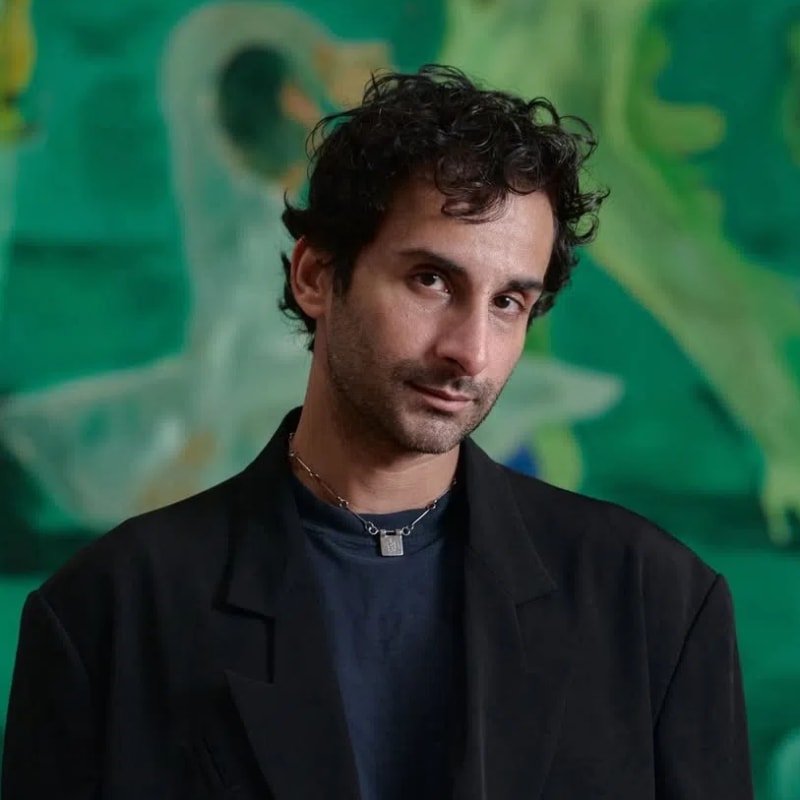
Pakistani-American painter based in New York whose luminous figurative works depict intimate scenes of queer South Asian men, blending Old Master techniques with contemporary diasporic experience.
Pakistani-American painter based in New York whose luminous figurative works depict intimate scenes of queer South Asian men, blending Old Master techniques with contemporary diasporic experience.
Salman Toor was born in 1983 in Lahore, Pakistan, and lives and works in New York City.
His paintings often depict intimate moments in the lives of imagined young, brown, South Asian, queer men within fantasized settings. Toor received his United States citizenship in 2019.
Toor grew up in an affluent Lahore family as the eldest of three siblings. His father owned a Honda dealership and embodied traditional masculinity, while his mother was nurturing and affectionate. He began sketching at five, often inspired by images of beautiful young women from his mother's fashion magazines.
Toor attended Aitchison College, an all-boys institution established during British rule, where his femininity made him a target for ridicule and bullying. Daily, peers would mimic his gait, which he described as sashaying. Although he faced occasional physical confrontations, his artistic talent eventually won him respect and admiration among classmates. By the time he reached sixteen and took the O-level exams, he achieved world distinction in art, scoring in the top percentile.
Art classes at Aitchison were optional, and few students participated, yet Toor enrolled in every available course, spending most of his free time in the art room. It was there that he forged lasting friendships with Komail Aijazuddin, Ali Sethi and Leo Kalyan. The art room offered solace, a refuge where they could be themselves.
At fifteen, Toor attempted to disclose his sexuality to his parents, but they dismissed his feelings, asserting he was not developed yet and did not understand. Although both parents eventually came to accept his identity, Toor indicated it was more an act of tolerance than true understanding. In Pakistan, homosexuality is criminalized, and while the law is not strictly enforced, public displays of gay affection can be perilous.

Toor's art education was in academic painting. Over the course of his growing up in Lahore, Pakistan, prior to moving to the United States, he became deeply knowledgeable about the works of modern Pakistani and Indian painters such as Colin David, Bhupen Khakhar, and Amrita Sher-Gil.
In 2002, the artist moved to the United States to study painting and Western art history, finding inspiration in Dutch Golden Age painting, a seventeenth-century movement of realist painting known for its vivid depictions of everyday human interaction and astute social observations. Toor moved to the United States from Pakistan in 2002, aged 20, to study painting and drawing at Ohio Wesleyan University in Delaware, Ohio, largely on an international student scholarship and having never visited the country before.
Toor graduated with a Bachelor of Fine Arts from Ohio Wesleyan University in 2006. After graduating from Ohio Wesleyan in 2006, Toor moved to New York, joining Aijazuddin and Sethi in a Greenwich Village apartment. Toor found a position in the marketing department of an art magazine but soon felt unfulfilled. He realized he was wasting his time and applied to several graduate schools, ultimately enrolling at Pratt Institute.
Toor earned his M.F.A. at Pratt Institute in 2009. At Pratt, Toor focused on Old Master paintings, a pursuit supported by his professors. He described his early work as non-risky and non-threatening, while developing a unique style characterized by layered surfaces and subtle underpainting.
After graduating from the Pratt Institute in 2009, Toor primarily resided in New York. Although New York felt like home, Toor faced an impending expiration of his student visa. He consulted an immigration attorney and filed for a green card, providing additional documentation as requested. A year passed, leaving Toor anxious and uncertain about his future, prompting him to pack his belongings and return to Lahore.
Shortly after, he participated in a two-person exhibition at the Canvas Gallery in Karachi, where he presented a provocative portrait of Muhammad Ali Jinnah, Pakistan's founding father, depicted as a disheveled nude. Despite the conservative nature of Pakistan, the work was well-received, leading to regular exhibitions at Canvas. Shortly thereafter, Aicon Gallery in New York included his work in a group show in London.
Just as Toor settled back into life in Lahore, he received news from his immigration lawyer that his green card had been approved, allowing him to return to New York in 2011. Upon returning to New York in 2011, Toor created a significant painting titled 9PM, the News, which diverged from his previous works. This deeply personal piece depicted a family dinner, reflecting feelings of melancholy and isolation.
In 2015, he showcased a series of twenty-three new paintings at Aicon Gallery, marking a departure from his previous style. The Tate in London acquired 9PM, the News, while other pieces found buyers, although some clients reacted negatively to the experimental nature of the Resident Alien series.

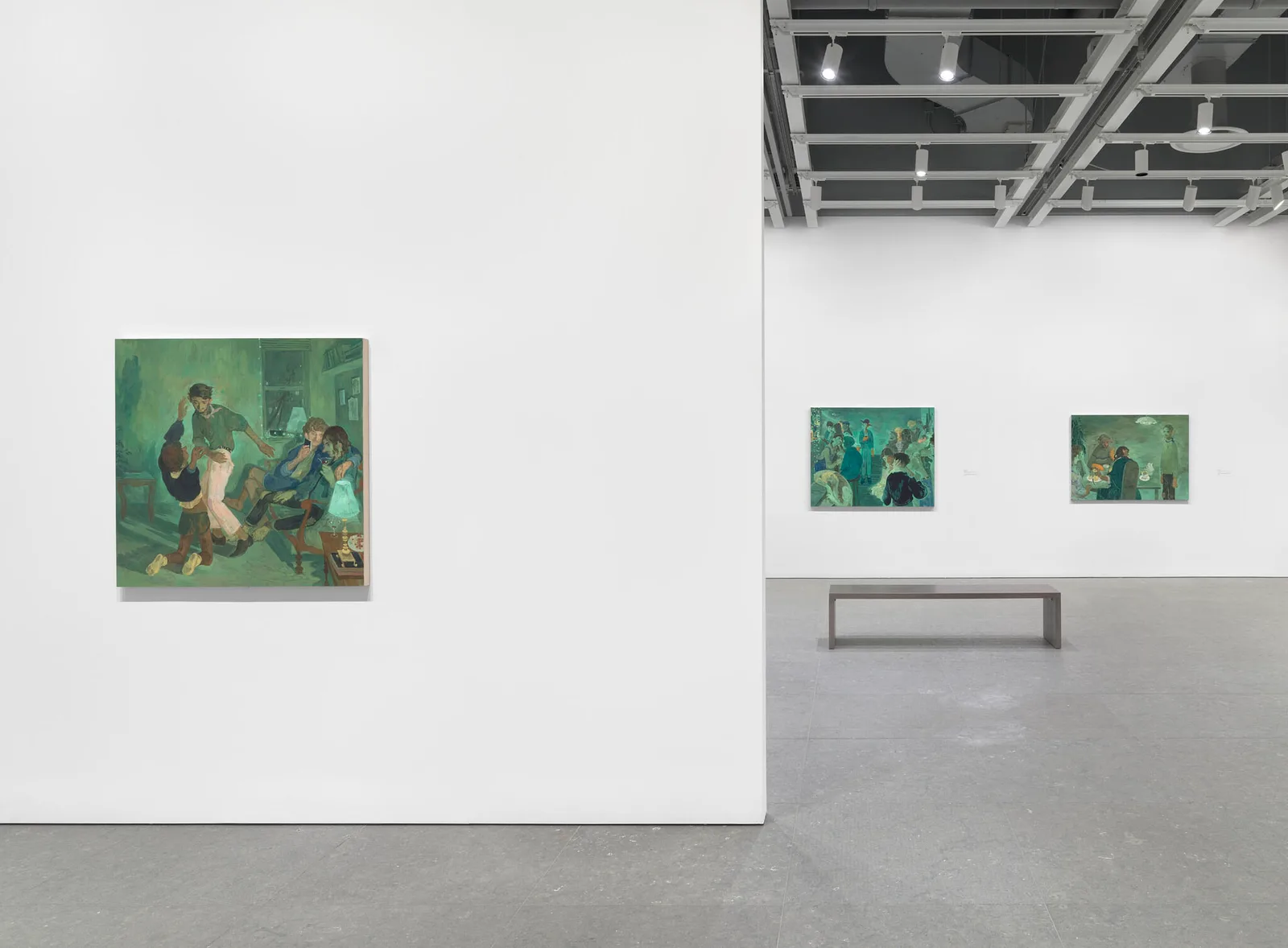
Toor's significant breakthrough occurred in 2020 when the Whitney Museum featured fifteen of his works. For his first museum solo exhibition, Salman Toor presented new and recent oil paintings at the Whitney Museum of American Art from November 13, 2020 to April 4, 2021. Known for his small-scale figurative works that combine academic technique and a quick, sketch-like style, Toor offers intimate views into the imagined lives of young, queer Brown men residing between New York City and South Asia.
The exhibition, How Will I Know, received enthusiastic acclaim. The New York Times praised it as a brilliant New York institutional debut, highlighting Toor's narrative prowess and distinctive brushwork. The New York Review of Books featured one of his works on its cover, underscoring the fresh intimacy he brought to themes of homosexuality within art.
From 2021 to 2022, Toor's painting Museum Boys was on view at the Frick Collection as part of the artist residency and the exhibition Living Histories: Queer Views and Old Masters. Toor's painting Museum Boys draws on the quiet domestic exchanges in Vermeer's paintings and alludes to their contents with a buckled hat, a pale shawl and a pearl earring. Set in an allegorical space filled with imaginary sculpture, a ghost-like figure in the foreground smiles coyly at the man in the middle ground, echoing the mood of tipsy flirtation in Vermeer's Officer and Laughing Girl.
Toor is the recipient of a Joan Mitchell Foundation Grant. His work is in the permanent collections of the Museum of Contemporary Art Chicago, Tate London, Whitney Museum of American Art New York, Walker Art Center Minneapolis, M Woods Beijing, Hessel Museum of Art at Bard College, RISD Museum Providence and Wake Forest University Art Collection Winston-Salem.
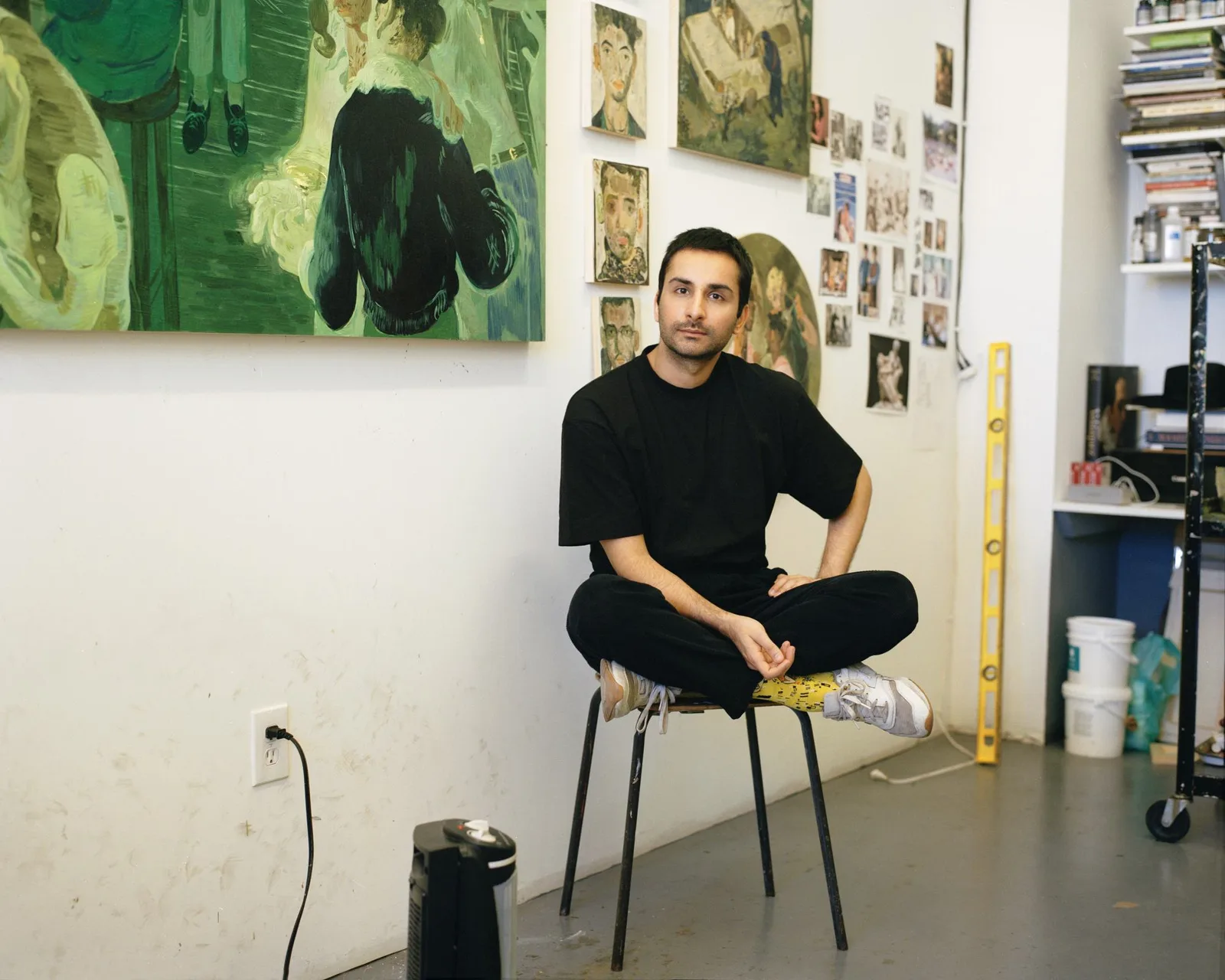
In the open Brooklyn loft where Toor works, there exists a single guiding principle: everything must originate from memory. Ephemeral images of a friend's visage, the curve of a lover's brows and perhaps a grin inspired by a Velázquez artwork blend into the unique figures that fill his canvases. The studio prohibits the use of photographs, wooden models, or reclining muses.
Toor's sumptuous and insightful figurative paintings depict intimate, quotidian moments in the lives of fictional young, brown, queer men ensconced in contemporary cosmopolitan culture. Trained initially in academic painting and deeply informed by European art history, Toor draws on Rococo, Baroque and Neoclassical traditions while incorporating contemporary urban imagery from South Asia and the global diaspora.
Regarding his affinity for the color green, Toor explained that a transformative moment in his studio occurred in 2018 when he decided to paint an entire scene using only shades of green. This decision led to a series featuring young men dancing in an apartment, employing olive and viridian tones. He appreciates green for its duality, noting it can convey warmth and coldness.
Toor is a huge fan of underpainting. There is an Old Master technique called grisaille painting, a gray-skin painting almost like a sketch, a value-based image that is made before color is added. He enjoys leaving parts of the painting kind of washed out and bald, because the painting is also kind of a drawing, drawing with the brush.
Toor is currently represented by Luhring Augustine in New York and Thomas Dane Gallery in London. Thomas Dane Gallery announced co-representation of Salman Toor with Luhring Augustine in September 2024.
A widely acclaimed two-part solo exhibition, Salman Toor: Wish Maker, was on view at Luhring Augustine Chelsea and Tribeca from June to July 2025. This marked the artist's first major presentation in New York since his watershed exhibition at the Whitney Museum of American Art in 2020, as well as Toor's first solo show with the gallery.
At auction, Toor's work has achieved significant results. In New York, Christie's and Sotheby's auctions featured Toor with a 2019 work, The Arrival, that pulverized the starting estimate set at 60,000 dollars and found a new owner for 867,000 dollars in May 2021. Sotheby's has presented works by Toor with estimates ranging from 60,000 to 600,000 dollars for various pieces.

Toor and Sethi acknowledged their feelings for each other six years ago, in 2022. Despite living in separate apartments in New York, their connection remains strong. Toor realized he had found a person he wanted to be with for life.
Toor returns to Lahore annually for several weeks. Gaining his U.S. citizenship in 2019 and committing to a life in New York felt somewhat like abandoning his family. Although his parents have been supportive, they remain distant and have yet to attend one of his significant exhibitions in person, which he attributes to the candid portrayals of queer sexuality that clash with their conservative values in Pakistan.
All four friends from Aitchison College have achieved success. Aijazuddin has established himself as an artist and writer in New York, while Sethi and Kalyan are acclaimed singers and songwriters known for their innovative contributions to South Asian music. Sethi's latest single has garnered over two hundred ninety million views on YouTube. The friends stay closely connected, communicating nearly every day through phone calls or online chats.
In October 2026, the Courtauld Gallery in London opened a major solo exhibition, Salman Toor: Someone Like You, which will remain on view through January 10, 2027. This major exhibition is the first solo exhibition in Europe of the celebrated New York-based painter. The exhibition at the Courtauld presents 19 paintings, all created since 2019, that focus on Toor's exploration of human interactions and the desire and struggle to experience a sense of belonging, both culturally and emotionally.
In May 2026, House of Nisaba, a major group exhibition featuring newly commissioned work by Toor, opened at the Moderna Museet in Stockholm. Toor was at work on new figurative paintings in 2026, continuing his exploration of queer community and diasporic identity.
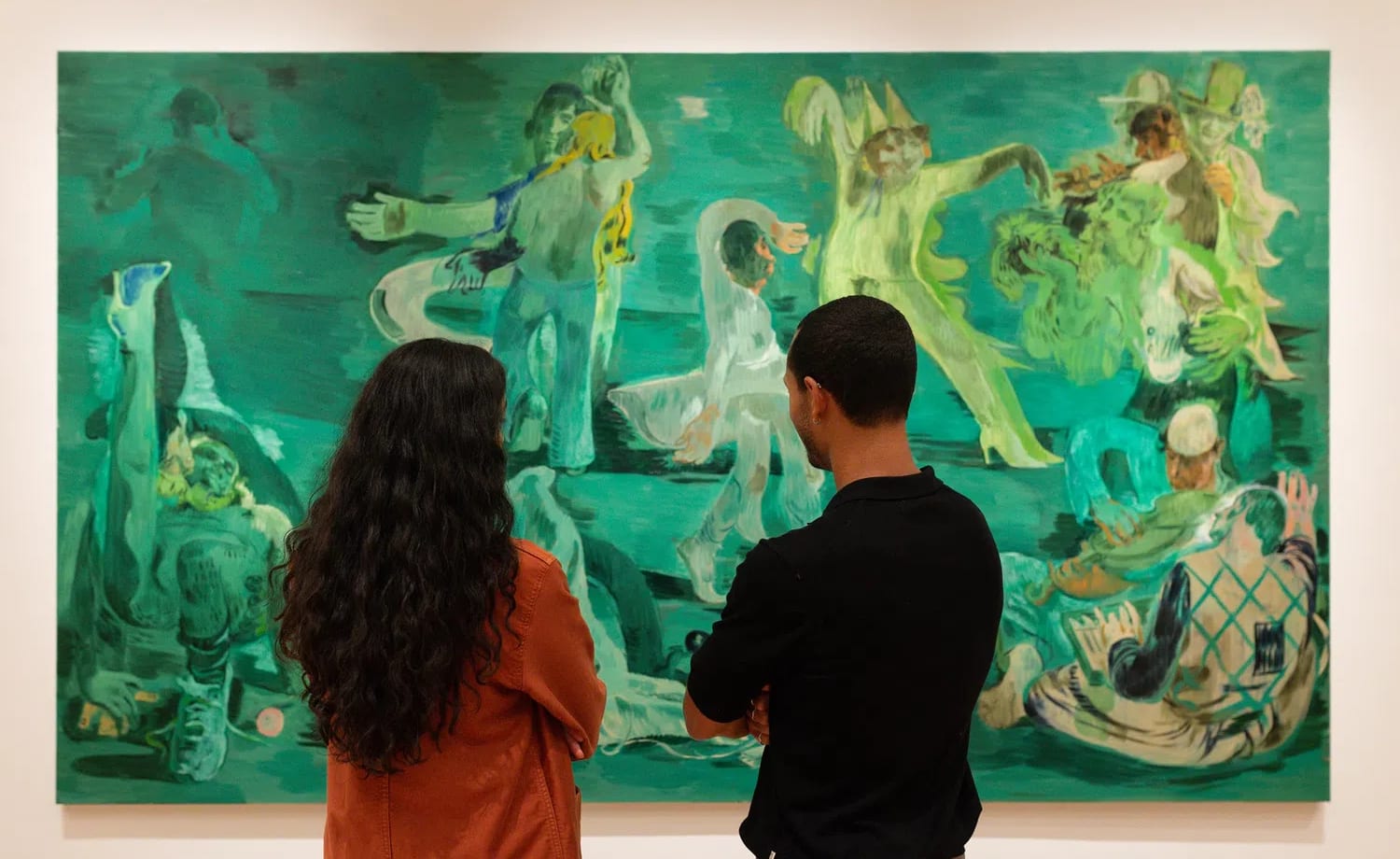
As his first solo European exhibition opens at the Courtauld, Toor talks about painting, politics and the pressure that success brings. In a Vogue interview published October 2, 2026, Toor discussed his work and the opening of his first European solo exhibition.
Toor continues to live and work in Brooklyn, creating art that explores the ambiguities of living in the East and West. There is a lingering question the artist has remarked on: what am I doing here in America? This question drives his ongoing exploration of identity, belonging, and the immigrant experience through his distinctive figurative paintings.
[My paintings] depict queer and immigrant lives that straddle different cultures and inhabit the tension between intimacy and exposure, belonging and estrangement. What it means to find a community, but also the daily costs associated with visibility.
Salman Toor