
Art history loves nothing more than unsettling a painting everyone thought they understood.
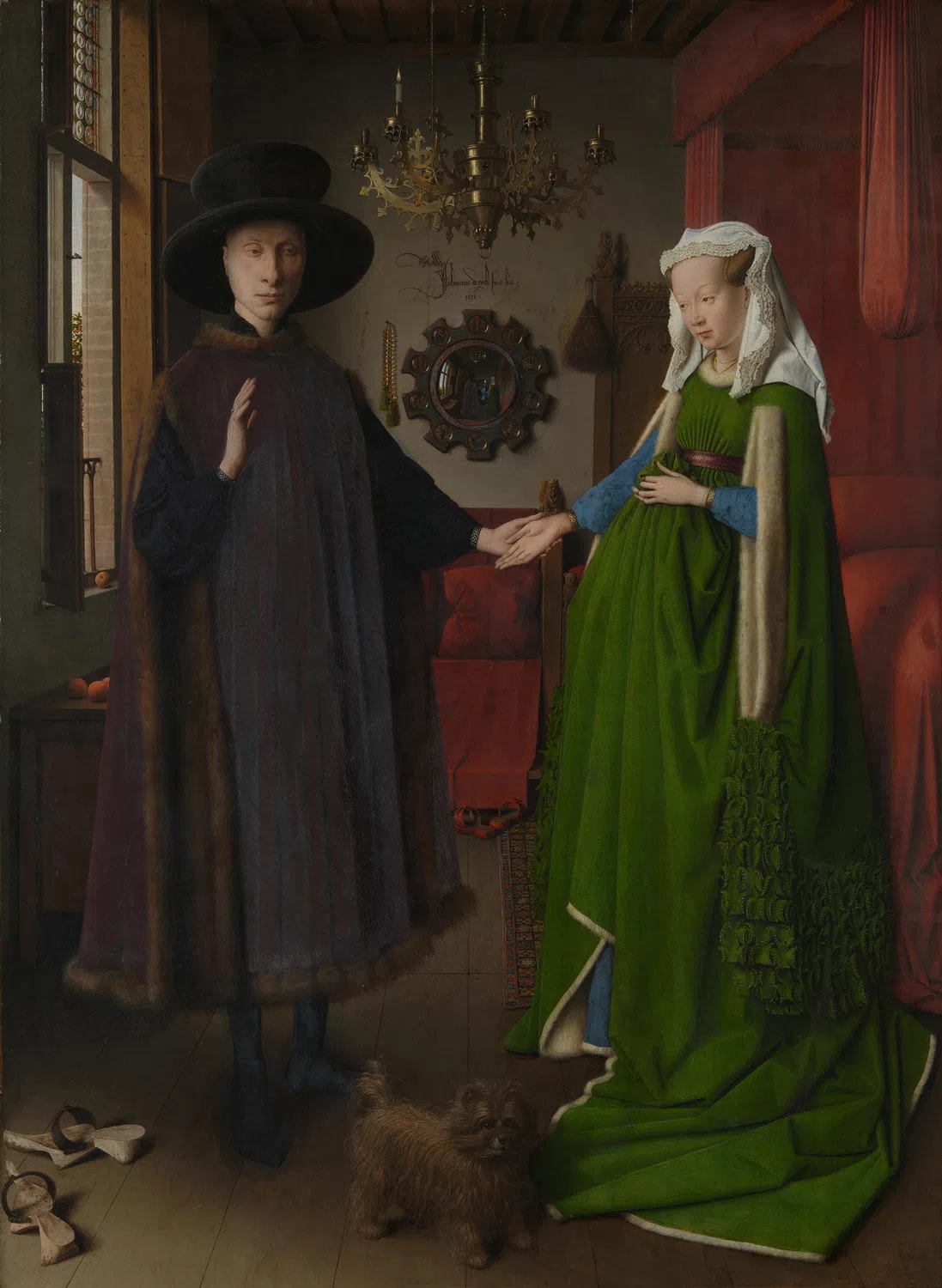
That's exactly what's happening to the Arnolfini Portrait, Jan van Eyck's 1434 panel and one of the most recognizable images in Western art. A new catalogue essay for the National Gallery's upcoming exhibition argues the couple staring out of the painting might not be the Arnolfinis at all. They might be Van Eyck and his own wife.
The claim comes from Stephan Kemperdick, curator of early Netherlandish and early German painting at the Gemäldegalerie in Berlin, writing for Van Eyck: The Portraits. The show opens at the National Gallery on November 21 and runs through April 11, 2027. It brings together, for the first time, all nine of Van Eyck's surviving painted portraits, roughly half of his twenty known surviving autograph works. Kemperdick has called it a "once-in-a-lifetime" event.
The ripple effects of his theory reach beyond the Arnolfini panel itself. Another Van Eyck portrait at the National Gallery, from 1433, showing a much older man than the figure in the Arnolfini Portrait, is now tentatively identified by the London museum as a self-portrait. That painting, Portrait of a Man (Self-Portrait?), will hang near Portrait of Margaret van Eyck, the artist's wife, on loan from Bruges. The Bruges panel, dated 1439, is the first known portrait of a woman who was not a member of the aristocracy.
So why question the Arnolfini identification now, nearly two centuries after it took hold? Kemperdick has been building this case for years, presenting versions of it at symposia in Ghent and Bruges and at a Courtauld Institute of Art lecture in 2023. This catalogue essay marks the first time his full argument appears in print.
His evidence centers partly on the painting's inscription. Above the convex mirror on the back wall, Van Eyck wrote "Jan van Eyck was here 1434" in an unusually ornate script. Kemperdick has revisited the inscription, which is unusually large and conspicuously places the artist's name next to the male figure's head, arguing this indicates a direct connection between Van Eyck and the man. Most Van Eyck signatures sit quietly on frames. This one practically shouts.
Then there's the question of the name itself. The Arnolfini identification traces back to the 1860s, when the British art historian W. H. James Weale read a reference in a sixteenth-century inventory to a "hernoul le fin" as a French rendering of the Italian surname Arnolfini. That inventory, compiled for Margaret of Austria in 1516, lists a large picture by "Johannes" showing a man called Hernoul le Fin with his wife in a chamber. A later 1523 entry calls him Arnoult Fin.
Kemperdick isn't buying it. He has reconsidered the association between the "hernoul le fin" reference and the Arnolfini surname, and, citing the early-modern habit of classifying the work as a lewd genre scene rather than a formal portrait, suggests the phrase was never a real surname at all. Instead, he reads it as a mocking nickname attached to the painting generations after it was made. A small carved figure of Saint Margaret on the bedpost, patron saint linked to childbirth and to the name Margaret itself, becomes, in his reading, a quiet signature of its own.
Not everyone is convinced. Nicholas Flory, co-curator of the show along with Emma Capron, says that he and Capron find Kemperdick's theory "interesting" but "speculative." The pair point to a mismatch that's hard to explain away. The dated Bruges portrait gives Margaret grey-blue eyes. The woman in the Arnolfini Portrait has brown ones. For a painter as fanatically precise as Van Eyck, that's not a small detail to wave off.
Maximiliaan Martens, an art historian at Ghent University, has gone further, saying he sees no reason to abandon the traditional reading. His position reflects decades of settled scholarship that Kemperdick is now asking colleagues to unsettle.
There's older baggage here too. Erwin Panofsky's influential 1934 essay read the painting as a kind of visual contract. He treated it as a unique form of marriage document recorded in paint, a theory that shaped how generations of viewers understood the scene. That reading already took a hit decades ago. A French naval historian, Jacques Paviot, found in 1994 that the Arnolfini man most associated with the painting didn't marry until 1447, six years after Van Eyck had died. If the marriage-certificate theory was already shaky, Kemperdick's identity challenge lands on ground that was softening anyway.
As for the woman's supposedly pregnant silhouette, long a staple of pub-quiz trivia, most scholars now treat that bundled green fabric as fashion rather than biology. Gathering heavy skirts that way was simply how wealthy fifteenth-century women carried their dresses.
None of this settles who's actually in the frame. What it does is expose how thin the documentary record really is. Everything rests on a few inventory lines written generations after Van Eyck put down his brush, plus whatever resemblance scholars can coax out of faces painted five years apart in different media and different states of finish.
The technical research behind this exhibition adds its own texture to the debate. Analysis of the National Gallery's self-portrait panel during its recent conservation treatment showed how Van Eyck adjusted the background's blue tone in the lower right corner to push the sitter's shoulder forward, Flory explained, creating a three-dimensional effect. It's the kind of workshop trick that reveals how deliberately Van Eyck constructed illusion, which only sharpens the stakes of arguing about who, exactly, he was constructing it for.
Press and members get an early look at the exhibition on November 18, with a members' preview two days later already sold out. The public opening on November 21 will put all nine portraits in one room for the first and, the gallery insists, only time. Visitors walking past the Arnolfini Portrait that week will be looking at a five-hundred-year-old couple whose names are suddenly, genuinely, up for grabs again.
Whether Kemperdick's reading survives scrutiny or gets filed alongside other discarded Arnolfini theories, the painting's basic trick hasn't changed. It still convinces you, instantly, that you're looking at real people in a real room. Figuring out exactly who they were has always been the harder part.
Check topics and authors from this story to see more stories like this in your personalized feed and receive updates when new work is published.


