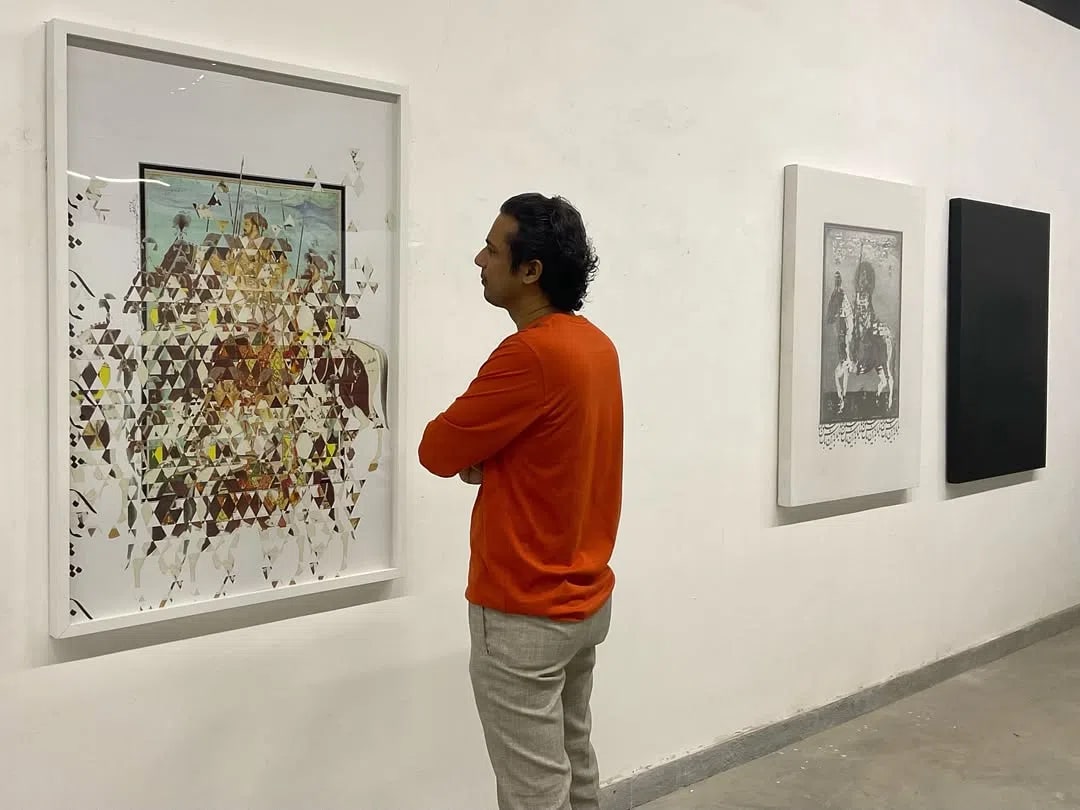

In Pakistan’s art circles, the miniature tradition keeps finding new ways to speak.
Classical forms meet current questions of memory, belief, and representation. Shiblee Muneer brings that conversation to Karachi with his solo exhibition The Allegory of an Image at Sanat Initiative.
The show runs from November 17 to November 26. It opened with a reception on the first evening. Muneer investigates the philosophy of image-making itself. Historical, social and political forces shape what we see and believe. They shape cultural memory too.
Artists do not invent images from nothing. Muneer made that clear in an interview with The Express Tribune. “An image-maker takes imagination from somewhere, a story from somewhere, an idea from somewhere and a technique from somewhere else. These are different tools, perspectives and means through which an image is constructed,” he said.

He works with cut paper, collage and mosaic elements. These methods show how fragments of different realities form one visual whole. An image is never just an object. It carries layered social meaning.
Muneer draws on the Mughal miniature tradition that runs through his family. Ancestors worked in Mughal and Sikh courts. His grandfather, Ustad Haji Mohammad Sharif, helped establish miniature painting as a formal discipline in Pakistan. Sharif taught at the Mayo School of Arts, later the National College of Arts.
“The Mughal visual language is something I have inherited through my family,” Muneer said. “The region we come from is also known for its manuscript art. Whenever I think about image-making or defining an image, this artistic tradition naturally comes to mind.”
Mughal imagery thrived under royal patronage. That link between art and power has not vanished. It simply takes new forms. “The powers are the same, but the images and their names have changed,” he noted.
Art already exists in daily life and across subjects. It needs recognition. “We do not make art. We identify art,” Muneer said.
Born in Jhang, Muneer trained early in calligraphy and traditional painting. He earned a diploma from the Naqsh School of Arts in Lahore. Later, he completed a BFA with distinction at Beaconhouse National University. He now teaches at the Lahore College for Women University.
His practice joins strict classical canons with mixed media. Collage, calligraphy, digital manipulation, and hyper-realism sit alongside miniature techniques. The result stays rooted yet open to the present.
In 2023, he received the Nigah Art Award for Best Contemporary Painter of Pakistan. The next year brought an international research fellowship through the University of Mazandaran in Iran. That included study of Persian manuscripts at Tehran’s Golestan Palace.
Muneer has shown work in Belgium, Germany, China, Turkey, Canada, the UAE, Bangladesh, Serbia and India. He took part in the Beijing International Art Biennale and Abu Dhabi Art Fair. Residencies in Germany, Bangladesh, Serbia and Belgium expanded his range.
Sanat Initiative, founded in 2014, has become a key Karachi platform for experimental and mid-career work. The gallery supports projects that test ideas rather than settle for safe display. Hosting Muneer fits that aim. It places a hereditary miniature practice inside a space known for contemporary risk.
The exhibition arrives amid steady interest in how South Asian artists rework court traditions. Viewers encounter precise craft that still questions authority, identity, and the construction of belief. Technique stays visible. So does the thinking behind each assembled surface.
What comes next for Muneer will likely build on this research into manuscripts and image systems. Teaching and new series will keep the dialogue open. The works at Sanat Initiative offer a clear look at one artist’s method of gathering fragments into meaning.
The show remains on view through November 26 at the gallery’s Karachi location.
Check topics and authors from this story to see more stories like this in your personalized feed and receive updates when new work is published.


