
Traditional performing arts across South Asia keep losing ground to screens and shrinking cultural budgets. Puppetry in Pakistan has felt that squeeze longer than most. This week, the country's state arts body tried to do something concrete about it.
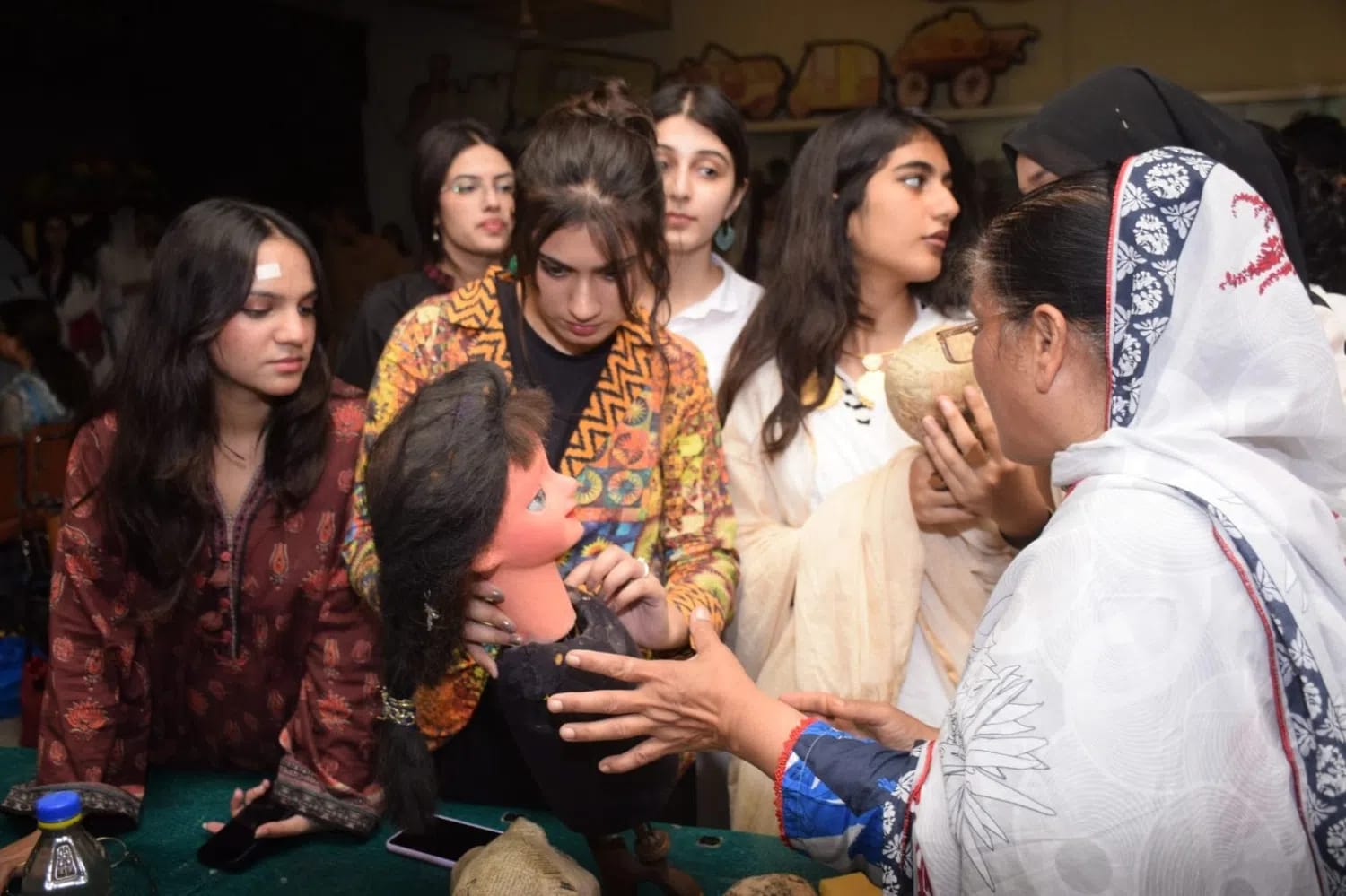
The Pakistan National Council of the Arts organized an interactive rod puppetry workshop for students of the National College of Arts, Rawalpindi campus. The session was held at the National Puppet Theatre Hall in Rawalpindi. It combined hands-on training with a live performance.
The workshop carried a plain, functional title. Organizers called it Introduction to Puppetry Art: Making and Handling of Rod Puppets, designed to introduce fundamental techniques and give students hands-on experience in puppet making and manipulation.

Syed Masroor Ali Shah ran the session. He is identified by PNCA as its puppet expert, and he brought a team of master puppeteers with him. Under their guidance, students explored the mechanics of rod puppets and learned to synchronize movement with dialogue, theatrical timing, and dance sequences. A live puppet performance followed, showcasing both traditional and contemporary puppetry techniques.
Shah framed the exercise as part of a bigger mission. He said PNCA remained committed to reviving and preserving the traditional art of puppetry in Pakistan. He added that the educational workshops aimed not only to keep the cultural art form alive among young people, but to use storytelling to promote social, economic and moral awareness.
That framing only makes sense against a longer institutional history. PNCA itself is not a recent invention. It was established through an Act of Parliament in 1973, with the mandate to lead the development of arts in Pakistan.

Its puppetry arm came two years later. The National Puppet Theatre was established in 1975, a step taken to revive the most popular folk art, which was dying due to negligence. The language of decline was built into the project from day one.
Training then meant sending people abroad. Two groups were sent to China for rod puppet training in 1975 and 1979, and a third group went to Poland in 1987. Those trips effectively built the technical backbone the theatre still relies on.
The roots go back even further. A renaissance in Pakistani puppetry had already come through the Pakistan Arts Council in the 1960s, under poet Faiz Ahmed Faiz, who pushed glove puppet performances in Lahore; Czech puppeteers then arrived to train young artists, and by 1964 puppetry reached television. The Rawalpindi puppet theatre itself started in 1975 under Shahid Toosi, founded with help from the late Faqir Hussain Saga and Zulfikar Ahmed.

Few names outside that circle ever broke through nationally. Farooq Qaiser did. He was a Pakistani puppeteer, television director, and writer, best known as the creator of the puppet character Uncle Sargam, introduced in 1976 on the children's show Kaliyan. Qaiser died in 2021. His generation is largely gone now.
Institutionally, the theatre still runs on a skeleton crew. It carries on free puppet shows at the National Art Gallery in Islamabad with an eleven-member team. That same team marks occasions like Kashmir Solidarity Day, Pakistan Day, Independence Day and World Tourism Day with annual shows. Eleven people covering a national calendar is not much of a buffer.
Outside the state system, the picture looks rougher. Independent reporting on Pakistani puppeteers found that puppet shows had largely lost their popularity and become irrelevant in the modern era, decades after serving as a major source of entertainment through the late 1970s. Freelance performers scrape by on festival and school bookings, with none of PNCA's institutional cushion.

Cross-institutional links do exist, at least on paper. UNIMA Pakistan was founded in 1993 through a collaboration between Rafi Peer Theatre Workshop, Rasheed Putli Group, the PNCA Puppet Theatre in Rawalpindi, and Farooq Qaiser. Whether that network still functions actively is less clear.
NCA itself is not starting from zero on this front. The college already runs a dedicated student group for the craft. Puppeteers specialize in the art of puppetry, using string puppets, rod puppets, shadow puppets, and muppets. There is even a Puppeteering Prize recommended by the society's patron.
That existing structure is what makes this particular workshop worth watching. A single afternoon of instruction will not replace decades of apprenticeship. But paired with an active student society, it looks less like a photo opportunity and more like a handoff point.
Whether PNCA follows up with recurring sessions or leaves this as a one-off will say more than the workshop itself. For now, Rawalpindi has handed fine arts students the mechanics of a craft that nearly vanished once already. What they do with it is the real test.
Check topics and authors from this story to see more stories like this in your personalized feed and receive updates when new work is published.


