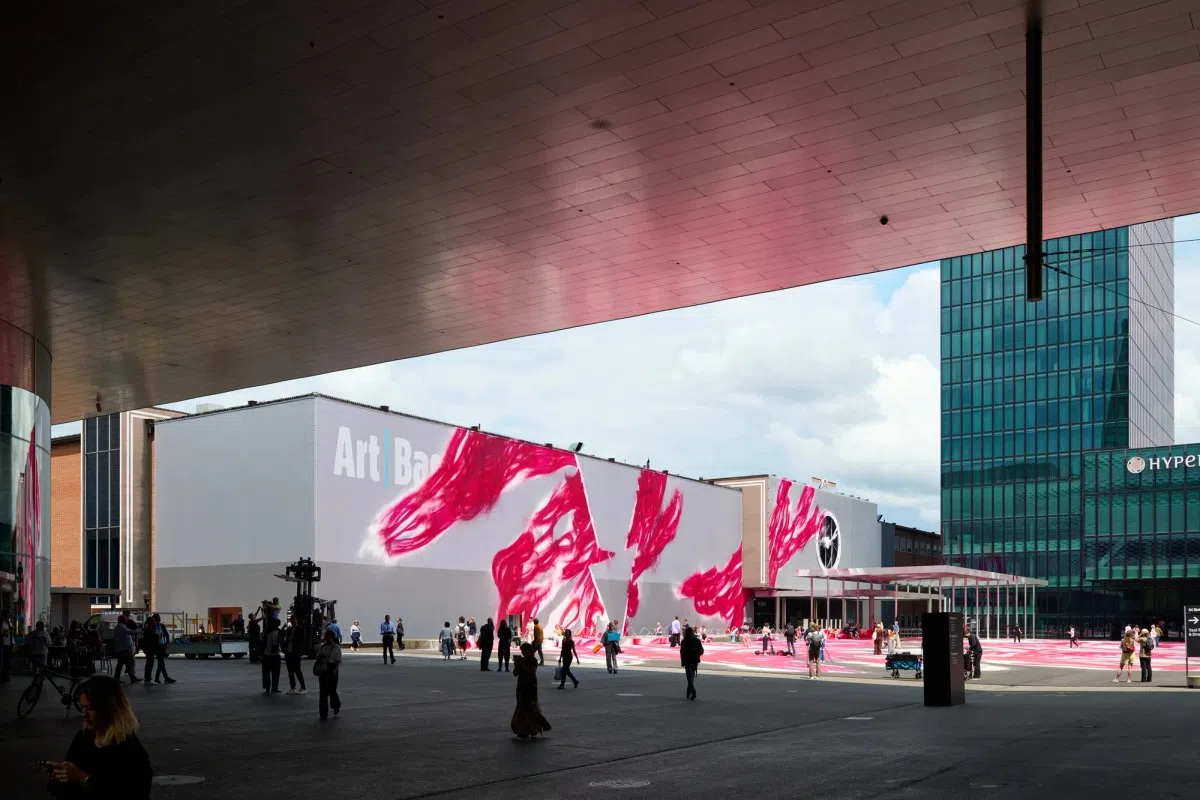
Art Basel opens in Switzerland this week, with VIP preview days on June 16 and 17, bringing together 290 galleries from 43 countries and territories, a slight increase from the 289 that participated last year. Of the 290 exhibitors, 21 are new to the fair, hailing from the Ivory Coast, Lebanon, Saudi Arabia, and Turkey, reflecting a broadening of the fair's geographic reach at a time when the art market itself is actively looking for new centers of gravity.
The mood is cautiously upbeat, and not without basis. The global art market returned to growth in 2025, with sales increasing by four percent year-on-year to an estimated 57.5 billion in 2024, reflecting a 12 percent decrease year-on-year.
That recovery, however, does not cancel out what dealers have been quietly navigating. The average number of buyers per dealer fell to 57 in 2025, the lowest since 2021. Galleries continue to grapple with rising operational costs, shifting buyer habits, and mounting geopolitical conflict. For smaller operations, the picture has been sharper still. The sharpest decline was among the smallest dealers, with those turning over less than $250,000 reporting a 40 percent drop, to 29 buyers on average.
Still, the data heading into 2026 shows a shift in sentiment. Confidence strengthened heading into 2026, with 43 percent of dealers expecting sales to improve and 38 percent anticipating stable performance. Sentiment also improved among auction houses, reflecting greater optimism despite ongoing economic and geopolitical uncertainty.
The fair itself has responded to the pressures dealers face. For 2026, Art Basel has introduced "Basel Exclusive," an opt-in initiative that asks exhibitors to keep at least one major work out of pre-fair PDFs and email previews, with the goal of making the fair feel less like a digital scan and more like a place where important works still have to be seen in person. The response has been strong, with 193 of the 240 exhibitors in the main galleries section opting in.
Beyond sales tactics, the edition carries artistic weight. Nairy Baghramian and Ibrahim Mahama will unveil two major new public works in Basel this June, as part of the inaugural class of Art Basel Gold Awardees. Baghramian will present her work on the Messeplatz, while a large-scale installation by Ghanaian multidisciplinary artist Mahama will be on view on the Münsterplatz. The fair's "Premiere" sector, dedicated to recent production, will expand to include 17 presentations, up from 10 in 2025.
"For one week, Basel becomes the central meeting point of the art world," said Maike Cruse, the fair's director. That framing carries more weight this year than it might in calmer times. The year has already seen Art Basel Qatar and a much-discussed Venice Biennale, followed by a packed week of fairs in New York. Basel arrives as the last major market event before summer, under conditions that remain genuinely uncertain but are no longer worsening.
Geopolitical and economic instability ranks as the number one concern for the art trade, a position it has now held for several cycles. What has changed is the industry's relationship to that anxiety. Dealers are not expecting a boom. What many are arriving with, instead, is a clearer sense of where their collectors are, what material travels, and which fairs are still worth the cost. As a result of high costs and uncertain sales, galleries are rethinking participation strategies, with some choosing to slim down their schedules and focus on a smaller number of key fairs where the return is expected to be strongest. Basel, by most measures, remains on that short list.
Check topics and authors from this story to see more stories like this in your personalized feed and receive updates when new work is published.


