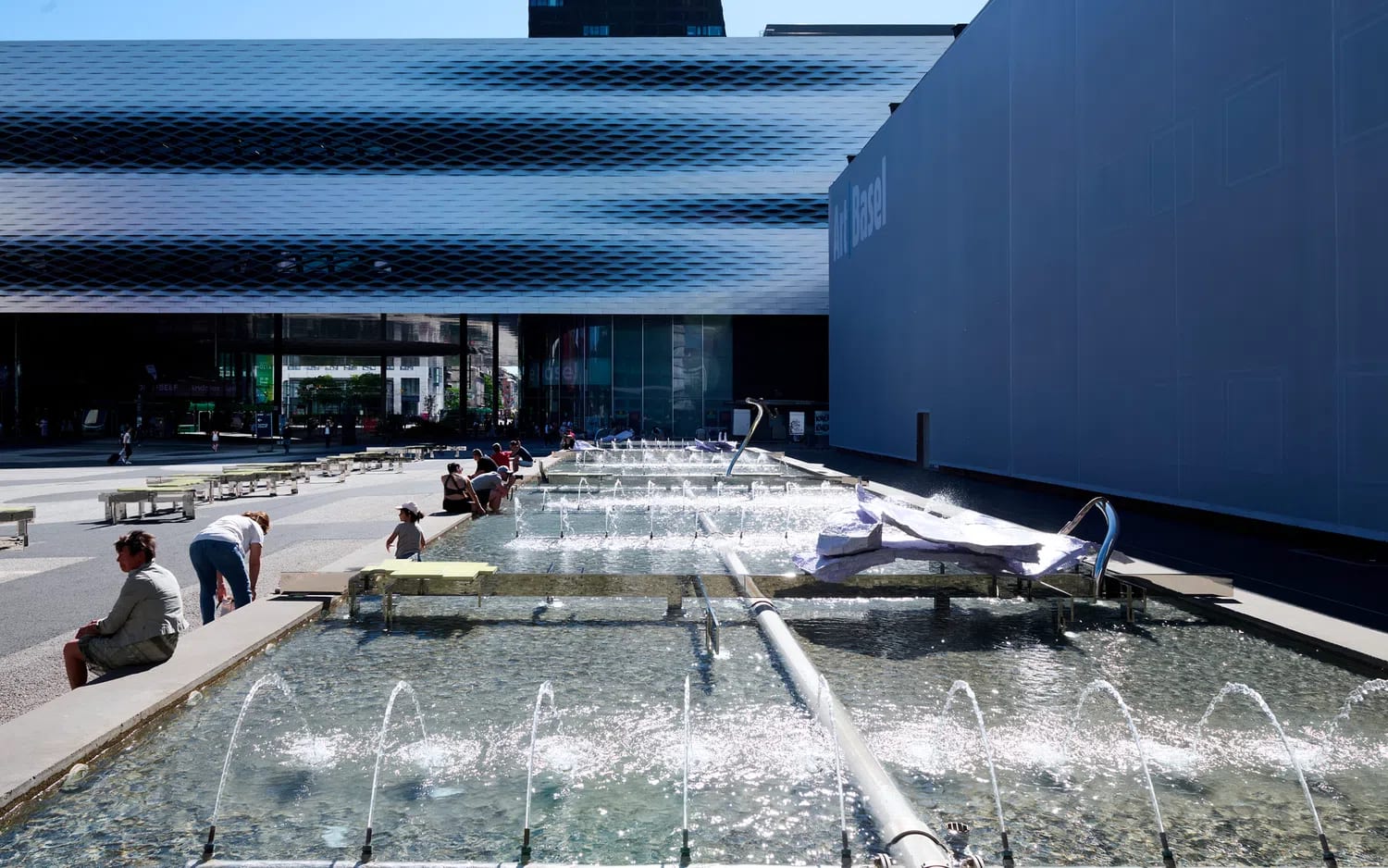
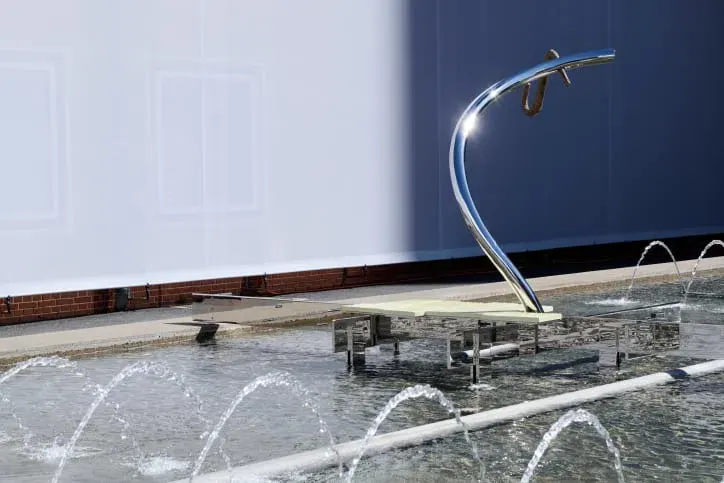
The fountain on the Messeplatz is still running. That much is certain. Around it, rising from polished steel armatures threaded through the water, four large lavender forms hover in what feels like the aftermath of some gentle collision. They are biomorphic, vaguely bodily, precariously stacked. They do nothing except exist in public, held up, in mild defiance of the gravity that the city otherwise insists upon. For several minutes on the opening morning of Art Basel 2026, a group of children stopped to look. They didn't have tickets. Nobody asked them to move along.
That small moment, unremarkable in every way, might be the truest image of what this year's edition is actually trying to do. Art Basel 2026 has arrived with a question embedded in its architecture: when the market conversation inside Messe Basel tilts increasingly toward the digital and the algorithmic, what does art owe to the person standing outside without a VIP lanyard? Two of the fair's most ambitious programs this year stage that tension directly, and the result is something richer than a trade event. It is, unexpectedly, a cultural argument worth having.
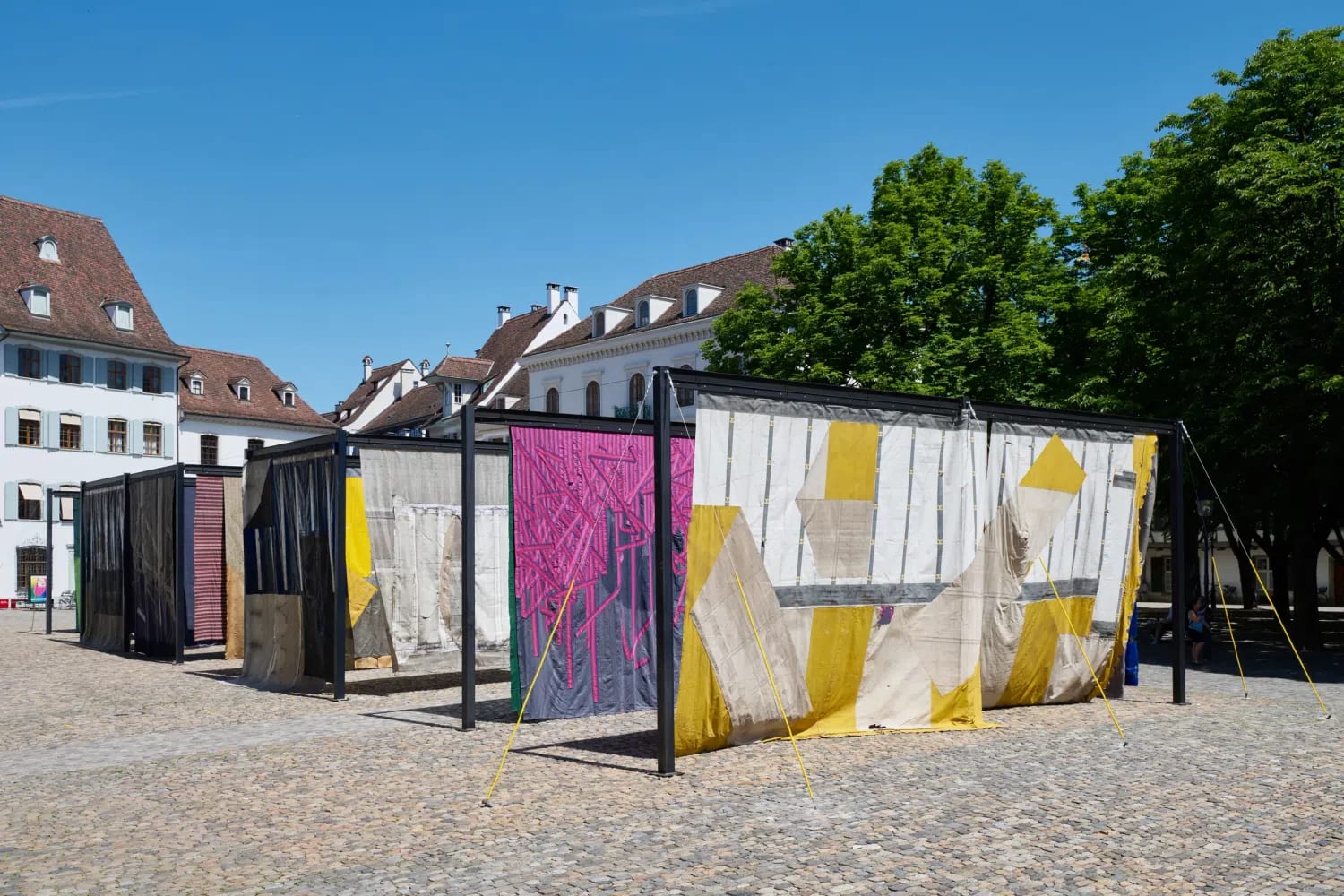
The lavender sculptures belong to Nairy Baghramian. Her commission, Modèle vivant (S'empilant) (2026), conceived for the Messeplatz fountain, unfolds as a rhythmic assembly of four large-scale sculptural groupings that extend her distinctive artistic language, combining biomorphic forms with geometric support structures, with abstract, allusive aluminum casts painted in a soft lavender tone appearing stacked and precariously balanced on polished steel armatures. It arrived in Basel alongside an equally ambitious outdoor commission: on the Münsterplatz, Ghanaian installation artist Ibrahim Mahama unveiled an installation entitled The God of Small Things (2026). Both artists are part of Art Basel's inaugural class of Gold Awardees, and Art Basel announced the commissions earlier this year. Both works are free to encounter. Neither requires explanation. Together they set the register for a fair that is simultaneously more commercially cautious and more culturally curious than it has been in several years.
Circuits and Canons
Now in its third edition, Zero 10, Art Basel's global initiative dedicated to art of the digital era, makes its debut at Art Basel's flagship fair with an expanded, open format. It is the initiative's first co-curated edition and largest presentation to date, with twenty exhibitors transforming the Event Hall at Messe Basel into a platform for artistic experimentation and exchange. The co-curators are Trevor Paglen, a 2026 LG Guggenheim Award recipient and MacArthur Fellow, and digital art strategist Eli Scheinman. Together they have organized the program around the theme The Condition, and the choice of that spare, clinical phrase is itself a kind of manifesto.
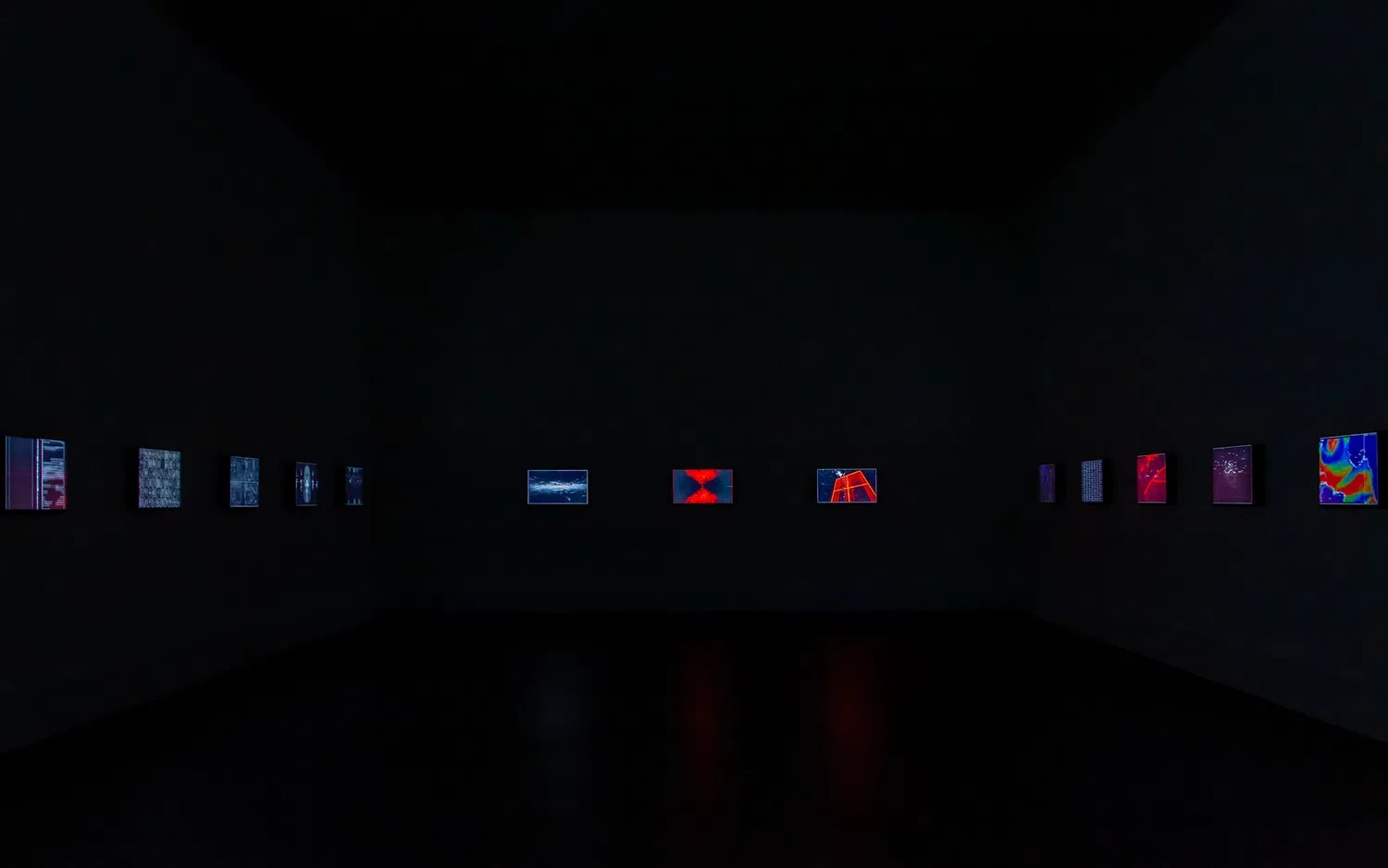
Paglen believes that digital art has too often been held back by uneven curation and by a failure to identify the artists and works capable of sustaining serious critical attention. His solution was to build an argument through time. The presentation examines roughly seven decades of instruction-based and computational art, bringing together contemporary artists such as John Gerrard, Agnieszka Kurant, Avery Singer, and Hito Steyerl with historical pioneers including Vera Molnár, Mary Ellen Bute, Ted Nemeth, and Ben F. Laposky.
The sweep is deliberate. Molnár, a pioneer of algorithmic art since 1968, is the subject of a historical presentation in conjunction with her exhibition at the Kunstmuseum Basel. That tie-in matters. The Hungarian-born Molnár, who died in 2023, represents an emerging canon of digital art, and her early experiments in algorithmic art are being presented by Oniris.art and Interface Gallery. Placing her beside living practitioners is not nostalgia. It is taxonomy. It says: this lineage exists, it has intellectual seriousness, and it belongs here as much as any bronze.
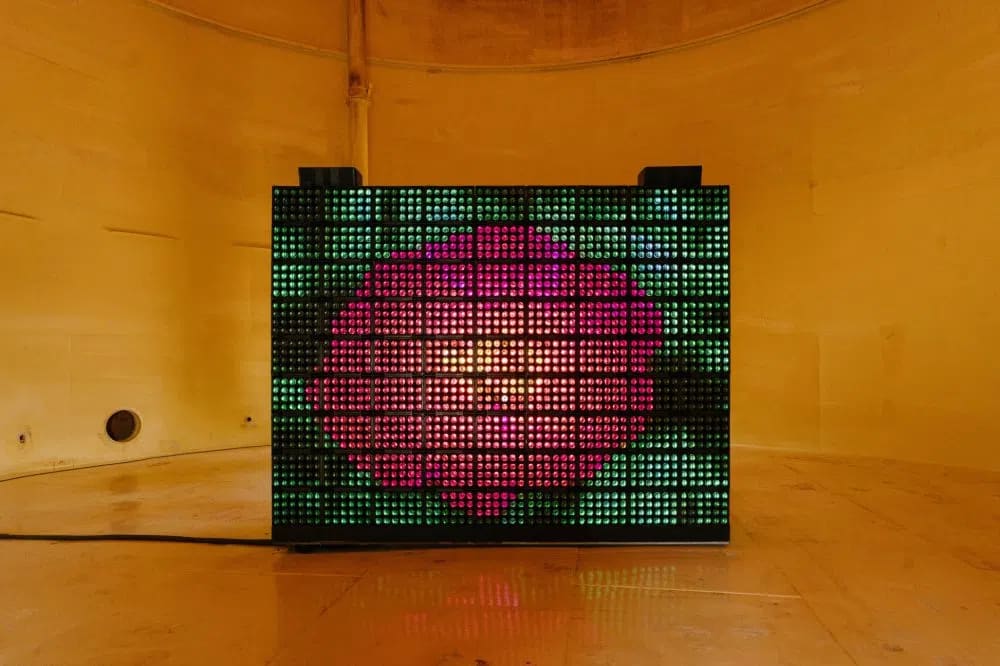
Among the living practitioners, Steyerl's contribution is the room that most visitors return to. Presented jointly by Esther Schipper and Andrew Kreps Gallery, Green Screen (2023) combines an experimental LED wall made from recycled glass bottles, living plants, and AI-generated imagery, with bioelectrical signals from the plants influencing both sound and low-resolution animations of blooming flowers, creating a feedback loop between the organic and digital. The work sits somewhere between a greenhouse and a server room, which is more or less where contemporary life resides too.
Avery Singer's Shit Coin Maxi (2025), presented with Hauser & Wirth, reflects on cryptocurrency speculation through layered digital-painterly compositions, while Andreas Gursky's Ocean V at Sprüth Magers transforms satellite imagery into vast oceanscapes exploring climate, borders, and planetary observation. Singer's title alone earns a read: the vocabulary of speculative finance inserted into what looks, at a glance, like abstract painting. It is funny and unsettling in equal measure.
The London-based Uzbek artist Aziza Kadyri uses a custom-trained AI model to examine authorship and collective memory in her piece A Borrowed Hand (2026), on show at Zero 10 with eastcontemporary gallery. Her work brings into the open the question that The Condition is designed to hold without resolving: what is authorship when the instrument thinks? Scheinman has said as much directly. "Why do you even need the human if the machine, the algorithm, the model, the agent can produce work?" he asks. "I think at this moment in time it's more important than ever to present work that interrogates that exact question."
For Paglen, the opposition between digital art and the traditional art world no longer makes sense given how deeply intertwined the two have become. That position is less a provocation than a description of the current moment. Galleries participating in Zero 10 include long-standing Art Basel exhibitors such as Hauser & Wirth, Marian Goodman, Andrew Kreps, Esther Schipper, and Sprüth Magers, alongside exhibitors with dedicated digital programs including Asprey Studio and Fellowship, and the first-time participation of Basel-based research institution HEK, the Haus der Elektronischen Künste. The presence of HEK is significant: a local institution anchors the sector in the city's own intellectual history rather than treating Basel as simply a venue for the international market to pass through.
Each day of the fair featured a special Zero 10 panel, co-curated by Paglen and Scheinman, exploring how artists engage with the technologies fundamentally altering image-making, authorship, value, and contemporary life itself. Artists Aria Dean and Josh Kline, alongside novelist Hari Kunzru, discussed authorship, originality, and expertise in a world progressively dominated by AI. These were not panels about the art market. They were panels about what it means to make something when the question of agency has become genuinely difficult.
The Street Pushes Back
Step out of the Event Hall and across the Messeplatz, and a different kind of argument is already underway. Parcours, Art Basel's sector for site-specific public work, has been running since the preview days and will remain open after the collectors have gone home. Curated for the third time by Stefanie Hessler, Director of Swiss Institute in New York, the public art sector unfolds along Clarastrasse, connecting the fairground with the Rhine, with one installation on view across the river near Bankverein.
Hessler's chosen theme this year is conviviality. It is a word that risks sounding gentle, even anodyne, until you follow it back to the Latin root: to live together, to share a table. This year's Parcours meditates, in Hessler's own words, on "the beauty of living together and of sharing space and time with other humans, but also the complexity and ruptures, especially in times of conflict and war."
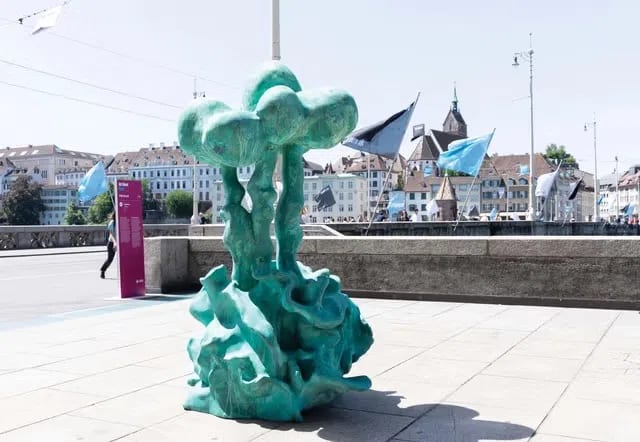
The selection follows from that framing honestly. Hessler's program explores themes of living together, including rituals, ecological relations, public space, memory, resistance, and technology, and features over twenty mostly new works by an international roster of artists from Europe, Africa, the Americas, and Asia. Projects are located along Clarastrasse, in a church, hotels, restaurants, a distillery, and other semi-public venues. Among the participants are Kader Attia, Nicole Coson, Pélagie Gbaguidi, Amol K. Patil, Haegue Yang, Miao Ying, and Edi Rama.
Hessler has spoken about what the word convivial actually demands. "They also include our relationship to the natural world and the cultural ecosystems we form part of, including ritual, myth, and storytelling," she says. "How we create meaning, but also how we express our beliefs in public space, in architecture, in the way we create places and opportunities for gathering. For many artists, conviviality is a prerequisite to making work."
The curatorial question Hessler keeps asking is a genuinely political one. "It asks who has the ability to define how we live together and how we use shared space," she says. Parcours stages that question across a city still very much in use. Trams run through it. Children walk past it. People who have never heard of Art Basel encounter it on the way to work.
American artist Sarah Crowner extends her long-running investigation into abstraction and movement with Sliced Wings, a series of geometric posters installed throughout Basel, including inside its trams, with the title referring simultaneously to birds, architectural forms, and political factions. For Hessler, the project offers a subtle commentary on the commercial environment surrounding Art Basel: by occupying existing advertising infrastructure, the posters interrupt the visual language of consumption with an abstract artistic gesture.
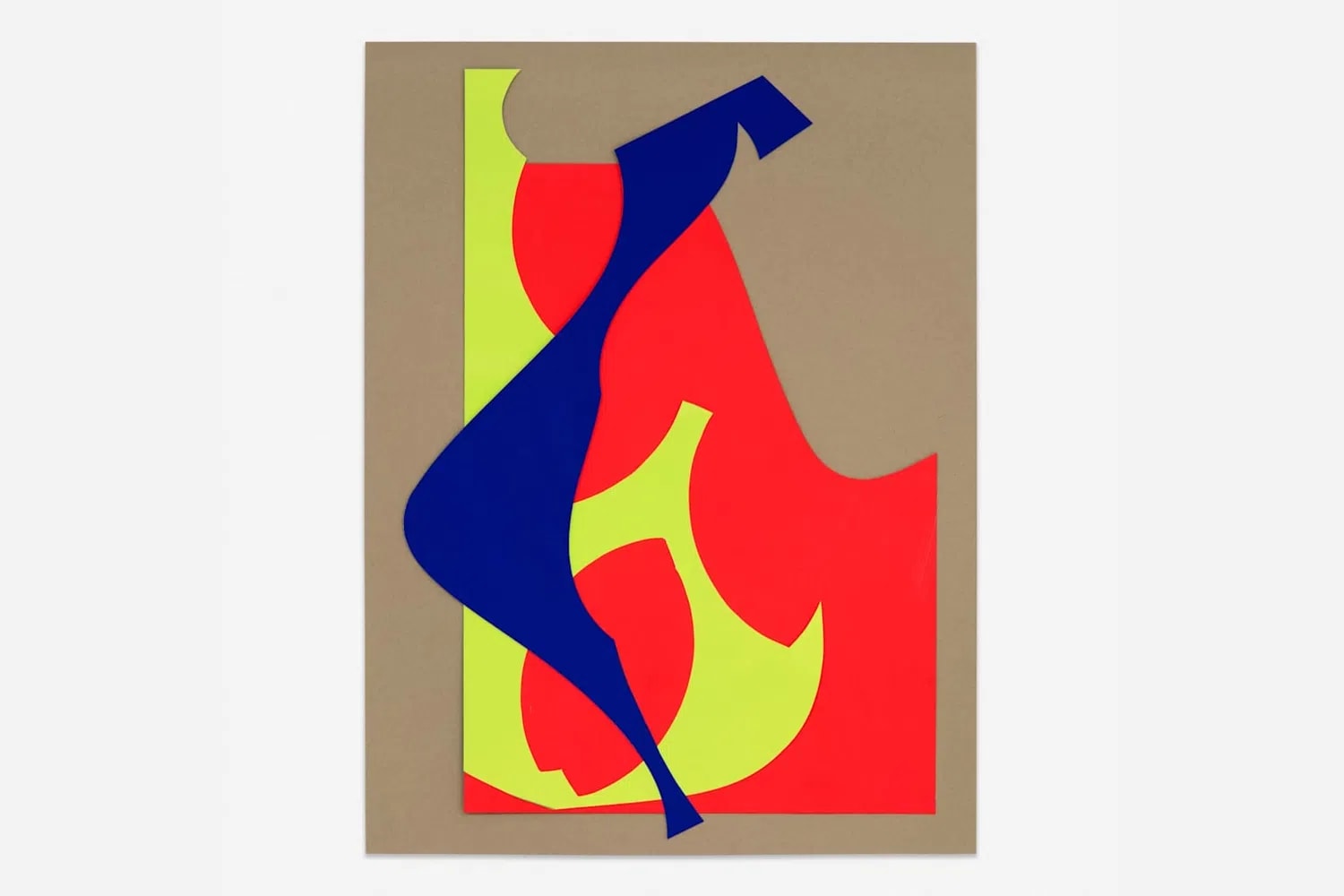
That interruption is not accidental. Parcours has always had a strand of mild refusal running through it, a way of reminding the city that art week belongs to more people than can afford to walk through the main hall. The sector's 21 site-specific projects are free and open to all. That civic commitment has weight when set against the access economics of the main fair. It also reframes the gallery week: the most radical gesture at Art Basel 2026 might be a poster series inside a municipal tram.
Parcours and Zero 10 are nominally separate programs with different curators, different audiences, and different ambitions. But they share a preoccupation. Both are thinking about what it means to exist alongside systems that feel larger than any individual: algorithmic systems in Messe Basel's Event Hall, spatial and social systems along Clarastrasse. Both ask what remains of human agency inside structures that have their own logic. The conversation between them is not scheduled. It happens whether the fair intends it or not.
The Cautious Register of Money
Inside the main galleries, the word most often heard during the first day of the VIP preview was not "sold" but something subtler: "interest." The market is moving, but it is moving carefully.
According to the Art Basel and UBS Art Market Report 2026, global art sales rose by 4% in 2025 to an estimated $59.6 billion, marking the first year of growth since 2022. However, the increase represents a cautious recovery rather than a return to boom conditions. The figures carry context: the market remains below its post-pandemic peak of $68.1 billion achieved in 2022 and is still smaller than it was a decade ago, having declined 7% since 2015.
On the floor, that translates into behavior. Art advisor Benjamin Godsill said that "buyers are feeling like it's safe to say yes to things again," though the fair may not be a "feeding frenzy" like it once was, with works in the $200,000 to $2 million range selling steadily. The eight-figure Picasso that anchored the opening sales bulletin was real, but it was also a signal: blue-chip works continue to find buyers; the more contested territory is everything in between.
Haily Widrig, founder of Art Partners Advisory, noted that a majority of works on offer were either very high-value works starting around $2 million and up, or on the much lower end between $25,000 and $150,000. "There is more disparity in the market than in previous years," she observed. "There seems to be a go-big-or-go-home attitude at the booths."
David Zwirner, whose gallery staged six projects in Unlimited, read the current moment differently. "The resale of very young art has slowed down, and that's what we want. The speculative energy out of the young market has disappeared. That's great news." By the end of the first day, the gallery had sold an Unlimited installation by Isa Genzken for €1.2 million to a European museum. That transaction, a serious institutional acquisition rather than a speculative flip, represents exactly the kind of market activity gallerists say they prefer.
Emerging sectors showed genuine momentum. In Statements, the sector for solo presentations by emerging artists, Gypsum Gallery sold nine works by Egyptian artist Hana El-Sagini, priced between EUR 3,000 and 10,000. A representative of the gallery said: "We've believed in El-Sagini's work for a long time, so there is something deeply satisfying about seeing the fair respond so strongly, it's the kind of reaction that tends to mark a turning point in an artist's trajectory."
Early sales were also reported across the Parcours, Statements, and Zero 10 sectors, including a mask sculpture by Ishi Glinsky, Inertia: Here and Home (2026), on display as part of Parcours, which sold for USD 50,000 to 75,000 at P.P.O.W to a prominent US-based collector with a private foundation. Public art selling from the street, without a booth, without a booth number: that, too, is a shift worth noting.
Structural progress continued on representation. Female artist representation strengthened further in 2025, reaching 50% among primary market galleries and 45% across all dealers, with works by female artists accounting for 37% of sales by value, up from 28% in 2018, though disparities persist at the highest revenue levels. The auction market remains heavily skewed, with only 11% of artists appearing in the top 200 auction rankings being women, accounting for just 8% of sales value. The distance between those two figures is the distance between structural progress and structural change.
The 2026 edition also brought a new Unlimited, curated for the first time by Ruba Katrib, Chief Curator and Director of Curatorial Affairs at MoMA PS1, with the sector including 59 large-scale projects presented by 66 international galleries. Katrib's approach tilted the sector toward works that demanded time rather than just space: pieces that slowed the pace of the fair rather than adding to its spectacle.
The Premiere sector expanded to 17 presentations of works from the past five years, reinforcing the fair's commitment to recent production alongside its historical depth. Confidence heading into 2026 had already strengthened, with 43% of dealers expecting sales to improve and 38% anticipating stable performance. Whether the week confirmed that optimism remains to be seen in final sales figures, but the mood on the floor was, in the old sense of the word, cautiously alive.
The Fountain Keeps Running
There is a museum parallel worth holding. The Beyeler Foundation dedicated a major retrospective to Pierre Huyghe during fair week, while the Kunstmuseum simultaneously opened exhibitions on Helen Frankenthaler, Cao Fei, and Molnár. Museum Tinguely presented Angelica Mesiti. Basel in fair week becomes, briefly, one of the most concentrated environments for contemporary culture anywhere on earth. The question is always whether the fair itself earns that context, or merely borrows it.
This year, with The Condition and Parcours running in near-dialogue, Art Basel 2026 did something that fairs rarely manage: it generated a curatorial argument that transcended any individual sale. Zero 10's arc from Molnár's plotters to Kadyri's AI models insists that digital art has a history rigorous enough to stand beside any other lineage in the building. Parcours insists that the street, the tram, the church, and the distillery are as legitimate a site for serious work as any white-cube booth.
The AI anxieties that hum through The Condition and the questions of coexistence that run through Parcours are not, finally, separate conversations. Both are asking what culture looks like when the systems we live inside, computational and social, become impossible to ignore. Both are asking who gets to participate.
Baghramian's intervention on the Messeplatz subtly reconsiders the relationship between sculpture, site, self, and spectator within the dynamic context of Art Basel in Basel. That reconsideration was there every morning before the doors opened: lavender forms above the fountain's water, available to anyone who happened to pass. The art market will keep moving, cautiously upward, with its flight to quality and its vanished speculative froth. But what this edition quietly proposed was that the most durable conversations happen in the open air, where no ticket is required, and no algorithm curates the encounter.
The fountain is still running.
Check topics and authors from this story to see more stories like this in your personalized feed and receive updates when new work is published.


