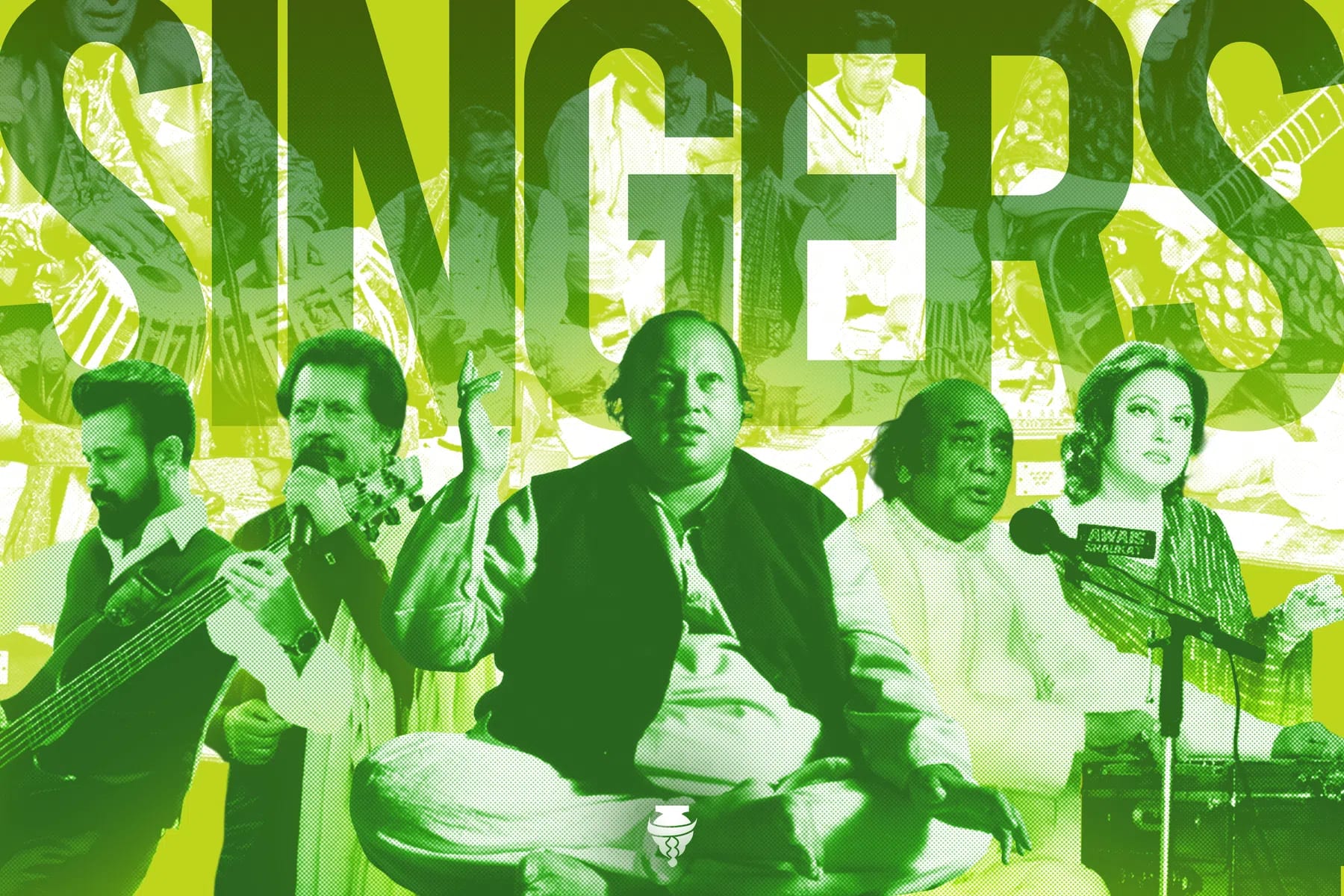

Pakistan's musical heritage runs centuries deep, long before the country even had borders on a map.
What emerged after 1947 was something extraordinary: a tradition that fused Sufi devotion, Mughal-era classical training, Punjabi folk energy, and eventually Western pop and rock into a sound no other country on earth could replicate.
The country's music is a blend of various influences, including Persian, Arabic, Punjabi, Sindhi, and Afghan. Folk music is particularly popular and is often used to tell stories or express emotions, while Sufi music also carries deep significance as a form of religious expression.
This list ranks the 15 most popular Pakistani singers of all time, measured by a combination of cultural impact, global reach, critical recognition, commercial success, and lasting influence across generations. We have not restricted this to a single genre.
Qawwals sit alongside pop icons, ghazal masters share space with Bollywood crossover hitmakers, and female powerhouses stand equal to male legends. Every entry includes genre, birth details, and the kind of specific facts that fans and researchers actually search for.
Start with the quick-reference table for a scan, then read more deeply into whatever grabs your attention.
| # | Singer | Primary Genre | Born | Notable For |
|---|---|---|---|---|
| 1 | Nusrat Fateh Ali Khan | Qawwali, Sufi, World | Oct 13, 1948, Faisalabad | "King of Kings of Qawwali"; Rolling Stone's 200 Greatest Singers |
| 2 | Mehdi Hassan | Ghazal, Film Playback | Jul 18, 1927, Luna, Rajasthan (British India) | "Emperor of Ghazal"; Nishan-e-Imtiaz recipient |
| 3 | Madam Noor Jahan | Film Playback, Ghazal | Sep 21, 1926, Kasur, Punjab (British India) | "Malika-e-Tarannum"; seven-decade career |
| 4 | Abida Parveen | Sufi, Classical, Ghazal | 1954, Larkana, Sindh | Pakistan's foremost female Sufi vocalist |
| 5 | Atif Aslam | Pop, Rock, Filmi | Mar 12, 1983, Wazirabad, Punjab | Top streaming Pakistani artist globally |
| 6 | Rahat Fateh Ali Khan | Qawwali, Filmi, Pop | Dec 9, 1974, Faisalabad | Nusrat's nephew; one of Pakistan's highest-paid singers |
| 7 | Nazia Hassan | Disco Pop, Filmi | Apr 3, 1965, Karachi | Pioneer of South Asian pop; Disco Deewane |
| 8 | Ali Zafar | Pop, Rock, Filmi | May 18, 1980, Lahore | "Prince of Pakistani Pop"; actor-painter-musician |
| 9 | Junaid Jamshed | Pop, Nasheed | Sep 3, 1964, Karachi | Vital Signs frontman turned spiritual icon |
| 10 | Alamgir | Pop | Nov 21, 1955, Dhaka (then East Pakistan) | One of the pioneers of modern Pakistani pop |
| 11 | Abrar-ul-Haq | Pop, Bhangra, Punjabi Folk | Jul 21, 1969, Faisalabad | Billo De Ghar phenomenon; philanthropist |
| 12 | Hadiqa Kiani | Pop, Sufi, Classical | Aug 11, 1974, Rawalpindi | Coke Studio stalwart; UNICEF Goodwill Ambassador |
| 13 | Sajjad Ali | Pop, Ghazal, Classical | Nov 2, 1966, Karachi | Multi-instrumentalist; child prodigy turned icon |
| 14 | Momina Mustehsan | Pop, Acoustic | Sep 5, 1992, Lahore | Coke Studio breakout; BBC 100 Women |
| 15 | Attaullah Khan Esakhelvi | Folk, Ghazal | Aug 19, 1951, Isakhel, Mianwali | "King of Saraiki Folk"; 50,000+ songs catalog |
1. Nusrat Fateh Ali Khan

No conversation about Pakistani music, or about great singing in general, begins anywhere else.
Born Pervez Fateh Ali Khan on October 13, 1948, in Lyallpur (now Faisalabad), he was a singer, songwriter, and music director primarily associated with qawwali, the devotional music tradition of Sufi Islam. His ancestors had been musicians for almost 600 years, a lineage so deep that music was less a career choice than a bloodline inheritance.
What makes his story genuinely remarkable is that his father initially wanted him to pursue medicine or engineering, viewing the qawwali profession as socially beneath the family's potential. Fate had other plans.
His qawwali career began after singing at his father's funeral in 1964, and he gave his first public performance as a qawwal in 1966, singing alongside his uncles. What followed was three decades of relentless reinvention. He didn't just preserve qawwali; he cracked it open, speeding up tempos, layering sargam and khayal vocal techniques, and collaborating across cultural lines that no Pakistani artist had crossed before.
He gained international fame performing in the United Kingdom in 1985, touring the United States in 1989, and contributing to Hollywood film soundtracks in the 1990s, collaborating with artists such as Peter Gabriel and Michael Brook. He has been recognised among the 50 Great Voices by NPR and the 200 Greatest Singers of All Time by Rolling Stone.
He died on August 16, 1997, in London, at just 48. Even after death, his Qawwalis and Sufi tracks remain among the most popular songs during wedding seasons and family gatherings, keeping him at the top of all-time streaming lists.
Key Facts
Full Name: Pervez Fateh Ali Khan
Born: October 13, 1948, Faisalabad, Punjab, Pakistan
Died: August 16, 1997, London, England (cardiac arrest, age 48)
Genres: Qawwali, Sufi, Classical, Folk (Punjabi), World
Title: Shahenshah-e-Qawwali ("King of Kings of Qawwali")
Labels: Real World Records, OSA, EMI, Virgin Records
Notable Collaborators: Peter Gabriel, Michael Brook, Eddie Vedder
Awards: Pride of Performance (Government of Pakistan); UNESCO Music Prize (1995)
Signature Works: Afreen Afreen, Allah Hoo, Dum Mast Qalandar, Mustt Mustt
Legacy: Family musical lineage spanning 600+ years; nephew Rahat Fateh Ali Khan carries the tradition
2. Mehdi Hassan

If Nusrat Fateh Ali Khan was the spiritual storm of Pakistani music, Mehdi Hassan was its quietly devastating opposite: a voice so controlled, so deeply rooted in classical raga, that a single held note could empty a room of conversation. He was a Pakistani ghazal singer, famously called the "King of Ghazal" or "Shahanshah-e-Ghazal," known for his deep and husky baritone voice.
Born into a musical family, he was naturally inclined towards the art from a young age. He claimed to belong to the 16th generation of hereditary musicians hailing from the Kalawant clan. That heritage nearly evaporated during the 1947 Partition: he started performing at an early age and seemed headed for a successful musical career when the partition of India happened, forcing his family to migrate to Pakistan, where they suffered severe financial hardships.
He worked as a mechanic and a bicycle-shop laborer before music could feed him again.
In 1957, Hassan was allowed to sing on Radio Pakistan, primarily as a thumri singer and later as a ghazal performer, which earned him recognition within the musical fraternity. From there, he became arguably the most important voice in Pakistani cinema's golden era. It is estimated that Hassan sang for over 300 films during his career.
Legendary Indian singer Lata Mangeshkar once likened his songs to the "voice of god."
Key Facts
Full Name: Mehdi Hassan Khan
Born: July 18, 1927, Luna, Rajasthan, British India (conflicting reports place the year at 1927, 1931, or 1933)
Died: June 13, 2012, Karachi, Pakistan
Genres: Ghazal, Classical (Thumri, Dhrupad), Film Playback
Title: Shahenshah-e-Ghazal ("Emperor of Ghazal")
Awards: Nishan-e-Imtiaz, Hilal-e-Imtiaz, Tamgha-e-Imtiaz, Pride of Performance
Films: Sang for over 300 Lollywood productions
Heritage: 16th generation of Kalawant clan hereditary musicians
Signature Works: Ranjish Hi Sahi, Gulon Mein Rang Bhare, Zindagi Mein To Sabhi Pyar Kiya Karte Hain
3. Madam Noor Jahan

Very few artists in any country's history have spanned seven decades while staying relevant through every single one.
Madam Noor Jahan was a legendary singer and actress in British India and Pakistan whose career spanned more than six decades. She was renowned as one of the greatest and most influential singers of her time in South Asia and was given the honorific title of Malika-e-Tarannum, meaning "the Queen of Melody."
Born Allah Wasai on September 21, 1926, in Kasur, Punjab (then British India), she performed her first film song as a child in 1935. She became a major Bollywood presence in the 1940s before moving to Pakistan after Partition, where she redefined what playback singing could be. Noor Jahan didn't just sing in front of orchestras; she commanded them. Her voice carried patriotic anthems during the 1965 war with India, rallying an entire nation's morale.
She recorded an estimated 10,000 songs across her career in Urdu, Punjabi, Sindhi, Pashto, and Bengali.
What distinguished her from other playback singers was range: ghazals, folk, film songs, patriotic ballads, classical pieces. She refused to be categorized. Her death on December 23, 2000, in Karachi prompted a national mourning period that revealed just how embedded her voice had become in Pakistan's self-identity.
Key Facts
Full Name: Allah Wasai (later Noor Jahan)
Born: September 21, 1926, Kasur, Punjab, British India
Died: December 23, 2000, Karachi, Pakistan
Genres: Film Playback, Ghazal, Folk, Patriotic, Classical
Title: Malika-e-Tarannum ("Queen of Melody")
Languages Sung In: Urdu, Punjabi, Sindhi, Pashto, Bengali
Estimated Songs: Approximately 10,000 recordings
Awards: Pride of Performance (1957); Nigar Award (multiple years)
Notable Fact: Sang morale-boosting songs during the 1965 India-Pakistan war that became national anthems of resilience
Bollywood Connection: Starred in and sang for Bollywood films in the 1940s before Partition
4. Abida Parveen

Ranking a living legend is tricky. You can't summarize a career that's still unfolding.
Yet Abida Parveen stands so far above the field in Sufi music that excluding her from any top-five conversation would be dishonest. Among singers born in Pakistan, Pantheon ranks her alongside the most globally recognized names the country has ever produced.
Born in 1954 in Larkana, Sindh, she grew up learning from her father, Ustad Ghulam Haider, himself a well-known Sufi singer and music teacher. Sindh's mystical poetry tradition, rooted in the works of Shah Abdul Latif Bhittai and Sachal Sarmast, flows through every note she delivers.
Her voice isn't technical in the conservatory sense; it's volcanic. Parveen can hold a stadium full of thousands in silence with a single phrase, then escalate into a controlled ecstasy that leaves audiences weeping.
She has performed at venues from the Barbican Centre in London to the Kennedy Center in Washington, D.C. Coke Studio, the Pakistani music platform that reshaped how the world heard South Asian music, featured her across multiple seasons, producing some of the show's most-viewed episodes.
Unlike many of her peers, she sings equally in Urdu, Sindhi, Saraiki, and Punjabi, which gives her a cross-regional popularity inside Pakistan that few other artists can match.
Key Facts
Full Name: Abida Parveen
Born: 1954, Larkana, Sindh, Pakistan
Genres: Sufi, Classical, Ghazal, Folk
Languages: Urdu, Sindhi, Saraiki, Punjabi
Teacher: Ustad Ghulam Haider (her father)
Awards: Hilal-e-Imtiaz; Pride of Performance; multiple Nigar Awards
International Venues: Barbican Centre (London), Kennedy Center (D.C.), multiple world tours
Coke Studio: Featured across multiple seasons; among the platform's most-viewed artists
Signature Works: Yaar Ko Hamne Ja Ba Ja Dekha, Chaap Tilak, Ghoom Charakhra
5. Atif Aslam

If streaming numbers told the whole story, the argument would be over before it started.
Atif Aslam is still the gold standard; whether it is a soulful ballad or a huge energy track, he has the ability to appeal to millions of views within hours on Spotify and YouTube. But the numbers only confirm what his voice already proved: a raw, cracked-edge texture that sounds like nobody else on either side of the India-Pakistan border.
Born on March 12, 1983, in Wazirabad, Punjab, Muhammad Atif Aslam broke through with Aadat in the early 2000s, a track initially recorded with his band Jal before a split sent him solo. He made his film debut in the 2011 social drama Bol, which received critical acclaim and was a box-office success in Pakistan.
Bollywood absorbed him eagerly; he became one of the rare Pakistani artists to sing consistently for major Hindi films through the 2000s and 2010s, contributing playback vocals to blockbusters before geopolitical tensions complicated cross-border collaboration.
His Coke Studio appearances have generated some of the platform's highest view counts, and he remains one of Pakistan's most internationally recognized musicians.
His voice is immediately identifiable: a slightly nasal, emotionally charged delivery that works as well on Sufi-inflected tracks as on pop anthems.
Key Facts
Full Name: Muhammad Atif Aslam
Born: March 12, 1983, Wazirabad, Punjab, Pakistan
Genres: Pop, Rock, Sufi Rock, Filmi
Breakthrough: Aadat (early 2000s, initially with band Jal)
Bollywood: Sang playback for numerous Hindi films, including Race, Ajab Prem Ki Ghazab Kahani, Prince
Acting Debut: Bol (2011)
Awards: Multiple Lux Style Awards; Tamgha-e-Imtiaz (2008)
Streaming: One of the most internationally streamed Pakistani artists on Spotify and YouTube
Coke Studio: Featured across multiple seasons; among the show's most-viewed performers
6. Rahat Fateh Ali Khan

Carrying the surname of the greatest qawwal in history could have been a burden that crushed any lesser artist.
Rahat Fateh Ali Khan turned it into a launching pad. Atif Aslam, Rahat Fateh Ali Khan, and Ali Zafar are considered modern-day greats, with Rahat being the highest-paid artist. For good reason: one of his songs has over 1.3 billion views on YouTube.
Born December 9, 1974, in Faisalabad, he began training under his uncle Nusrat Fateh Ali Khan at the age of seven and joined his uncle's qawwali party as a teenager. After Nusrat's death in 1997, the weight of the entire qawwali legacy landed on his shoulders. Rather than retreating into tradition, Rahat stretched into Bollywood playback, romantic pop, and cinematic soundscapes, becoming one of Bollywood's most sought-after voices throughout the 2000s and 2010s.
Tracks like O Re Piya from Aaja Nachle and Tere Mast Mast Do Nain from Dabangg became chart-toppers across South Asia.
His ability to pivot between raw, traditional qawwali settings and polished studio productions has kept him relevant across generational shifts in listener habits. His Qawwalis and Sufi tracks remain among the most popular songs during wedding seasons and family gatherings, keeping him at the top of all-time streaming lists.
Key Facts
Full Name: Rahat Fateh Ali Khan
Born: December 9, 1973, Faisalabad, Punjab, Pakistan
Genres: Qawwali, Sufi, Filmi, Pop, Semi-Classical
Training: Under uncle Nusrat Fateh Ali Khan from age seven
Bollywood: Playback for Dabangg, Aaja Nachle, Cocktail, Agent Vinod, and dozens more
Awards: Filmfare Award for Best Playback Singer (multiple); Pride of Performance
YouTube Milestone: Single song surpassing 1.3 billion views
Signature Works: O Re Piya, Tere Mast Mast Do Nain, Zaroori Tha, Afreen Afreen (Coke Studio)
7. Nazia Hassan

She was fifteen years old when she changed everything.
Her song "Aap Jaisa Koi" from the Indian film Qurbani (1980) made her a legend and pop icon in Pakistan and all of South Asia, and her debut album Disco Deewane (1981) charted in fourteen countries worldwide, becoming the best-selling Asian pop record up until that time. Born April 3, 1965, in Karachi, Nazia Hassan didn't just introduce pop music to Pakistan; she gave the entire subcontinent permission to dance to it.
Working alongside her brother Zoheb Hassan, she released a string of records through the 1980s that sold staggering numbers: some estimates place the combined total at over 60 million copies worldwide. The Pakistani pop movement had emerged in the 1980s, led by musicians such as Nazia Hassan, Alamgir, and Vital Signs. But Nazia was the figure who gave the genre its first truly international hit.
She was also a qualified lawyer and political analyst, with degrees from Richmond University and the University of London.
Her death on August 13, 2000, at age 35, from cancer, cut short a life that had already accomplished more than most artists manage in twice the time. The Pakistani government awarded her the Pride of Performance posthumously in 2002.
Key Facts
Full Name: Nazia Hassan
Born: April 3, 1965, Karachi, Sindh, Pakistan
Died: August 13, 2000, London, England (cancer, age 35)
Genres: Disco Pop, Filmi, Synth-Pop
Breakthrough: Aap Jaisa Koi from Qurbani (1980), recorded at age 15
Record Sales: Estimated 60+ million copies worldwide (with Zoheb Hassan)
Education: Law degree (University of London); degree from Richmond University
Awards: Pride of Performance (2002, posthumous)
Signature Works: Aap Jaisa Koi, Disco Deewane, Boom Boom, Dosti
8. Ali Zafar

Most artists struggle to master one discipline.
Ali Zafar is not only a singer, but a songwriter, actor, and painter as well. Born in Lahore, he is known as the "Prince of Pakistani Pop" and trained at the National College of Arts before attending Government College University, Lahore. His artistic education actually started in painting; music came second, which may explain why his approach to pop has always felt more visual and cinematic than his contemporaries.
His self-titled debut album in 2003 contained Channo, a track that became one of the biggest-selling singles in Pakistani pop history. From there, Zafar crossed into Bollywood acting, starring in Tere Bin Laden (2010), Mere Brother Ki Dulhan (2011), and Kill Dil (2014).
He managed something rare: genuine commercial traction as both a leading man and a soundtrack voice in India, at a time when very few Pakistani artists were doing both.
His genre range spans pop, rock, electronic, folk, classical, Sufi, and filmi. He received the Pride of Performance from the Government of Pakistan in 2021, and his Coke Studio collaborations remain among the platform's most replayed entries.
Key Facts
Full Name: Ali Zafar
Born: May 18, 1980, Lahore, Punjab, Pakistan
Genres: Pop, Rock, Electronic, Folk, Sufi, Filmi
Title: Prince of Pakistani Pop
Education: National College of Arts; Government College University, Lahore
Bollywood Films: Tere Bin Laden, Mere Brother Ki Dulhan, Kill Dil, Dear Zindagi
Awards: Pride of Performance (2021); Lux Style Awards (multiple); Filmfare nominations
Labels: Universal Music, Sony Music, T-Series, YRF Music, among others
Signature Works: Channo, Rangeen, Rockstar, Jhoom
9. Junaid Jamshed

No Pakistani artist has lived two lives as dramatically different as Junaid Jamshed.
Born September 3, 1964, in Karachi, he rocketed to fame as the lead vocalist of Vital Signs, the band whose 1987 track Dil Dil Pakistan became an unofficial national anthem. That single song turned the Vital Signs into one of the most commercially successful bands in Pakistani history and put Jamshed's face on every magazine in the country.
The Vital Signs were among the musicians who led the Pakistani pop movement. Jamshed's solo career through the 1990s produced hits like Us Rah Par and Sanwali Saloni, and he was routinely called the biggest male pop star Pakistan had ever produced. Then, in the early 2000s, he stepped away from music entirely. He publicly embraced a more conservative interpretation of Islam, stopped performing, and became a prominent religious figure, launching the clothing brand J. and recording naats (devotional hymns).
The transformation was complete and permanent.
Jamshed died on December 7, 2016, in the PIA Flight 661 crash near Havelian. His death united both halves of his public legacy: fans who loved Dil Dil Pakistan and followers who revered his religious work mourned the same man.
Key Facts
Full Name: Junaid Jamshed
Born: September 3, 1964, Karachi, Sindh, Pakistan
Died: December 7, 2016, Havelian, Khyber Pakhtunkhwa (PIA Flight 661 crash, age 52)
Genres: Pop, Rock (with Vital Signs); Nasheed (solo, post-2000s)
Band: Vital Signs (lead vocalist)
Career Shift: Left music in the early 2000s for religious ministry and nasheed recording
Business: Launched the J. clothing brand
Awards: Graduate of UET Lahore (engineering background)
Signature Works: Dil Dil Pakistan (Vital Signs), Us Rah Par, Sanwali Saloni
10. Alamgir

Before Nazia Hassan's disco, before the Vital Signs' rock anthems, before Coke Studio existed as a concept, there was Alamgir.
Alamgir was considered one of the earliest pioneers of pop in Pakistan, leading to a pop revolution in the country. Born November 21, 1955, in Dhaka (then East Pakistan), he moved to Karachi and grew up in a country that had virtually no tradition of Urdu-language pop music.
He started singing on the Pakistan Television Corporation at the beginning of the 1970s, when the people in Pakistan were not yet familiar with modern Urdu pop music. Shair Siddiqui hired him for the first pop musical program, Sunday Ke Sunday, a TV series of Karachi Television in 1971, introducing Alamgir with the song Albela Rahi.
It proved to be a hit in 1972 among the youth. His second pop song, Pyar Hai Zindagi Ka Gehna, was also an Urdu translation of a foreign song, and he soon became popular among the younger generation in the country.
There was a time during the 1970s when music-loving boys and girls gathered regularly on the streets near the Karachi Jheel Park to catch a glimpse of this pop singer as he traveled along in his red sedan in the evening. That kind of fan hysteria simply did not exist in Pakistan before him. He didn't just popularize pop. He proved that it was possible.
Key Facts
Full Name: Alamgir (stage name)
Born: November 21, 1955, Dhaka, East Pakistan (now Bangladesh)
Genres: Pop, Urdu Pop
Breakthrough: Albela Rahi (1971/1972, PTV debut)
Historical Role: Pioneer of Pakistani pop and Urdu pop on television
Known For: Bengali renditions alongside Urdu pop; Aamay Bhashaili Rey
Legacy: Directly influenced Nazia Hassan, Vital Signs, and the entire 1980s/1990s pop wave
Awards: Pride of Performance
11. Abrar-ul-Haq

Some artists build a career on technical precision.
Abrar-ul-Haq built his on pure, infectious energy. His debut 1995 album Billo De Ghar is widely reported to have sold millions of copies worldwide, which made him a household name and granted him the title of "King of Pakistani pop and bhangra." (Note: one source reports sales above 40 million; the figure remains disputed, but even the lower estimate makes it one of the best-selling Pakistani albums ever.)
Born on July 21, 1969, in Faisalabad, Punjab, to a civil servant father, he is the youngest among eight siblings and belongs to a Punjabi Jat family of the Kahlon clan. Before music, he pursued academics seriously, graduating from Sir Syed College, Rawalpindi, before earning a Master's degree in social sciences from Quaid-i-Azam University, Islamabad.
What separates him from most pop artists is the humanitarian dimension. He is the founder and chairman of the Sahara for Life Trust, a private organization that has been providing health services to the people of Narowal and surrounding areas since 1998.
He also entered politics as Pakistan Tehreek-e-Insaf's candidate for the National Assembly from constituency NA-78 in the 2018 general election.
Key Facts
Full Name: Abrar-ul-Haq
Born: July 21, 1969, Faisalabad, Punjab, Pakistan
Genres: Pop, Bhangra, Punjabi Folk
Title: King of Pakistani Pop and Bhangra
Education: Master's degree in Social Sciences, Quaid-i-Azam University
Debut Album: Billo De Ghar (1995; Reported sales figures vary considerably between sources.)
Philanthropy: Founded Sahara for Life Trust (1998); health services across Narowal district
Political Career: PTI candidate, NA-78, 2018 elections
Signature Works: Billo De Ghar, Nach Punjaban, Preeto
12. Hadiqa Kiani

Hadiqa Kiani occupies a category that has too few members: Pakistani female artists who broke through commercially and stayed at the top for decades rather than fading after an initial wave of attention.
Born August 11, 1974, in Rawalpindi, she won national singing competitions as a teenager and released her debut album Raaz in 1995, at a time when female pop artists in Pakistan could be counted on one hand.
Her career arc covers pop, Sufi, and classical territory. She's performed in Urdu, Punjabi, Pashto, Turkish, and Persian, giving her a linguistic range that matches her vocal one. UNICEF appointed her as a National Goodwill Ambassador for Pakistan, and her humanitarian work in flood-affected areas gave her a public presence that extended well beyond music stages.
In Coke Studio, she delivered some of the franchise's most memorable performances. Her acting career, particularly in the drama Dobara, expanded her creative profile further.
Kiani doesn't get mentioned as often as Atif Aslam or Rahat Fateh Ali Khan in international conversations, which is a gap that says more about the industry's gender dynamics than about her talent.
Key Facts
Full Name: Hadiqa Kiani
Born: August 11, 1974, Rawalpindi, Punjab, Pakistan
Genres: Pop, Sufi, Classical, Folk
Languages: Urdu, Punjabi, Pashto, Turkish, Persian
Debut Album: Raaz (1995)
UNICEF Role: National Goodwill Ambassador for Pakistan
Acting: Lead role in drama serial Dobara
Awards: Multiple Lux Style Awards; Pride of Performance
Signature Works: Boohey Barian, Jaanan, Kamli (Coke Studio)
13. Sajjad Ali

Sajjad Ali is one of those rare musicians whose critical respect and commercial reach never forced him to choose between them.
Born November 2, 1966, in Karachi, Sajjad Ali was a child prodigy who received classical music training from his uncle, Tassaduq Hussain. His father, Shafqat Hussain (Sajan), was a film actor and cricketer. He made his first appearance on Pakistan Television at the age of eight. His brother, Waqar Ali, is also a recognized musician, but it was Sajjad who turned his early training into a pop-adjacent career that spanned four decades without ever losing its classical center.
His 1991 hit Babia became one of the most-played tracks in Pakistani pop history, blending classical vocal runs with Western pop production in a way that nobody else was attempting at the time. Later records moved between ghazal, pop, and experimental territory.
Sohni Lagdi, Panchi, and Har Zulm each sounded like the work of a different artist entirely, which is exactly the point: he never repeated himself.
He relocated to Dubai and later to the United States but continued releasing music. His 2020s return to regular releases, including viral hits, proved that his voice has aged into something richer rather than diminished.
Key Facts
Full Name: Sajjad Ali
Born: November 2, 1966, Karachi, Sindh, Pakistan
Genres: Pop, Ghazal, Classical, Semi-Classical
Training: Classical vocal training under Ustad Hamid Ali Khan
First TV Appearance: Age eight, Pakistan Television
Awards: Multiple Nigar Awards; Graduate of Karachi's music circuits
Current Residence: Has lived in Dubai and the United States
Signature Works: Babia, Sohni Lagdi, Panchi, Har Zulm, Lagaya Dil
14. Momina Mustehsan

Coke Studio became one of the most influential Pakistani music platforms of the 21st century, but few Pakistani artists experienced a breakthrough as rapid as Momina Mustehsan's.
Born September 5, 1992, in Lahore, she was a biomedical engineering student at Stony Brook University in New York when her Coke Studio Season 9 duet Afreen Afreen with Rahat Fateh Ali Khan exploded in 2016, accumulating hundreds of millions of YouTube views and turning her into a household name overnight.
In recent years, Pakistani pop music has seen a revival, with new artists such as Atif Aslam, Ali Zafar, and Momina Mustehsan making waves both nationally and internationally. Mustehsan's appeal rested on a combination of factors that the traditional Pakistani music industry had not packaged together before: a trained soprano-range voice, fluency in English and Urdu, a STEM academic background, and a social media presence that resonated with young South Asian women globally.
BBC named her among its 100 Women list, and Forbes Pakistan profiled her as a symbol of millennial female achievement across disciplines.
She's released additional solo tracks and collaborative singles, though none matched the seismic impact of Afreen Afreen. Mustehsan has been open about her desire to balance music with advocacy and academic pursuits, which makes her profile distinctly different from career-only musicians.
Key Facts
Full Name: Momina Mustehsan
Born: September 5, 1992, Lahore, Punjab, Pakistan
Genres: Pop, Acoustic, Sufi-Pop
Education: Biomedical Engineering, Stony Brook University, New York
Breakthrough: Afreen Afreen (Coke Studio Season 9, 2016, with Rahat Fateh Ali Khan)
Recognition: BBC 100 Women list; Forbes Pakistan profile
Awards: Lux Style Award nominations
Signature Works: Afreen Afreen (Coke Studio), Awari (Ek Villain soundtrack), Tera Woh Pyar
15. Attaullah Khan Esakhelvi

Numbers in music often get inflated by publicists, but Attaullah Khan Esakhelvi's catalog is so enormous that even conservative estimates beggar belief: upwards of 50,000 songs across a career that began in the mid-1970s.
Born August 19, 1951, in Isakhel, Mianwali, in Punjab's remote northwestern belt, he sang in a raw, emotionally direct style rooted in Saraiki and Punjabi folk traditions that connected with rural and working-class audiences across Pakistan in a way that no polished studio artist could replicate.
His voice isn't polished. It doesn't need to be. Esakhelvi's strength is the emotional truth he brings to songs about heartbreak, separation, and the hard edges of life in Punjab's smaller towns. He performed in a 'mega concert' arranged by the Pakistan National Council of the Arts in Islamabad alongside other folk artists.
His fan base stretches from Pakistani truck drivers who blast his cassettes on long-haul routes to diaspora communities in the UK and the Middle East who play his music at every wedding and gathering.
Esakhelvi never crossed into Bollywood, never chased a pop makeover, and never needed to. His audience found him on their own terms. That kind of organic, unmanufactured popularity, sustained over nearly five decades, is its own kind of extraordinary.
Key Facts
Full Name: Attaullah Khan Esakhelvi
Born: August 19, 1951, Isakhel, Mianwali, Punjab, Pakistan
Genres: Saraiki Folk, Punjabi Folk, Ghazal
Catalog: Estimated 50,000+ songs
Languages: Saraiki, Punjabi, Urdu
Awards: Pride of Performance (Government of Pakistan)
Audience Base: Rural Punjab, Pakistani truck-driving community, UK/Middle East diaspora
Signature Works: Idhar Zindagi Ka Janaza Uthega, Koi Rohi Yaad Karendi, Pyar Naal Na Sahi
Pakistani Singers in Bollywood
One of the most frequently searched topics around Pakistani music is which artists sang for Bollywood films.
The answer reveals something deeper about the subcontinent's cultural connections: regardless of political tensions, music has repeatedly crossed the India-Pakistan border when little else could. Nusrat Fateh Ali Khan provided soundtracks for Indian films in the 1990s. Rahat Fateh Ali Khan became one of the most prolific Pakistani playback voices in Hindi cinema, recording for dozens of Bollywood productions.
Atif Aslam's Bollywood catalog includes some of his most globally streamed tracks. Ali Zafar appeared as both an actor and singer in multiple Yash Raj and other major Hindi productions. Nazia Hassan's career literally launched through a Bollywood film.
Even after the 2016 restrictions on cross-border artistic collaboration, these recordings continue generating billions of streams, proving that borders may limit visas but not playlists.
The Streaming Revolution and Pakistan's Shifting Musical Landscape
Pakistani singers in 2026 continue to dominate streaming platforms, with digital streaming services opening new avenues for local artists, and the country's music industry seeing phenomenal growth in recent years.
What's changed is who benefits most. The old guard still rules long-tail listening: Nusrat's qawwalis spike every Ramadan and wedding season; Mehdi Hassan's ghazals remain the go-to for late-night reflection playlists. But when it comes to Gen-Z Pakistani music, Young Stunners, the duo of Talha Anjum and Talhah Yunus, have transformed Urdu rap and represent an entirely new lane.
In 2026, Pakistani hip-hop experienced a huge rise in growth.
The coexistence is the point. A country where a 600-year-old qawwali lineage can top the same streaming charts as a trap-beat rapper is a country whose musical identity refuses to sit still. That restlessness, that refusal to be just one thing, is what has always made Pakistani music worth paying attention to.
Frequently Asked Questions
Who is the most popular singer in Pakistan of all time?
Nusrat Fateh Ali Khan is widely regarded as one of Pakistan's most internationally acclaimed singers and is known as the Shahenshah-e-Qawwali (King of Kings of Qawwali). He was included in Rolling Stone's 200 Greatest Singers of All Time list, while his family has a musical tradition spanning more than 600 years.
Who are the top 10 Pakistani male singers?
Among the most influential and popular Pakistani male singers are Nusrat Fateh Ali Khan, Mehdi Hassan, Atif Aslam, Rahat Fateh Ali Khan, Ali Zafar, Junaid Jamshed, Alamgir, Abrar-ul-Haq, Sajjad Ali, and Attaullah Khan Esakhelvi, representing qawwali, ghazal, pop, folk, and bhangra.
Who is the king of Pakistani pop?
Abrar-ul-Haq is widely associated with the title King of Pakistani Pop and Bhangra, while Ali Zafar is known as the Prince of Pakistani Pop. Alamgir is regarded as one of the pioneers of modern Pakistani pop and helped popularize the genre through television in the early 1970s.
Which Pakistani singers have sung in Bollywood?
Several Pakistani singers have worked in Hindi cinema. Nusrat Fateh Ali Khan contributed to Indian film projects in the 1990s, Rahat Fateh Ali Khan became a prominent Bollywood playback singer, Atif Aslam recorded songs for films including Race, Ali Zafar acted and sang in Bollywood productions, and Nazia Hassan achieved her major breakthrough with the song Aap Jaisa Koi from the 1980 film Qurbani.
Who are the most famous female Pakistani singers?
Among the most influential Pakistani female singers are Madam Noor Jahan, known as Malika-e-Tarannum (Queen of Melody), Abida Parveen, Nazia Hassan, Hadiqa Kiani, and Momina Mustehsan. Noor Jahan is widely reported to have recorded around 10,000 songs, while Abida Parveen is internationally renowned for her Sufi music.
Who is the highest-paid Pakistani singer right now?
There is no reliable public ranking that establishes which Pakistani singer is the highest-paid in 2026. Rahat Fateh Ali Khan and Atif Aslam are among Pakistan's most commercially successful singers, with major audiences and international music careers, but publicly available streaming figures do not establish their exact earnings or ranking by pay.
What is Coke Studio and which Pakistani singers performed on it?
Coke Studio is a Pakistani music television and recording platform known for bringing together established and emerging artists in collaborative performances. Pakistani singers who have appeared on the platform include Abida Parveen, Atif Aslam, Rahat Fateh Ali Khan, Ali Zafar, Hadiqa Kiani, and Momina Mustehsan. Momina Mustehsan and Asim Azhar's 2016 rendition of Afreen Afreen became one of Coke Studio's most widely viewed performances.
Which Pakistani singer has recorded the most songs ever?
Attaullah Khan Esakhelvi is widely credited with recording more than 50,000 songs, making him one of the most prolific Pakistani singers. Madam Noor Jahan is also widely reported to have recorded around 10,000 songs during her career, making both singers notable for exceptionally large recorded catalogues.
Check topics and authors from this story to see more stories like this in your personalized feed and receive updates when new work is published.


