
Skip to content
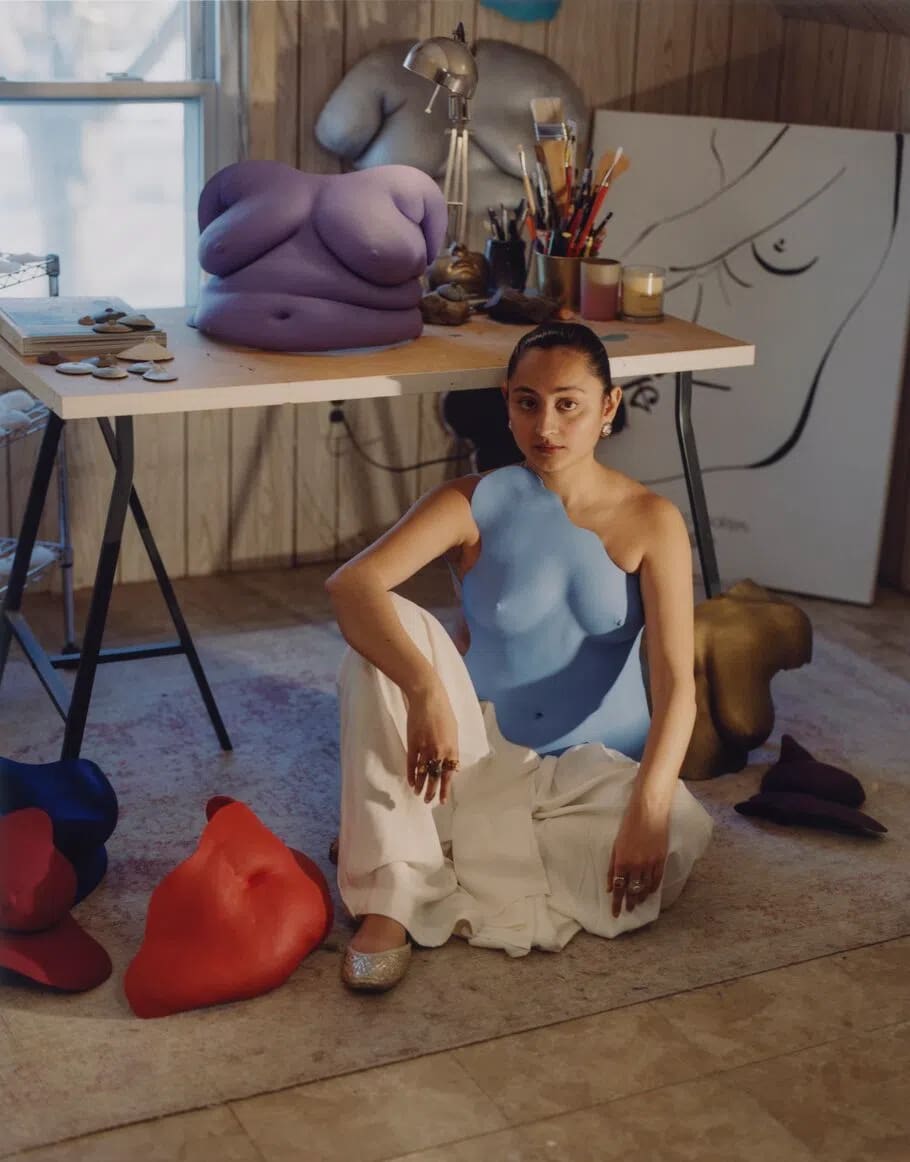
In this portrait, the Pakistani artist and fashion designer Misha Japanwala sits on the floor of her art studio surrounded by several of her signature, handcrafted body-cast sculptures. She is positioned centrally, looking directly at the camera while wearing white, wide-leg trousers and a striking, asymmetrical sky-blue resin breastplate molded to her torso. Behind her stands a light-wood work desk covered with art supplies, including a jar of paintbrushes and candles, and topped by a large, lavender-colored sculptural torso. Propped against the wall behind the desk is a large canvas featuring a minimalist black-and-white calligraphic silhouette drawing. Scattered around her on the floor are additional sculpted anatomical forms in bold shades of red, dark blue, gold, and dark purple, highlighting her unique creative practice that explores themes of bodily autonomy and the deconstruction of shame.

Artist Misha Japanwala sits on her studio floor modeling a custom sky-blue breastplate amid her anatomical sculptures. Lindsay Perryman/Hannah Traore Gallery

Pakistani Artist Misha Japanwala Joins Oscar Selection Panel

The visual artist behind sculptural pieces in Christopher Nolan's 'The Odyssey' adds her voice to the group that chose 'Hanging by a Wire' as the country's 2027 entry

Pakistan keeps pressing for stronger Oscar visibility after years of limited traction in the international feature race. This year's selection process brought a notable mix of voices to the table, including visual artist Misha Japanwala.

Japanwala joined the Pakistan Academy Selection Committee for the 2026 cycle. Deputy chairperson Sana Zahra Jafri led the panel. Other members included veteran actors Marina Khan and Hina Khawaja Bayat, directors Nabeel Qureshi and Shahzad Rafique, producer Badar Ikram, and actor-influencer Tamkenat Mansoor.

The group selected Mohammed Ali Naqvi's documentary Hanging by a Wire as Pakistan's official entry for Best International Feature Film at the 99th Academy Awards. It marks the first time the country has put forward a documentary in the category.

The film revisits the 2023 cable car rescue in Battagram, where schoolchildren and adults hung hundreds of feet above a ravine. It blends real footage with reconstructions and premiered at Sundance.
Advertisement

Advertisement

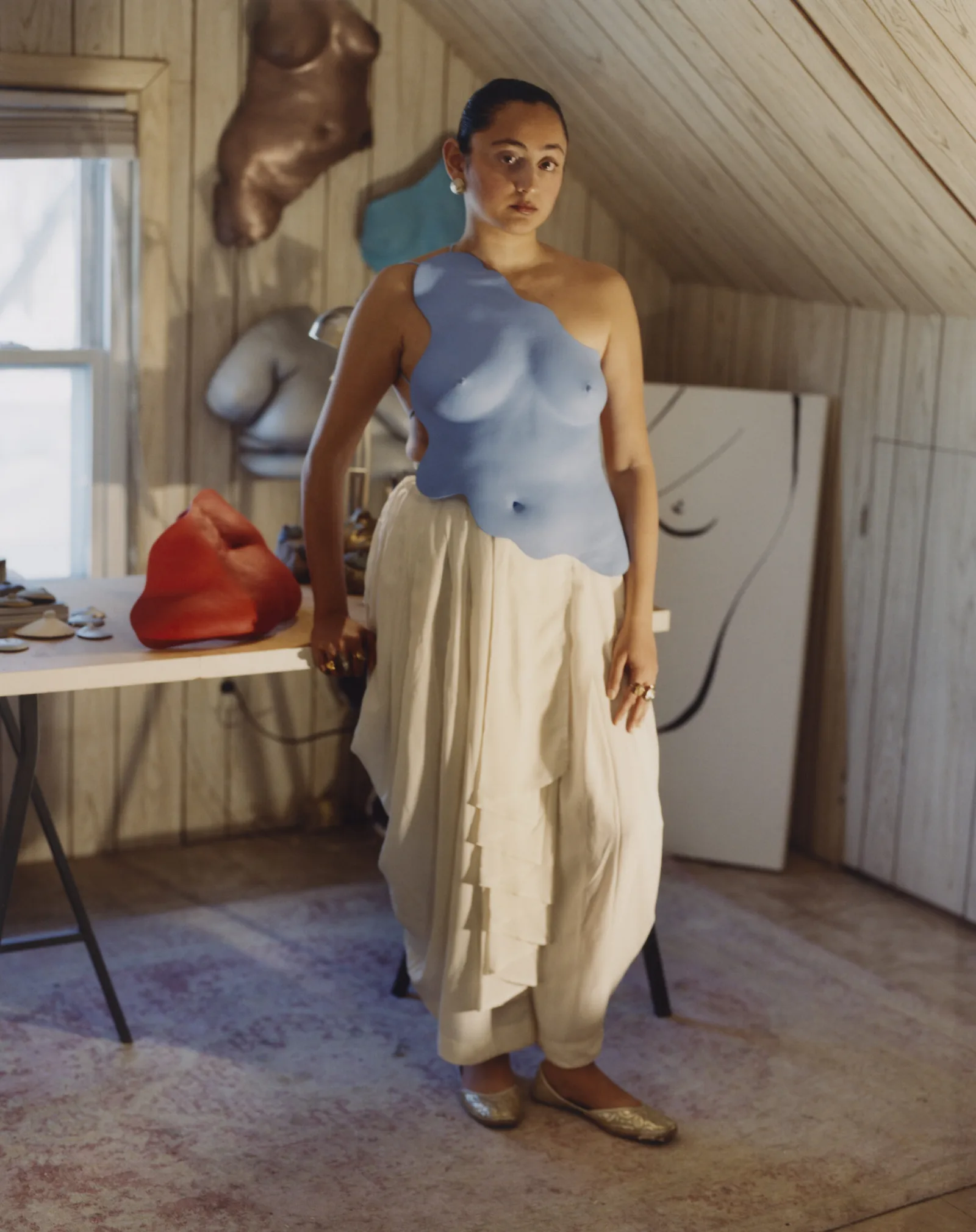
An elegant portrait of Pakistani visual artist and fashion designer Misha Japanwala standing inside a wooden-paneled attic studio. She is captured looking directly at the camera, wearing an asymmetric, one-shoulder sky blue sculptural breastplate molded directly from a female torso. She styles the statement armor over voluminous, draped white pants resembling a traditional dhoti or lungi, paired with gold metallic traditional flats. Her dark hair is slicked back into a neat bun, highlighting chunky gold statement earrings and a matching large ring on her finger. The artist's workspace is cluttered with creative materials, featuring several other multi-colored plaster anatomical casts—including a prominent red abstract form on a white worktable to her left, a metallic brown torso mounted on the back wall, and a large black-and-white minimalist outline drawing of a figure resting against the wall behind her. Soft, natural light streams in from a window on the left, casting subtle shadows across the splattered studio floor and emphasizing the tactile, raw qualities of both her wearable sculptures and her working environment.
Artist Misha Japanwala posing in her creative studio. Lindsay Perryman/Hannah Traore Gallery

Jafri explained the panel's makeup in clear terms. “Our priority was to put together a panel that was not only experienced in cinema, but also diverse in terms of age, gender, professional background and creative perspective. We wanted each member to bring a distinct relationship with film and culture, because ultimately the strength of a jury lies in the range of perspectives around the table,” she said.

She singled out Japanwala's place on it. “Japanwala needs no introduction.

She has made a significant mark internationally as a Pakistani artist, with her latest work including sculptural pieces created for Christopher Nolan’s The Odyssey, worn by Lupita Nyong’o. Her contribution to global cinema as a Pakistani artist is noteworthy, and we felt her perspective was an important one to have on the committee,” Jafri added.

Pakistani artist and fashion designer Misha Japanwala stands smiling in a vibrant, sleeveless, monochrome red outfit alongside a display case showcasing intricate costumes from Christopher Nolan's epic film, The Odyssey. Behind the glass partition, three distinct mannequins feature the metallic, textured bronze armor and sculptural elements that Japanwala custom-designed for Oscar-winning actress Lupita Nyong'o's portrayal of Helen of Troy. The presentation backdrop flashes fiery orange and dark hues emblazoned with the large text "THE ODYSSEY". Japanwala accessorizes her bright attire with clear-framed eyeglasses, a statement silver necklace, and a woven brown handbag while posing proudly next to her Hollywood cinematic contributions.
Misha Japanwala beside her custom costume sculptures for Christopher Nolan’s The Odyssey. Misha Japanwala (via Instagram)

Japanwala built her practice around body casting. Raised in Karachi, she studied fashion design at Parsons School of Design. Her resin and metal sculptures reclaim the female form and challenge shame. They have appeared on Cardi B, Gigi Hadid, and Lil Nas X.

Advertisement

Advertisement

Forbes named her to its 30 Under 30 Asia list. Nyong’o wore one of her breastplates to the 2023 Tony Awards before recommending her for The Odyssey. Japanwala created an asymmetrical bronze neck-and-shoulder plate and a choker for the actress as Helen of Troy.

Naqvi stepped aside as chairperson this cycle to submit his own film. He had held the role since 2023. “I’m honoured that Hanging by a Wire has been selected to represent Pakistan in the International Feature Film category at the 99th Academy Awards, and grateful to the Pakistan Academy Selection Committee,” he said. He called it a disaster film that really happened, shot in large part by the community itself.

Jafri praised the film's seamless mix of archival and new material. She noted it captures Pakistani resilience, contradictions, and faith. The committee reviewed a wide range of submissions this year. Members watched every film and delivered rankings on deadline. The official announcement came on October 1 at the Mosaic International Film Festival in Mississauga, Canada, where the documentary also won the Sabeen Mahmud Award for Courage in Cinema.

Advertisement

Advertisement

A full-length, wide portrait captures Pakistani artist and designer Misha Japanwala standing at the edge of a calm ocean under a clear, bright sky. She is facing the camera directly, wearing one of her signature, custom-molded sculptural breastplates. The wearable art piece is sculpted to the precise contours of a female torso and features a textured, oxidized finish with soft shades of verdigris, copper, and turquoise patina, resembling aged bronze. Her long dark hair is wet and slicked back, with several strands stylized into dramatic, calligraphic swirls across her forehead and face. Around her lower half, a long black fabric is draped tightly like a sarong, extending down past her knees. She rests both hands lightly on her upper thighs as gentle, foamy waves wash onto the sandy shoreline behind her. The lighting is bright and natural, casting soft shadows beneath the sculptural form and emphasizing its detailed skin-like textures.
Artist Misha Japanwala stands at the shoreline wearing a custom-sculpted patina breastplate that bridges fine art and fashion. Aleena Naqvi

Jafri herself brings deep credits. She co-produced the Oscar-shortlisted Joyland. Her short Permanent Guest premiered at TIFF 2025. She co-wrote Yasmeen’s Element, which played SXSW.

Including an artist known for wearable sculpture expands the usual film-industry lens. Japanwala's international path and focus on bodies and autonomy offer a different cultural read. The same goes for Mansoor's social media work on justice issues. Jafri stressed that Academy rules demand independence, craft representation, and no conflicts.

Pakistan has submitted films since 1959 with sparse shortlist success.

Joyland reached that stage. A documentary first signals openness to nonfiction forms that travel. Japanwala's seat may encourage more cross-disciplinary picks ahead. Her global ties could also sharpen how Pakistani stories reach wider voters. The film now heads into the awards calendar with theatrical plans in the UK and US plus a Paramount+ date.

Check topics and authors from this story to see more stories like this in your personalized feed and receive updates when new work is published.

Advertisement

Advertisement

Advertisement

PakistaniArt uses cookies to remember your preferences, keep the site running smoothly, and understand which stories our readers care about most. We never sell your data. See our Cookie Policy for exactly what we collect and why.