There is a roll of film buried beneath a beech tree somewhere in the woods outside Oxford. It has been there long enough for mycelium to find it. Soil microbes have crept across its surface, marking it, transforming it in ways no darkroom chemical could replicate. When Harriet Rutter eventually retrieves that film and prints from it, what she gets back is not quite what she put in.
That exchange, between intention and nature, between the human mark and the nonhuman world that rewrites it, sits near the heart of what the RCA2026 School of Arts and Humanities Show is actually doing. The Royal College of Art, the world's leading art and design university, has opened its Battersea campus to the public, presenting the thesis works of its graduating students from across the School of Arts and Humanities. The show runs from 18 to 21 June, and what it offers is less a survey than a reckoning: with material, with history, with the planet, with what it means to make things right now.
Founded in 1837 as the Government School of Design, the RCA received a Royal Charter and university status in 1967, and formally became the Royal College of Art in 1896. In 2026, the institution was named the number one university for art and design by QS World University Rankings by Subject for the twelfth consecutive year. That longevity carries weight. The alumni roster ranges from David Hockney to Tracey Emin to Booker Prize winner Douglas Stuart. The grad show, accordingly, arrives with expectations. This year's cohort, spread across ten programmes, seems entirely unintimidated by that inheritance.
Something Alive in the Frequency
Amanda Seibæk, studying MA Painting, translates the tension between poetry and scientific language into visual form, and A BALLAD is her multimedia installation exploring whales, sound, and ecological loss, inspired by a lone Pacific baleen whale singing beyond others' hearing range, connecting personal experience with broader questions of communication and isolation. Combining moving image, sound, and sculpture, the work reflects on communication, isolation, and the ecological consequences of underwater noise pollution.
There is something almost unbearably apt about this as a thesis work. The whale sings beyond anyone's range to hear. The artist translates that frequency into image and object. The viewer, standing in the hangar space at Battersea, becomes the only witness to a signal that was never meant to reach land. Seibæk's practice does not moralise. It listens.
Ajea Zahid, Pakistani-born, draws from memory, everyday encounters and the intimate textures of human relationships to create figurative works that hover between the familiar and the unknowable. Her oil on canvas, The Regulars (2026), evokes quiet anticipation, subtle alienation, displacement, identity, and gendered spatial dynamics. There is something quietly piercing about these scenes of waiting and belonging rendered in moody, gestural palettes. The figures seem suspended in their own unresolved frequencies. Zahid listens closely to the unspoken pauses between people and places.
Painting at the RCA has long drawn the heaviest foot traffic at these shows. This year's cohort is expansive. Calder MacKay explores the emotional resonance of imagery, operating in the space between painting and photography to unpick the overstimulation and quiet alienation of contemporary life. MacKay's use of distortion and archival sources brings a forensic quality to what is ostensibly affective terrain. Other painters in the cohort pull in different directions: Lala Drona into geopolitics and duality, Garance Zoe Bray into quieter registers, Mohini Kaur and Hyunah Koh each arriving with distinct formal sensibilities.
What the Ground Remembers
Rutter, studying MA Photography, experiments with the intersection of ecology and analogue photography, looking at the visible and invisible aspects of forests, documenting the tranquility of Oxford's woods before processing and burying her film beneath the very beech tree she photographs, with the resulting images becoming a collaboration with nature, marked by traces of mycelium and soil microbes.
This is photography as surrender. Not control, not capture, but ceding authorship to the biological systems already present. The resulting prints carry a kind of ghostliness, presence and absence occupying the same frame. It is a practice that asks what it means for an image to be alive, and whether visibility requires the absence of everything that is invisible.
The ground recurs across the show in other forms. Aninda Singh, working in MA Ceramics and Glass, investigates the enduring links between ecology, colonial histories, and cultures of consumption, combining clay structures inspired by termite mounds with botanical references, examining how systems of colonial exploitation continue to shape contemporary environmental and social realities. Singh's work, titled Terra Strata, does not separate the ecological from the political. Termite architecture is among the most sophisticated structural engineering in the natural world. By modelling her clay forms on that logic, Singh proposes an alternative hierarchy of knowledge, one that Western systems of extraction have historically suppressed.
Sophie de Carvalho, also in MA Ceramics and Glass, approaches the same materiality from a different direction: her tactile landscapes of glazes, metals, and glass evoke sensory wonder in the manner of natural transformation, surfaces that seem less made than grown. Where Singh reasons through material, de Carvalho feels through it.
Borders That Cannot Hold
Isabella Lozano, studying MA Print, interrogates themes of displacement, identity, and belonging through a multidisciplinary practice spanning print, installation, photography, and sculpture. Lozano's work I am a jug is particularly arresting, a piece in which she poses as a juice jug, using mismatched cultural symbols to reflect on migration and the exportation of ideas, images, and people.
The image is absurd. It is also precise. To be a container that moves, to carry meaning across borders and be received as something merely useful or decorative, is a specific kind of experience. Lozano makes that experience legible with wit, not pathos.
Christabel Png, in MA Contemporary Art Practice, uses reactive dye on silk to explore intermission and materiality: fabric as a site of pause, surfaces that absorb and release in equal measure. The work's formal elegance holds a conceptual rigour about time and duration that positions Png among the show's most quietly ambitious practitioners.
Across the broader School of Arts and Humanities show, works explore identity and belonging, cross-species relations, conflict, displacement, resilience, resistance, home, memory, and decolonial cosmologies. These are not themes chosen for their currency. They are the actual preoccupations of this particular group of artists, many of whom are navigating what it means to make work from multiple cultural positions simultaneously.
The Place Art Gets Made
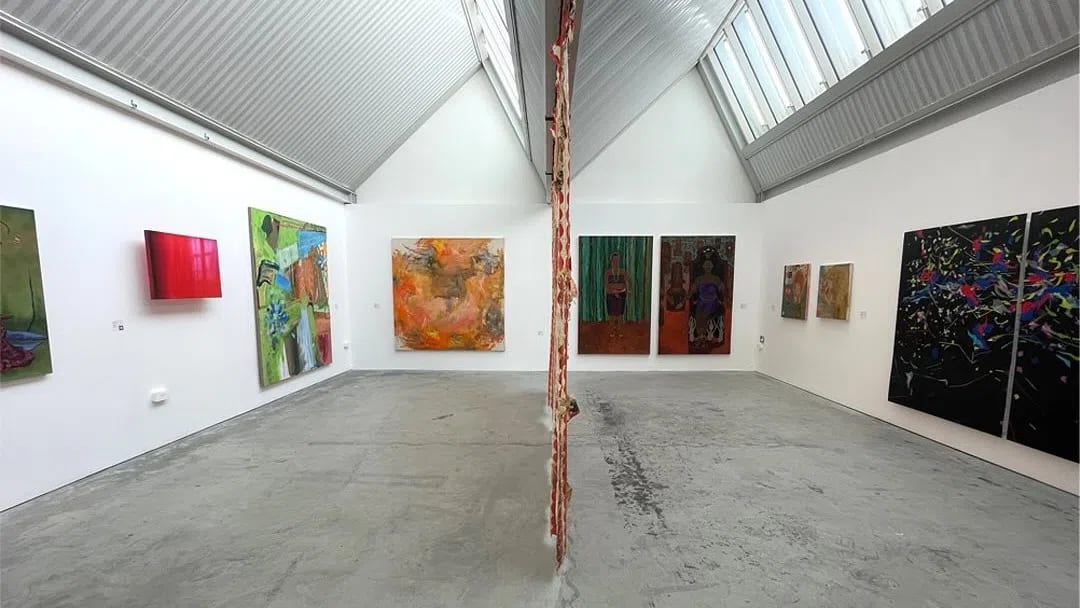
Taking place in the RCA Battersea campus's central hangar space, the exhibition explores the many ways that art urges us to pay attention, come closer, stand back, look deeper, take action, and take time. That curatorial instruction, pay attention, is earned. This is not a show that announces itself loudly. It accumulates.
The Royal College of Art is the only entirely postgraduate art and design university in the world. That distinction shapes what happens in these studios. Without undergraduates, without the developmental arc of a foundation year, the RCA's students arrive already formed, already asking specific questions. With over 25,000 alumni across the globe, the graduates form a unique global network of artists, creators, designers, and innovators. That network is what awaits this cohort on the other side of June.
The RCA's annual graduate exhibitions have long served as a platform for emerging practitioners whose work often goes on to shape contemporary culture. Past RCA grad shows have launched careers that eventually found their way into the Tate, the Turner Prize, and major international biennials. A selection of works from RCA2026's graduating students will be available for purchase through RCA Sales, a special sales platform open from 17 June until 20 July.
But that context, however real, slightly misses the point of what the show is doing right now. Rutter's film is still in the ground in some sense. Seibæk's whale is still singing. Singh's termite-architecture clay forms still hold the logic of a different kind of intelligence.
Running from 18 June to 19 July across the RCA's Battersea, Kensington, and White City campuses, the city-wide showcase offers visitors a glimpse into the future of art, design, architecture, and communication through a diverse range of projects spanning ecology, technology, identity, sustainability, and social change. The Arts and Humanities show, opening the programme and closing on 21 June, is the first word. It is also, in certain ways, the most irreducible one.
What these artists share, across ten different programmes and ten different sets of materials, is a refusal to make work that looks away. The beech tree gets the film back changed. The question the show keeps asking, quietly and without fanfare, is whether the viewer comes back changed too.
Check topics and authors from this story to see more stories like this in your personalized feed and receive updates when new work is published.


