A line wobbles across a canvas, drifting leftward before correcting itself. It traces no grid, follows no algorithm, obeys no prompt. The paint sits thick in places, thin in others. There is a fingerprint near the edge, barely visible, from where a hand steadied the surface. On a wall nearby, a creature grins from a field of saturated red, its proportions impossible, its eyes too large for its skull. Everything about the room says: someone was here.
This is the aesthetic proposition gathering force across galleries, studios, and design platforms in 2026. A quiet but unmistakable turn toward work that wears its human origins on the surface. Naïve painting, tactile mixed media, and what critics now call the "Imperfect by Design" movement have moved from the margins into serious institutional and commercial attention. In a moment defined by technological acceleration and an oversupply of digital perfection, a quieter shift is taking place in the studio, with a clear pattern emerging across conversations with artists, collectors, and curators. The story is not simply about style. It is about what counts as evidence of life.
Where the Customs Officer Still Lives
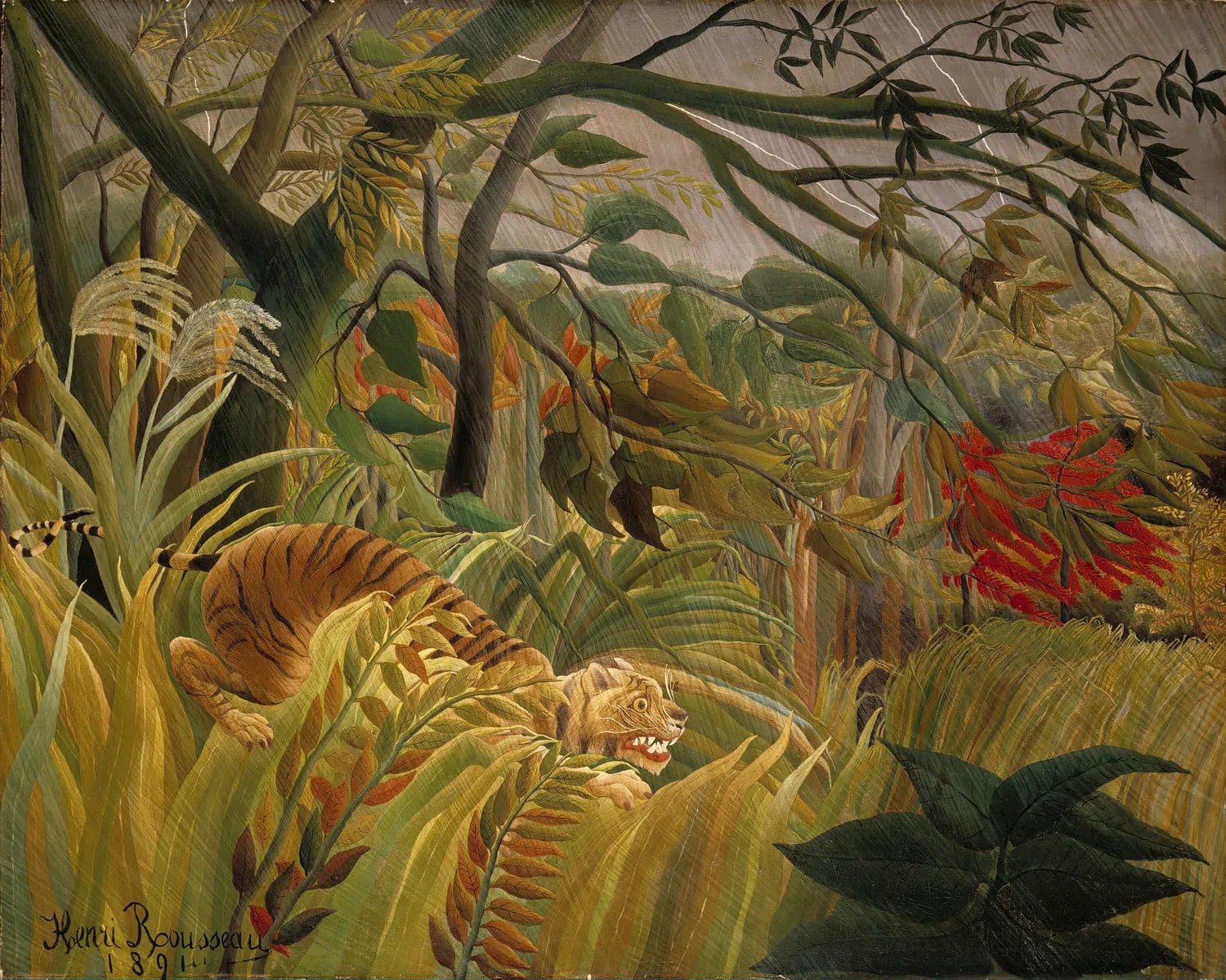
Every contemporary movement carries its ancestors in its bloodstream. Henri Rousseau became a full-time artist at the age of forty-nine, after retiring from his post at the Paris customs office. His amateurish technique and unusual compositions provoked the derision of contemporary critics, while earning the respect of modern artists like Pablo Picasso and Wassily Kandinsky for revealing "the new possibilities of simplicity."
Rousseau never studied at any academy. His best-known works are lush jungle scenes, inspired not by firsthand experience of such locales, but by frequent trips to the Paris botanical gardens and zoo. Audiences in the 1890s laughed. Félix Vallotton, reviewing Tiger in a Tropical Storm (Surprised!) at the Salon des Indépendants in 1891, wrote that it "ought not to be missed; it's the alpha and omega of painting." That review split open a fault line between polish and presence that has never fully closed.
When Pablo Picasso happened upon a painting by Rousseau being sold on the street as a canvas to be painted over, he instantly recognized the older artist's genius, and in 1908 held a now-legendary banquet in his honor at Le Bateau-Lavoir. At that gathering, Rousseau reportedly told Picasso: "We are the two greatest painters of this era: you in the Egyptian style and I in the modern style!"
That confidence, rooted not in training but in instinct, is precisely what today's naïve revival draws upon.
Monsters with MFAs
Robert Nava paints dragons, angels, and hybrid beasts with spray paint, grease stick, and acrylic on raw canvas. The results look hurled at the surface. They buzz with the visual grammar of a child's sketchbook redrawn at billboard scale. But Nava holds an MFA from Yale. He received his BA in Fine Art from Indiana University Northwest and completed his graduate degree at the Yale School of Art. His work is deliberately unpolished, never accidentally so.
His solo exhibition Supercharger ran at Pace Gallery in Tokyo from February to April 2026. In 2025, Pace staged Reverse Alchemy: Dubuffet, Basquiat, Nava in Berlin, placing Nava alongside two foundational figures of raw, anti-academic expression. That curatorial decision carried real weight. It announced that Nava's paintings belong within a lineage stretching back through Jean-Michel Basquiat's crown-tagged heads and Jean Dubuffet's Art Brut agitations.
Nava's work now sits in the permanent collections of the Musée d'Art Moderne in Paris, the Art Institute of Chicago, the Museum of Contemporary Art San Diego, and the Museum of Fine Arts in Houston. His six-figure auction debut signalled serious confidence in naïve style art.
He is not alone. In an environment saturated with machine-generated imagery, work by artists such as David Shrigley, Stik, and Iván Montaña carries an emotional directness that feels increasingly rare. Shrigley's deadpan text-and-drawing works turn gallery visitors into laughing co-conspirators. Stik reduces the human figure to six lines and two dots, yet produces public art that carries startling emotional precision.
Australian painter Jordy Kerwick, completely self-taught, began painting in 2016 and quickly developed his raw yet sophisticated visual language, working with oil, enamel, house paint, and charcoal. Kerwick often speaks about "unlearning," stripping away what he sees as unnecessary rules about proportion and depth. His canvases swarm with wolves, tigers, and fantastical hybrid creatures, every form placed with purpose even when the composition appears impossible.
What the Algorithm Cannot Fake
Why now? The answer is sitting in every pocket, on every screen. This trend is a direct response to what observers call "AI fatigue," where users scroll past smooth, algorithmically generated art because it feels empty. Artificial intelligence can now generate flawless visuals in seconds. That capability, paradoxically, has made flawlessness feel cheap.
According to Adobe's 2026 Design Trends Report, 78% of designers say they are intentionally adding "human imperfection" to their work. Canva's 2026 Design Trends Report declares this the "Year of Imperfect by Design." Canva's platform data shows a 30% surge in searches for tactile, realistic textures. The numbers trace a clear arc: the more ubiquitous machine precision becomes, the more audiences crave its opposite.
Taronish Batty, writing for ELLE India, captured the logic concisely: "When AI can generate flawless visuals in seconds, imperfection becomes a marker of effort, time, and labour. It signals authorship."
AI trained on vast amounts of "good" design produces output that clusters toward the median. It averages. It optimizes. It produces things that are technically competent and aesthetically safe. And as a result, the market has started to reject the aesthetic register that AI defaults to. Perfection, it turns out, creates its own uncanny valley.
This rebellion carries philosophical ancestry older than generative software. The Japanese concept of wabi-sabi teaches that beauty exists in imperfection, impermanence, and incompleteness. That philosophy has quietly influenced design for decades, but 2026 marks its explosive mainstream adoption in Western commercial creative fields.
Rough Surfaces, Real Returns
The market has followed the eye. After a decade shaped by algorithmic polish and frictionless production, collectors are gravitating toward art that is unmistakably made, marked by intuition, risk, and the imperfections that signal authorship.
Mario Zonias, co-founder of Maddox Gallery in London, identified naïve painting as one of seven defining contemporary art trends for 2026. He described its rise as "one of the clearest signals of the moment," noting that what once appeared unrefined is now recognized for what it is: an intentional rejection of polish in favor of instinct and immediacy.
Contemporary naïve painting sits alongside the renewed interest in figuration and overlaps naturally with street art culture, illustration, and neo-expressionist intensity. It is accessible without feeling simplistic. That balance matters commercially. Galleries that once treated rough-edged work as decorative are now building exhibitions and acquiring programs around it. Montaña's works appeared in the 2025 group exhibition Paradiso at Maddox Gallery.
The broader design world is tracking a parallel shift. Naïve art, characterized by childlike simplicity, wobbly lines, irregular shapes, and intentional "mistakes," has reached critical mass, with brands like Duolingo, Mailchimp, and Oatly leaning into the aesthetic for years before it went mainstream. One of the clearest signs of naïve design entering commercial territory came from Cheetos, which worked with Goodby Silverstein & Partners to create a typeface drawn entirely with designers' non-dominant hands.
The Wobble That Holds
What remains unclear is whether "Imperfect by Design" constitutes a lasting cultural recalibration or a reactionary phase that will lose its charge once AI tools learn to simulate messiness, too. Some observers believe the shift runs deeper than aesthetics. As AI becomes more dominant, the desire for human connection will grow. Human imperfection represents a long-term cultural shift toward valuing human labor and "soul" in art.
Coraline Steiner, writing in Designerly Magazine, framed the stakes plainly: "It is also more than a trend, but a meaningful response to an increasingly digital, fabricated world."
Naïve artists challenge the dominance of technical proficiency and academic training in contemporary art, offering unfiltered expression, experiences, and emotions from the artist's unique perspective. In Zagreb, the Croatian Museum of Naïve Art continues that democratizing mission, holding 2,000 works by self-taught artists with no formal training.
Think of Rousseau again, standing at his 1908 banquet, utterly certain of his place beside Picasso. He had no formal credentials, no gallery pedigree, no algorithmic shortcut to fluency. What he had was a tiger crouching in painted grass, rendered with a sincerity so total it bent the entire conversation around itself. More than a century later, the line wobbles on, and people are leaning closer to look.
Check topics and authors from this story to see more stories like this in your personalized feed and receive updates when new work is published.


