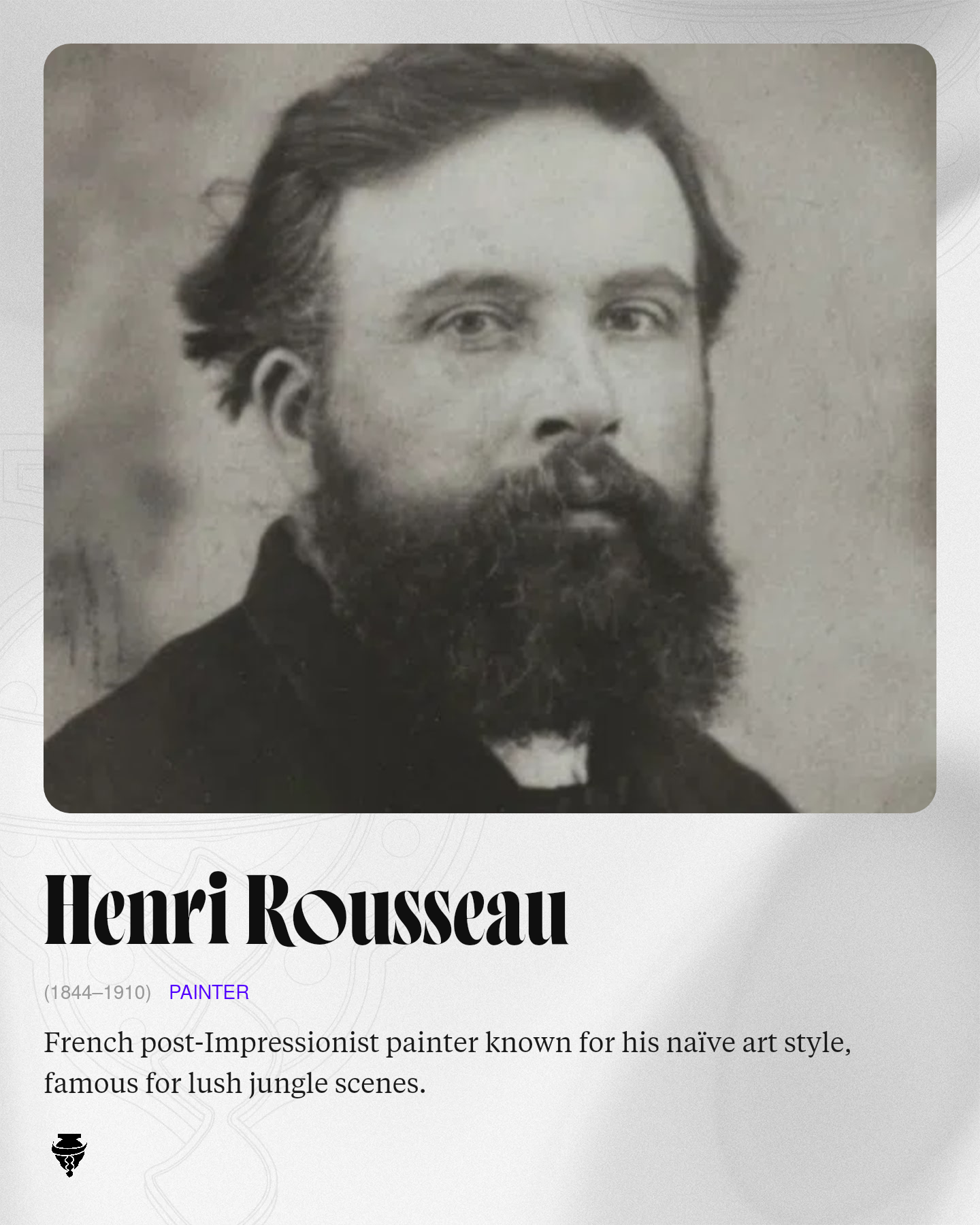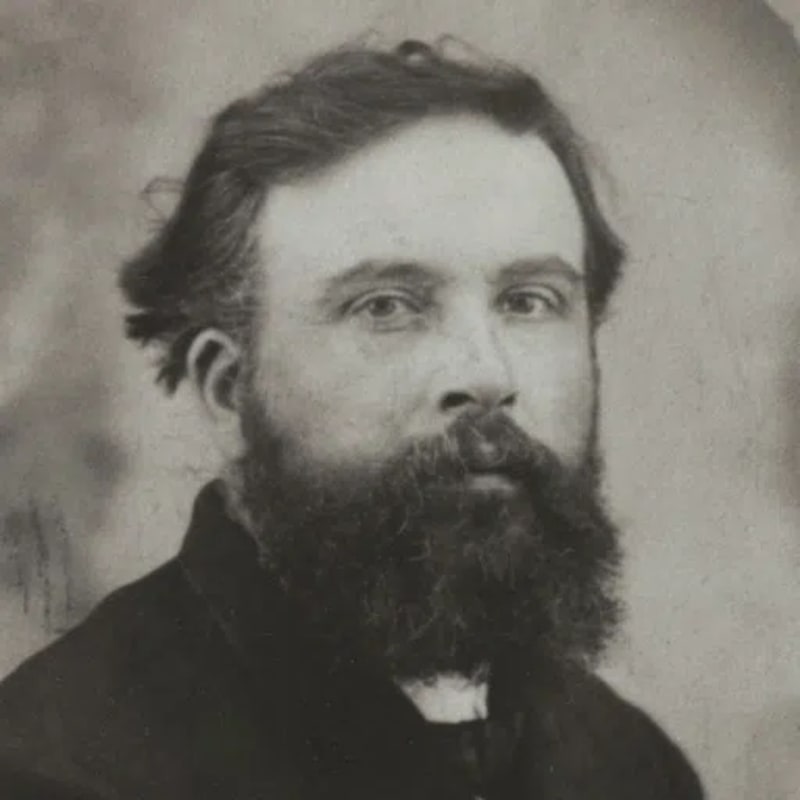
Henri Rousseau
French post-Impressionist painter known for his naïve art style, famous for lush jungle scenes.
French post-Impressionist painter known for his naïve art style, famous for lush jungle scenes.
Henri Julien Félix Rousseau (21 May 1844 – 2 September 1910) was a French Post-Impressionist painter in the Naïve or Primitive manner.
He was not trained at elite art academies, did not mingle in high society, and spent the majority of his working life collecting taxes. Yet his luminous, dreamlike paintings of jungles, exotic beasts, and mysterious moonlit landscapes would go on to transform how generations of artists thought about color, composition, and imagination itself. Ridiculed during his lifetime by critics, he came to be recognised as a self-taught genius whose works are of high artistic quality. Today, the name Henri Rousseau stands as a towering symbol of creative perseverance and the triumph of raw talent over formal convention.
Henri Julien Félix Rousseau was born into a middle-class family in the town of Laval in northwest France on May 21, 1844. His father was a tinsmith, and the family's income was modest. The young Henri's childhood was marked by financial instability. He attended Laval High School as a day student, and then as a boarder after his father became a debtor and his parents had to leave the town upon the seizure of their house.
Despite the upheaval, Rousseau showed early promise in two areas that would shape his life. He was mediocre in some subjects at high school but won prizes for drawing and music. These twin passions, visual art and the violin, would remain with him until his final days.
After finishing school, Rousseau's path took a turbulent turn. In his late teens, he was employed at a law firm. However, his career path changed forever when he committed perjury and was arrested. To evade his jail sentence, Rousseau signed up for the French army in 1863. However, he still had to serve a one-month sentence. He spent around four years in the military, and while he never saw combat or traveled abroad, this period proved pivotal to his creative imagination. He had also met soldiers, during his term of service, who had survived the French expedition to Mexico and listened to their stories of the subtropical country they had encountered. These vivid secondhand tales of tropical forests, exotic wildlife, and untamed landscapes would later ignite the jungle visions that made him world-famous.
Rousseau's father passed away in 1868, and he was excused from army duties so that he could support his mother. On leaving the army Rousseau moved to Paris, where he began working as a customs officer at the entrance to the city. Rousseau married his first wife, Clemence Boitard, in 1868. Their family life was shadowed by tragedy; of their several children, only a daughter, Julia, survived into adulthood.
In 1871, shortly after his first marriage, Rousseau was hired by the Paris Octroi, where his job was to collect tax on goods coming into Paris. It was this unremarkable civil service job that earned him the affectionate nickname he would carry for the rest of his life and beyond. He was also known as Le Douanier (the customs officer), a humorous description of his occupation as a toll and tax collector.
The role was not demanding at every moment, and it left Rousseau with valuable pockets of free time. His job as a customs officer required only occasional periods of diligence, and it is possible that Rousseau was able to practice drawing during slow periods at work. During these quiet hours at the city gates, with the bustle of Parisian commerce flowing past, a self-made artist was quietly coming into being.
Rousseau was entirely self-taught. Rousseau claimed he had "no teacher other than nature," although he admitted he had received "some advice" from two established Academic painters, Félix Auguste-Clément and Jean-Léon Gérôme. Rousseau had never had a formal art education; instead, he taught himself by faithfully replicating paintings in the art museums of Paris and by sketching in the city's botanical gardens and natural history museums.
The beginnings of his career as an artist are uncertain, but he claimed that he began to paint at the age of forty (1884), which corresponds to the time that he obtained a license to make copies of paintings at the Louvre. He spent hour after hour studying the masters at the Louvre, absorbing lessons in color, composition, and form through direct observation rather than classroom instruction. Because he had not studied art according to any prescribed method or under any teacher's supervision, the artist developed a highly personal style.
What truly set Rousseau apart was his source of inspiration for the jungle scenes he would become famous for. His best-known paintings depict jungle scenes, even though he never left France or saw a jungle. His inspiration came from illustrated books and the botanical gardens in Paris, as well as tableaux of "taxidermified" wild animals. He would visit the Jardin des Plantes and the natural history museums, studying the shapes and textures of tropical plants with meticulous care, then transforming those observations into breathtaking, otherworldly compositions on canvas.
Having been rejected from the Salon, he exhibited for the first time with the Groupe des Indépendants in 1885. This unjuried exhibition was a lifeline for artists who fell outside the rigid expectations of the academic establishment, and Rousseau embraced the opportunity wholeheartedly. Although Rousseau's art was not understood or accepted by the conservative, official art world of Paris, he was able to show his work in annual exhibitions organized by the Société des Artistes Indépendants. He submitted works to these open, unjuried shows from 1886 until the end of his life.
The early reception was harsh. One of the earliest works exhibited publicly was Carnival Evening, which caused some critics to either laugh or cry right in front of it. His flat perspective, bold color choices, and childlike sense of proportion bewildered viewers accustomed to academic realism. Yet amid the mockery, some sensed something extraordinary. When Tiger in a Tropical Storm (Surprised!) was exhibited in 1891, Rousseau received his first serious review when the young artist Félix Vallotton wrote: "His tiger surprising its prey ought not to be missed; it's the alpha and omega of painting."
In 1893, at the age of 49, Rousseau retired from his work as a toll collector and dedicated himself to his art. This was a bold and somewhat precarious decision. His pension was small, and he was far from wealthy. After Rousseau's retirement in 1893, he supplemented his small pension with part-time jobs and work such as playing a violin in the streets. He also worked briefly at Le Petit Journal, where he produced a number of its covers.
In 1893, Rousseau moved to a studio in Montparnasse, where he lived and worked until he died in 1910. It was in this modest atelier that some of the most iconic canvases of modern art took shape. In 1897, he produced one of his most famous paintings, La Bohémienne endormie (The Sleeping Gypsy). This mysterious masterpiece, depicting a dark-skinned woman asleep under a moonlit desert sky while a lion calmly stands beside her, has become one of the most recognizable images in world art.
The early twentieth century brought a dramatic shift in Rousseau's fortunes. In 1905, Rousseau's large jungle scene The Hungry Lion Throws Itself on the Antelope was exhibited at the Salon des Indépendants near works by younger leading avant-garde artists such as Henri Matisse, in what is now seen as the first showing of The Fauves. Rousseau's painting may even have influenced the naming of the Fauves. This proximity to the radical new movement helped reframe Rousseau not as an oddity, but as a kindred spirit to the most daring painters of the era.
His art was seen and appreciated by established artists such as Camille Pissarro and Paul Signac, who praised his direct, emotional approach to his subject matter. That year, he met the writer Alfred Jarry, who gave him the nickname "Le Douanier." Jarry introduced Rousseau to members of the Parisian artistic and literary avant-garde, including Pablo Picasso, Guillaume Apollinaire, Max Jacob and Marie Laurencin, all of whom became admirers of his art.
One of the most memorable episodes in art history followed. When Pablo Picasso happened upon a painting by Rousseau being sold on the street as a canvas to be painted over, the younger artist instantly recognised Rousseau's genius and went to meet him. In 1908, Picasso held a half serious, half-burlesque banquet in his studio at Le Bateau-Lavoir in Rousseau's honour. Guests at the banquet included Guillaume Apollinaire, Jean Metzinger, Juan Gris, Max Jacob, Marie Laurencin, André Salmon, Maurice Raynal, Daniel-Henri Kahnweiler, Leo Stein, and Gertrude Stein. The evening has entered art-world legend as a celebration of the unconventional brilliance that Rousseau embodied.
Rousseau's artistic style remains instantly recognizable. Henri Rousseau's painting style is characterized by his status as a modern naïve artist, marked by a lack of conventional expertise. His works often feature detailed, lush jungles, exotic figures, and wild beasts, rendered with rich colors. Rousseau's style includes a distinct absence of perspective, creating a floating effect, and figures are typically depicted full face or in strict profile.
His painting technique was labor-intensive and idiosyncratic. His painting technique was also unique since he applied one layer of paint at a time, creating multiple layers in each piece. He painted each colour one by one, firstly the blues and then the greens and so on, and painted from top to bottom. When Rousseau painted jungles, he sometimes used more than 50 shades of green.
He also developed the painting style of portrait landscape, in which he would place a person or a couple in the foreground of a landscape painting. His self-portrait, Myself: Portrait-Landscape (1890), remains a defining example of this approach.
Among his most celebrated works, The Dream (1910) stands as the crowning achievement of his career. The Museum of Modern Art in New York owns two of his most famous works, "The Sleeping Gypsy" (1897) and "The Dream" (1910), which depict a nude woman on a couch magically transported to a lush jungle inhabited by exotic birds and beasts. Painted in the final year of his life, The Dream brought together every element that had defined his vision: lush vegetation, wild animals, moonlit atmosphere, and a surreal blending of the domestic and the exotic.
Rousseau's personal life was never far from difficulty. His wife died in 1888, and he married Josephine Noury in 1898. Rousseau was married twice and had children, yet all of his family members had passed away before him. The loneliness that accompanied these losses seems to echo through the silent, dreamlike quality of his paintings.
His career also endured a serious legal setback. Rousseau's career then suffered a setback when he was imprisoned for bank fraud in 1907 after a musician acquaintance of his, Louis Savaget, persuaded him to participate in bank fraud. He used his reputation for being unworldly as his defence. His friends also backed up his claim, which convinced the authorities, and Rousseau was freed from jail.
In spite of his popularity among his fellow artists, Rousseau continued to be seen as a figure of amusement in the art world and lived in poverty for the rest of his life. He died in 1910, suffering from an infected leg wound. Henri Rousseau died on 2 September 1910 in the Hospital Necker in Paris.
Rousseau may have died in obscurity and poverty, but his legacy blossomed almost immediately after his passing. The artist Max Weber introduced Rousseau's work to American audiences with a New York exhibition in 1910, followed by a memorial exhibition organized by Robert Delaunay at the Salon des Indépendants the following year. Uhde also published the first biography on Rousseau, which made a profound impression on Wassily Kandinsky, who later purchased two of Rousseau's paintings and included reproductions of his work in the Blaue Reiter Almanac (1912).
Rousseau's work exerted an extensive influence on several generations of avant-garde artists. His work continued to influence other artists, from his friend Picasso and Fernand Léger to Max Ernst and the Surrealists. André Breton also hailed Rousseau as a "proto-Surrealist" for his art's absurdist and metaphysical quality, and use of bright colours and clear outlines, anticipating the compositions of Surrealists such as René Magritte and Giorgio de Chirico.
His influence even extends into popular culture. A Rousseau painting was used as an inspiration for the 2005 animated film Madagascar. Today, Rousseau's works are held in the collections of the Hermitage Museum in St. Petersburg, the Museum of Modern Art in New York, the Musée d'Orsay in Paris, and the National Gallery in London, among others.
Henri Rousseau's life is one of the most remarkable stories in the entire history of Western art. A man with no formal training, no wealth, and no powerful connections managed to create a body of work that reshaped the very definition of what painting could be. His lush, dream-soaked jungles, born not from travel but from an extraordinary imagination, continue to captivate millions of viewers around the world. From the walls of the Museum of Modern Art in New York to the Musée d'Orsay in Paris, his paintings remain monuments to the idea that true artistic genius knows no boundaries, not of class, not of education, and not of convention. Le Douanier, the humble customs officer, painted his way into eternity.
Because one has a right to paint one's dreams.
Henri Rousseau