
Museums across Britain have spent the past four years learning to live with a new kind of visitor, one who arrives not to look but to disrupt.
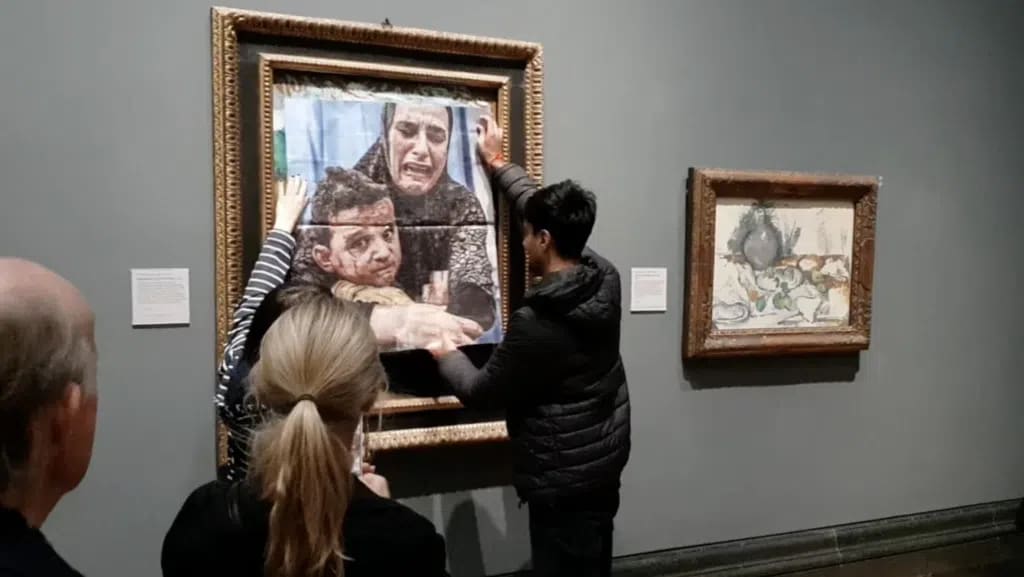
On July 28, a jury at Southwark Crown Court delivered its verdict on the latest chapter of that pattern. Jai Halai, 25, and Monday-Malachi Rosenfeld, 23, were convicted of criminal damage over an October 2024 protest at London's National Gallery. The pair, members of the campaign group Youth Demand, had taped a photograph of a Gazan mother and her injured child over the protective glass of Pablo Picasso's 1901 painting, Motherhood (La Maternité). They then poured red paint across the gallery floor.
The image itself carried its own weight. It was taken by Palestinian journalist Ali Jadallah, with a caption describing a mother holding her injured child after an Israeli attack near Al-Shifa Hospital in Gaza City. Placing it over a Picasso painting depicting maternal tenderness was, for the activists, the entire argument. The National Gallery confirmed at the time that the artwork sustained no physical damage, protected as it was by glass.
Motherhood dates from Picasso's early Paris years, painted just before his Blue Period fully took hold. It sits in the National Gallery's permanent collection as one of the institution's touchstones of early twentieth-century modernism, a status that made it an obvious target for activists seeking maximum visibility.

Halai, an NHS worker, explained her reasoning at the time. She said she was "taking action with Youth Demand because at this point it's been over one year of seeing my colleagues in the healthcare field decimated by the war in Gaza. Rosenfeld framed her participation differently. She said she was "taking action because, as a Jew," she felt it her "duty to denounce the genocide being committed in Gaza," adding that she wanted "the world to know that this is not in the Jewish name."
The protest followed a now familiar tactic borrowed from climate activism. Weeks earlier, Just Stop Oil members Phoebe Plummer and Anna Holland had been sentenced to two years and twenty months respectively for throwing soup over Van Gogh's Sunflowers at the same museum. Some cultural commentators criticised those sentences as excessively harsh. Pussy Riot founder Nadya Tolokonnikova weighed in publicly, describing such actions as "a carefully calibrated political statement, not the work of mindless hooligans."
Not every case has ended in conviction. A separate trial involving activists who glued themselves to a J.M.W. Turner frame at Manchester Art Gallery resulted in acquittal. That inconsistency has fuelled ongoing argument over how juries and courts should treat protest that targets cultural property rather than people.

Sector bodies have taken a harder line than commentators like Tolokonnikova. Museum organisations have condemned the targeting of art and cultural institutions, warning that such protests risk irreversible damage to heritage collections. Their concern extends beyond any single painting to insurance costs, conservation resources, and public access when galleries close rooms after incidents.
Sentencing for Halai and Rosenfeld is set for September. Whatever the outcome, the case has already hardened battle lines between those who see museums as neutral sanctuaries and those who see them as unavoidable stages. The debate over where protest ends and vandalism begins shows no sign of settling.
Check topics and authors from this story to see more stories like this in your personalized feed and receive updates when new work is published.