
Somewhere in the southeastern sprawl of greater Paris, in a house that belonged to the aunt of a suspected drug dealer, a canvas sat among bales of cannabis resin, stacks of designer clothing, and a modest pile of cash. Nobody was looking for a painting. The officers who entered the property on the morning of 15 June were tracking narcotics, not art. What they found instead was one of the strangest intersections of crime and culture in recent French memory.
French police have recovered a stolen Pablo Picasso painting during a drug trafficking raid in the southeastern suburbs of Paris. The painting, authenticated though not publicly named, belongs to a series of portraits Picasso made of Marie-Thérèse Walter, his model and lover in the 1920s and 1930s. French media report it may be valued between €12 million and €15 million. The recovery has reopened familiar questions about the vulnerability of privately held masterworks, the shadowy circulation of stolen art, and what it means that a portrait born from one of the twentieth century's most scrutinized love affairs wound up stashed in a suburban home alongside contraband.
Where the Painting Was Not
Officers from the Brigade des Stupéfiants, France's equivalent of the Drug Enforcement Administration, discovered the Picasso on June 15 at a property connected with a suspected drug dealer in Champigny-sur-Marne. Along with the painting, police seized nearly 40 pounds of cannabis, €7,000 in cash, and €200,000 worth of luxury clothing. The operation was routine in its aims: dismantle a trafficking network, seize drugs, arrest suspects. Art was never on the agenda.
The public prosecutor's office of Créteil confirmed: "This discovery was made during a search carried out as part of an investigation into drug trafficking." Authorities quickly opened a separate investigation into theft and dealing in stolen goods.
Six people were arrested following the raid, including a 37-year-old man who worked as a security guard at a Paris firm specializing in storing art and other valuables. According to French media reports, the man admitted to taking the Picasso from the Paris depot but claimed he did so to expose weaknesses in the company's security. That justification may prove difficult to sustain in court, given the rest of the haul surrounding the canvas.
A police source told The Art Newspaper that the theft appeared to be "opportunistic" and that "as it often happens in such cases, the gang had no idea what to do with it." This is a familiar refrain in art crime circles. Works of enormous cultural and financial weight are spirited away, only to become liabilities the moment they leave the legitimate market. You cannot walk into a gallery with a stolen Picasso and expect a sale.
The Woman Outside the Department Store
To understand the painting's significance, you have to return to a January afternoon in 1927, outside the Galeries Lafayette. On 8 January 1927, Marie-Thérèse Walter first met Pablo Picasso in front of the Paris department store. She was living with her mother and sisters in Maisons-Alfort. Picasso approached her and said, "You have an interesting face. I would like to do a portrait of you. I am Picasso." Walter was unfamiliar with his name but was flattered by the attention.
She was seventeen. He was forty-five and married.
Picasso was married to Olga Khokhlova, a Russian ballerina, with whom he had a five-year-old son. He and Walter began a relationship kept secret from his wife until 1935. Over the following decade, Walter became one of the defining subjects of his art. She reinvigorated Picasso's artwork. He began to draw her portrait repeatedly, inspired by her fresh, athletic appearance, curves, and oval face.
In Picasso's paintings, Walter appears as blonde, sunny, and bright, as in Le Rêve (1932), in contrast to his darker portrayals of Dora Maar, whom Picasso painted as the tortured "weeping woman." The photographer Brassaï once observed that Picasso "loved the blondeness of her hair, her luminous complexion, her sculptural body," adding that "at no other moment in his life did his paintings become so undulant, all sinuous curves."
By 1937, the year the recovered portrait is believed to date from, the emotional terrain had shifted. Their daughter Maya was born on 5 September 1935. Several months after the birth, Picasso began a relationship with the surrealist photographer Dora Maar. The resulting portraits of Walter from this period signify a transition, combining Walter's profile with that of Maar, produced in the same year as Guernica and The Weeping Woman, a significant phase in the artist's career.
The 1937 portraits hold a particular charge. They are documents of private upheaval layered over political catastrophe, made during the months Picasso was also responding to the bombing of the Basque town of Guernica by German and Italian warplanes. Walter was the model for at least three of the figures depicted in Guernica. Even as the relationship frayed, her presence saturated his work.
A Painting Without a Name
Authorities have not publicly identified the recovered canvas. The Art Newspaper reported that the painting, worth around €12 million, had been authenticated by the late Claude Picasso, one of the artist's sons, when it was sold by a Parisian dealer to a woman in Singapore. The portrait's theft had not been publicly reported; it was being held in private storage for the Singaporean owner.
This detail opens a quieter line of inquiry. Across Paris and other global art capitals, freeport warehouses and private storage facilities hold billions of euros worth of art that rarely sees daylight. Works pass between owners without ever hanging on a wall. In this case, a painting by one of the most famous artists in history was sitting in a depot, invisible to the public and apparently to the owner, who may not have known for some time that it was gone.
Authorities are now auditing the Parisian art repository to determine if any other high-value works have gone missing.
Claude Picasso, who died in 2023 at age 76, had been the court-appointed administrator of the Picasso estate since 1989. After an earlier authentication committee was disbanded in 1993, Claude and his half-sister Maya Widmaier-Picasso began issuing certificates of authenticity independently of one another. In 2012, four of Picasso's five surviving heirs established the Picasso Administration to streamline the process, announcing that Claude should be the sole recipient of authentication requests. His death, and that of Maya before him, has left the management of the estate to his sister Paloma, who took over in 2023.
That the recovered portrait bears Claude's authentication certificate places it within a verifiable lineage of provenance. Still, its journey from certified work to stolen object to drug-raid discovery traces a far less orderly path.
Picasso's Long History as a Target
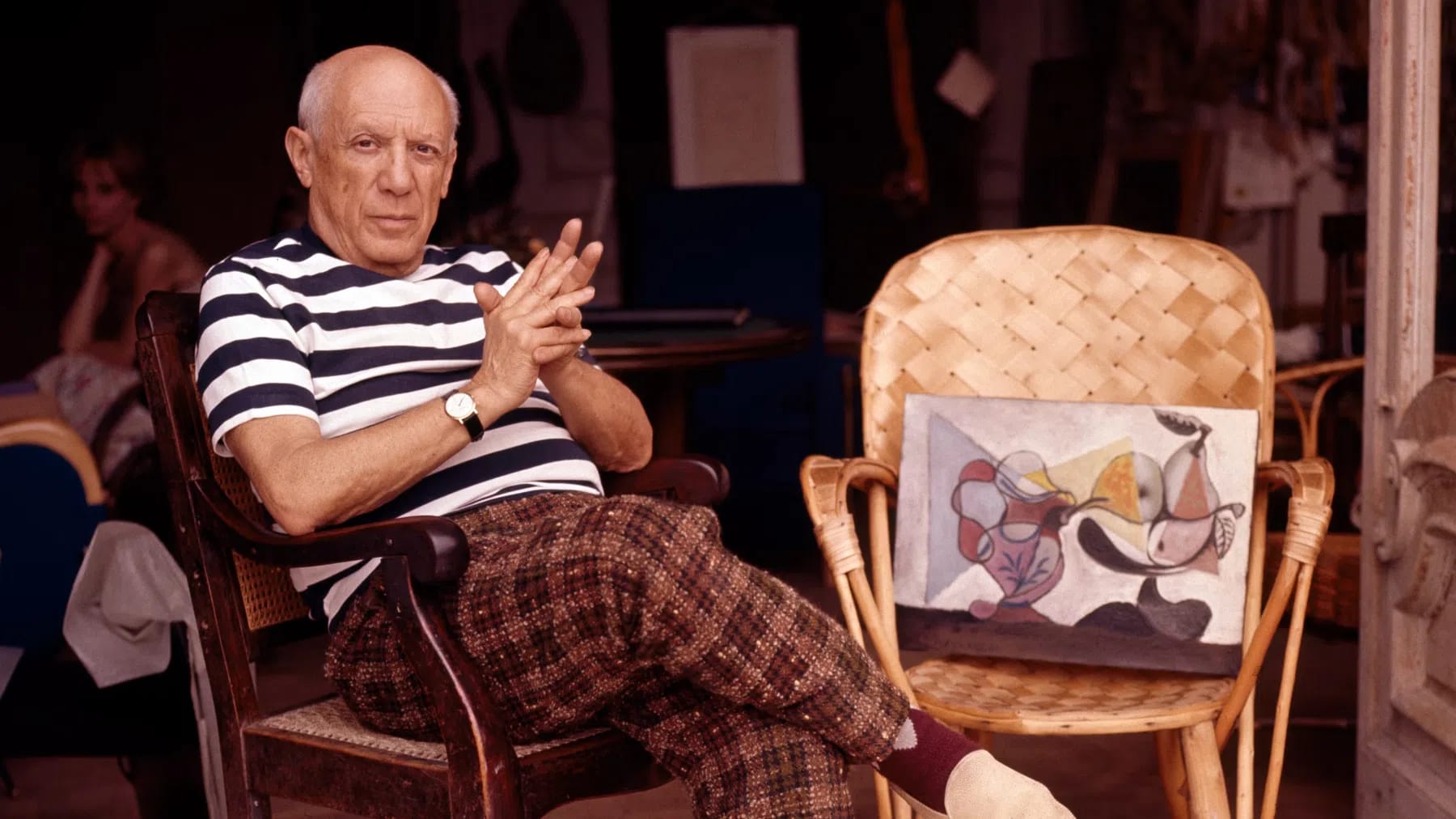
For decades, Picasso paintings have been a recurrent target for criminals, and in recent years a number of works have been recovered. The scale and frequency of these thefts set Picasso apart from virtually any other modern artist. His extraordinary output helps explain part of this: at his death in 1973 there were more than 45,000 unsold works in his estate, comprising 1,885 paintings, 1,228 sculptures, 3,222 ceramics, 7,089 drawings, and many thousands of prints. So many works in so many hands, across so many countries, creates a landscape ripe for theft.
In 2010, the Cubist Le pigeon aux petits pois (1911) was taken, along with works by Georges Braque, Henri Matisse, Amedeo Modigliani, and Fernand Léger, during a spectacular heist at the Musée d'Art Moderne de la Ville de Paris. The estimated total value of what was taken was around 100 million euros. The works have not been recovered.
Picasso gave Head of a Woman (1939), one of his fractured portraits of Maar, to the Greek people in 1949 in recognition of the country's resistance to Nazi forces. He inscribed the back: "For the Greek people, a tribute by Picasso." Just before dawn on 9 January 2012, two burglars slipped into the National Gallery in Athens through an unlocked balcony entrance and took the canvas. Greek authorities recovered it in 2021 in Keratea, a town in East Attica.
In 2024, Belgian police found Tête (1970) in an Antwerp basement; it had been stolen from a home in Tel Aviv a decade earlier. In 2022, two Paris gallerists were given suspended sentences and fined for selling stolen Picasso works worth more than $15 million.
The paradox of a stolen masterpiece is well documented: a work famous enough to be worth stealing is also famous enough to be impossible to sell openly. Instead, such works circulate within criminal networks, used as collateral or bargaining currency, exchanged privately at fractions of their actual market value. A Picasso worth millions functions in this context as a kind of portable asset, its cultural significance entirely beside the point.
What Follows from a Canvas Found
Two of the initial suspects were released and the remaining four appeared at a court hearing on June 19, with a trial expected for August. The security guard faces charges of theft and involvement in drug dealing. Whether his claim of whistleblowing holds any legal weight remains an open question.
In 2018, another portrait of Walter from the same period, the brightly colored Woman in Beret and Checkered Dress (1937), sold at Sotheby's London for £49.8 million. That painting, too, merges elements of Walter and Maar. James Mackie, then Sotheby's head of Impressionist and Modern Art, noted at the time that "while substantially this is a portrait of Walter, it's also a painting about duality." The recovered work, still unnamed, likely inhabits similar emotional territory: the overlapping geometries of desire and rupture that defined Picasso's output during those months.
For now, the portrait sits in evidence. Its owner in Singapore awaits its return. The storage facility faces scrutiny. And somewhere in the wider apparatus of French law enforcement, officers trained to track cannabis are writing reports about Cubism.
It is a strange coda to a painting that began, almost ninety years ago, in the charged space between a married man and a young woman outside a Paris department store. Picasso once said, "Art has neither a past nor a future. The art of the Greeks, the Egyptians and the great painters of other epochs isn't an art of the past." His own work keeps proving the point, surfacing in the most improbable present tenses.
Check topics and authors from this story to see more stories like this in your personalized feed and receive updates when new work is published.