For twenty agonizing minutes last November, a room full of bidders at Sotheby's newly christened Breuer Building in Manhattan fought over a single Gustav Klimt portrait. Gustav Klimt's Portrait of Elisabeth Lederer, fresh to market and carrying unmatched provenance, achieved $236.6 million after a 20-minute bidding battle. It proved a welcome shot in the arm for a trade that had spent three years wondering whether the era of nine-figure auction lots was behind it. When the gavel fell, it was the most expensive Modern artwork ever to sell on the block. Something had stirred.
That singular sale crystallized a broader story told in numbers released this spring. The 10th edition of the Art Basel and UBS Global Art Market Report 2026, authored by Dr. Clare McAndrew of Arts Economics, analyzes the global art market in 2025, placing its performance within the broader economic and wealth landscape. Global sales increased by 4% year-on-year to an estimated $59.6 billion, after two years of declining values. The upturn was real. It was also, by any honest measure, modest. And it arrived wrapped in enough caveats to fill a catalogue essay.
A Decade of Counting
The report itself occupies a peculiar position in the art world. Since McAndrew first began publishing annual market analyses in 2005, the global art market report was published by The European Fine Art Foundation (TEFAF) from 2005 to 2015, and since 2016 the annual research has been commissioned by Art Basel and UBS. McAndrew completed her PhD in economics at Trinity College Dublin in 2001. Over two decades, her work has become the closest thing the trade has to an annual physical. Galleries distrust it. Collectors cite it at dinner. Journalists quote it relentlessly. And everyone, whether they admit it or not, reads it.
On this tenth anniversary with Art Basel and UBS, the diagnosis was cautiously upbeat. McAndrew wrote: "The market welcomed a shift in direction in 2025, from the contraction of previous years to modest growth." However, it continued to operate in a volatile geopolitical environment, particularly regarding cross-border trade. While some categories of art were relatively insulated from the direct effects of tariffs, broader policy uncertainty and trade fragmentation created challenges for businesses.
The phrase "shift in direction" is carefully chosen. Despite the improvement, the market remains below its post-pandemic peak of $68.1 billion achieved in 2022. It sits 7% smaller than it was in 2015. Growth, yes. Recovery to pre-crisis form, no.
Where the Gavel Fell Loudest
Public auctions drove the turnaround. Public auction sales increased by 9% to $20.7 billion, while reported private auction sales declined by 4% to just under $4.2 billion. After years in which sellers hid behind the curtain of private deals, consignors returned to the saleroom in force. Sellers were again willing to expose works to the competitive dynamics of the auction room. In uncertain markets, sellers often prefer the discretion of private transactions; in more confident environments, auctions regain their appeal.
A handful of spectacular lots, arriving mostly in the second half of the year, reshaped the calendar. Christie's reported that the second half of 2025 marked a 26% increase in overall sales compared with the first six months. Sotheby's rode a similar wave. The house reported total sales of $7 billion, a 17 percent increase over 2024. Christie's reported a projected total of $6.2 billion, a 6 percent increase.
Bonnie Brennan, Christie's chief executive, captured the mood in a year-end statement. "The energy has returned to the saleroom, online, and across the market," she said, reporting "renewed confidence worldwide." Sotheby's CEO Charles F. Stewart struck a similar tone: "Our strong performance in the second half of the year demonstrates clear momentum in our markets."
But much of that momentum rested on a thin stratum of ultra-rare material. Public auction sales were driven by several record prices at the high end. While contemporary works had underpinned the post-pandemic recovery, the highest prices in 2025 were achieved for works from the early and mid-20th century. Klimt, Kahlo, Canaletto. Blue chip names from art history's deep reserves, not studio visits on Instagram.
The Gallery Floor
Dealers told a quieter story. Dealer sales reached $34.8 billion, marking a 2% rise and a return to stability after two years of decline. That 2% figure conceals sharp disparities. The rebound was more pronounced in the lower tiers: dealers with a turnover of between $250,000 to $500,000 a year enjoyed a 25% average boost in sales. Meanwhile, entities between $1 million and $10 million showed a slight decline of 1%.
A cost crisis shadows the recovery. Total operating costs rose by an estimated 5% on average, above the rate of inflation in most major markets and above aggregate sales growth. Shipping, staffing, fair fees, insurance: the expenses of running a gallery are climbing faster than revenue. While 43% of dealers with turnover above $10 million reported higher profit, in the $250,000 to $500,000 segment, 45% reported declining margins despite rising sales.
The middle is getting squeezed hardest.
Art Basel CEO Noah Horowitz acknowledged this tension: "In past reports, much of the conversation focused on sales and revenue. This year's data shows sales recovering and confidence returning. Yes, the performance is mixed. Some parts of the market are stronger than others, and cost pressures remain a real challenge. But the trend is up." Despite headlines during 2025 highlighting high-profile gallery closures, there was no evidence of closures outweighing openings. Horowitz did not minimize the losses: "I'm not going to underestimate the impact of Tim Blum, Venus over Manhattan, or Clearing closing their doors," he told ARTnews.
In a separate interview, Horowitz cautioned against interpreting shrinking sales in the ultra-contemporary category as a sign that collectors have lost interest. "What has cooled is the speculative part of the market," he said.
New Hands, Different Eyes
Beneath the revenue data, a structural transformation is underway. Paul Donovan, Chief Economist at UBS Global Wealth Management, described a "Great Wealth Transfer, with more than $83 trillion set to pass between generations in the coming decades." As wealth increasingly moves into the hands of women and younger collectors, collecting motivations and philanthropic priorities are evolving.
Gender parity in gallery representation reached a milestone in 2025. Primary market galleries reached gender parity, and across all dealers, women accounted for 45% of artists represented, up from 35% in 2018. Works by female artists accounted for 37% of sales by value, up from 28% in 2018. Yet disparities persist: women accounted for 55% of artists and 43% of sales among dealers with turnover below $250,000, compared to 35% of artists and 27% of sales at galleries with revenues above $10 million. Parity exists at the base. The summit remains steep.
Geography, too, is shifting. The US maintained its position as the leading art market, accounting for 44% of global sales by value. Sales reached $26 billion, growing 5% year-on-year. The UK held second place with 18%, while China remained third with 14%. France enjoyed one of the strongest performances, with sales rising 9% to $4.5 billion. Switzerland and Austria recorded gains of 13%, while Spain increased by 6%. The "other" regions outside of the US, UK, and China have grown their share from 17% of business in 2015 to 24% in 2025. Paris, not London, is increasingly where European dealers want to be.
Art fairs gained ground as physical gathering spaces regained their pull. Art fairs accounted for 35% of dealer sales, up from 31% in 2024. Online sales moved in the opposite direction. Online sales fell to $9.2 billion, their lowest level since 2019. The internet has not moved the top of the art market online; instead, it has expanded the middle, where collectors buy more frequently and often enter the market for the first time.
The Room Remembers
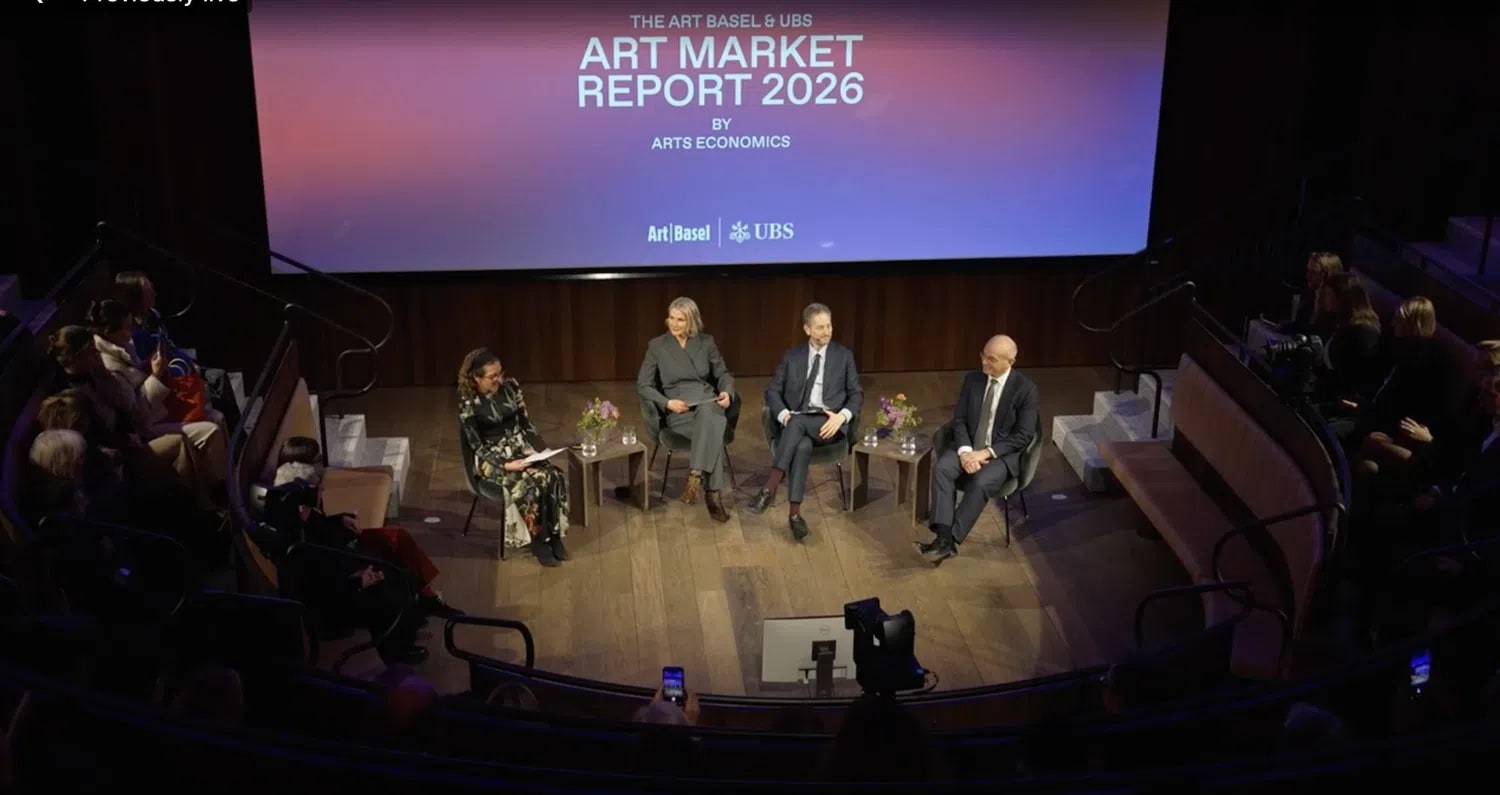
On the report's launch panel, moderated by Financial Times art market columnist Melanie Gerlis, McAndrew offered a concise reading: "Growth has returned, but it's qualified. What we're seeing is a market that is adjusting, with very different experiences depending on where you sit."
That phrase captures the tension running through every page of this tenth edition. A $236 million Klimt and a struggling mid-tier gallery in Chelsea exist in the same market, governed by the same report, separated by everything. A structural rebalancing toward established artists became more evident. While ultra-contemporary art had driven much of the post-pandemic recovery, sales by contemporary art dealers were stagnant in 2025. Dealers specializing in Old Masters recorded growth of 9%, while those focused on Modern art saw sales rise by 11%. Buyers in 2025 wanted certainty. They found it in art history.
Confidence strengthened heading into 2026, with 43% of dealers expecting sales to improve and 38% anticipating stable performance. Sentiment also improved among auction houses. Horowitz called 2025 "a return to growth for the art business and a strategic inflection point in its continued evolution."
An inflection point is not a destination. The market is growing again, but in a body that has changed shape since the pandemic years swelled it to $68 billion. Those who trade in art know the difference between a pulse and robust health. The numbers ticked upward in 2025. Whether the trade that inherits those numbers can sustain them, amid tariff headwinds, generational shifts, and rising costs, is the question the next decade of reports will try to answer. For now, the air has changed. The room is breathing, carefully, and listening for whatever comes next.
Check topics and authors from this story to see more stories like this in your personalized feed and receive updates when new work is published.


