
Few living artists have reshaped the way institutions think about perception quite like a certain 83-year-old Californian pilot-turned-sculptor of light. On June 19, 2026, James Turrell's largest Skyspace to date opened at ARoS Aarhus Art Museum in Denmark, just in time for the summer solstice. Titled As Seen Below, it is the artist's 100th Skyspace installation.
Measuring 16 meters in height and 40 meters in diameter, the work turns the sky into a material presence shaped by architecture, time, and light. That scale is roughly equivalent to the Pantheon's dome in Rome. A six-metre-wide central aperture sits at the apex, framing views of the shifting sky above. Visitors descend through a subterranean corridor before entering the vast domed chamber, where calibrated artificial light washes the interior walls and modulates the color of the sky seen through the oculus.
The installation operates through several modes: in Open Sky, the oculus remains open and frames the sky as a changing field during museum hours; in Colour Shift, the aperture closes, and the chamber becomes a fully interior environment; during Twilight sessions at sunrise and sunset, artificial color moves with changing daylight. The result is a space that never looks the same twice.
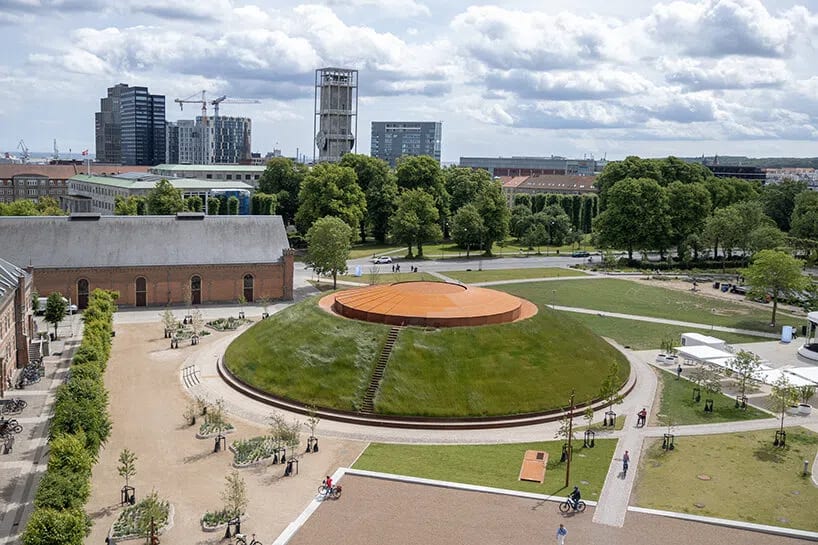
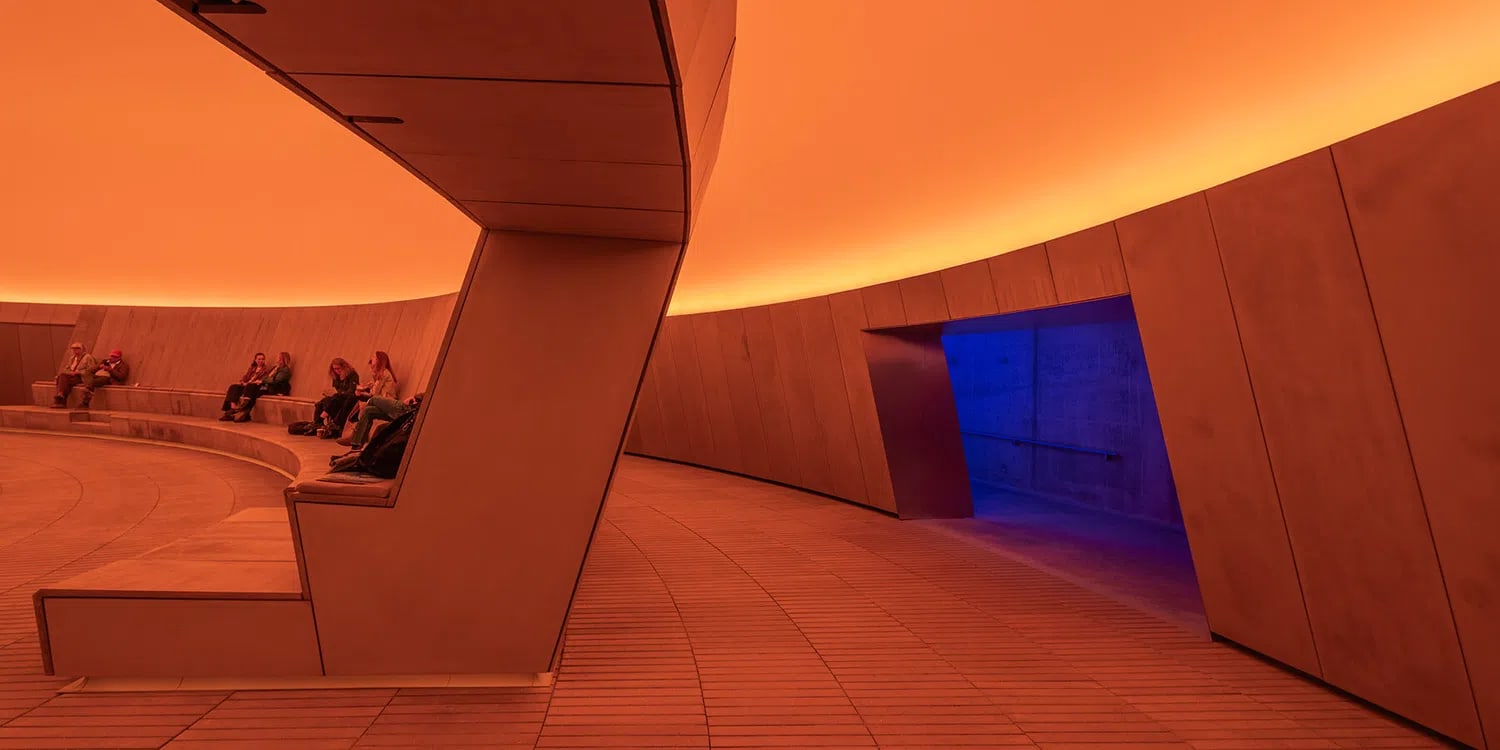
"With As Seen Below, I'm shaping the experience of seeing rather than delivering an image," Turrell said in a statement. "The architecture holds the sky close, so you recognise that the act of looking is the work itself. Here light isn't description; it's the substance you stand within. In this Skyspace, the day has weight, the evening has temperature, and the change belongs to you."
Born in 1943, Turrell is a central figure of the Light and Space movement. He studied perceptual psychology at Pomona College before turning to art at the University of California, Irvine. His Quaker upbringing and experience as a pilot informed his first Skyspace, installed at the Panza Collection in Varese, Italy, in 1974. His still-unfinished Roden Crater project in Arizona's Painted Desert, a volcanic cone turned into a naked-eye observatory, has been in progress since the late 1970s.
ARoS first announced its expansion plans, titled The Next Level, in 2014. Originally due to open in 2023, the project was delayed by financial setbacks. Construction began in June 2022. The completed expansion caps more than two decades of collaboration between the City of Aarhus, ARoS, and Schmidt Hammer Lassen Architects, the firm that designed the museum building that opened in 2004 and facilitated Olafur Eliasson's rooftop Your Rainbow Panorama in 2011.
"It has been a truly unique process to work with James Turrell over so many years," said Jette Birkeskov, partner-in-charge at Schmidt Hammer Lassen. "From the outset, it was clear that the architecture should not simply house the artwork but become part of it."
Rebecca Matthews, director of ARoS, called the work "the artist's most significant Skyspace to date," adding that it is "not only a monumental addition to ARoS but also a gift to the public." Unlike many Skyspaces conceived as intimate encounters, this one is designed as a shared, collective experience of light unfolding over time.
With Eliasson's rainbow walkway above and Turrell's dome below, ARoS now bookends its visitor journey with two of the most ambitious permanent commissions in any European museum. Whether the Danish institution's bet on slow looking can draw a generation raised on speed remains an open question. But As Seen Below makes a persuasive case that the sky is worth pausing for.
Check topics and authors from this story to see more stories like this in your personalized feed and receive updates when new work is published.


