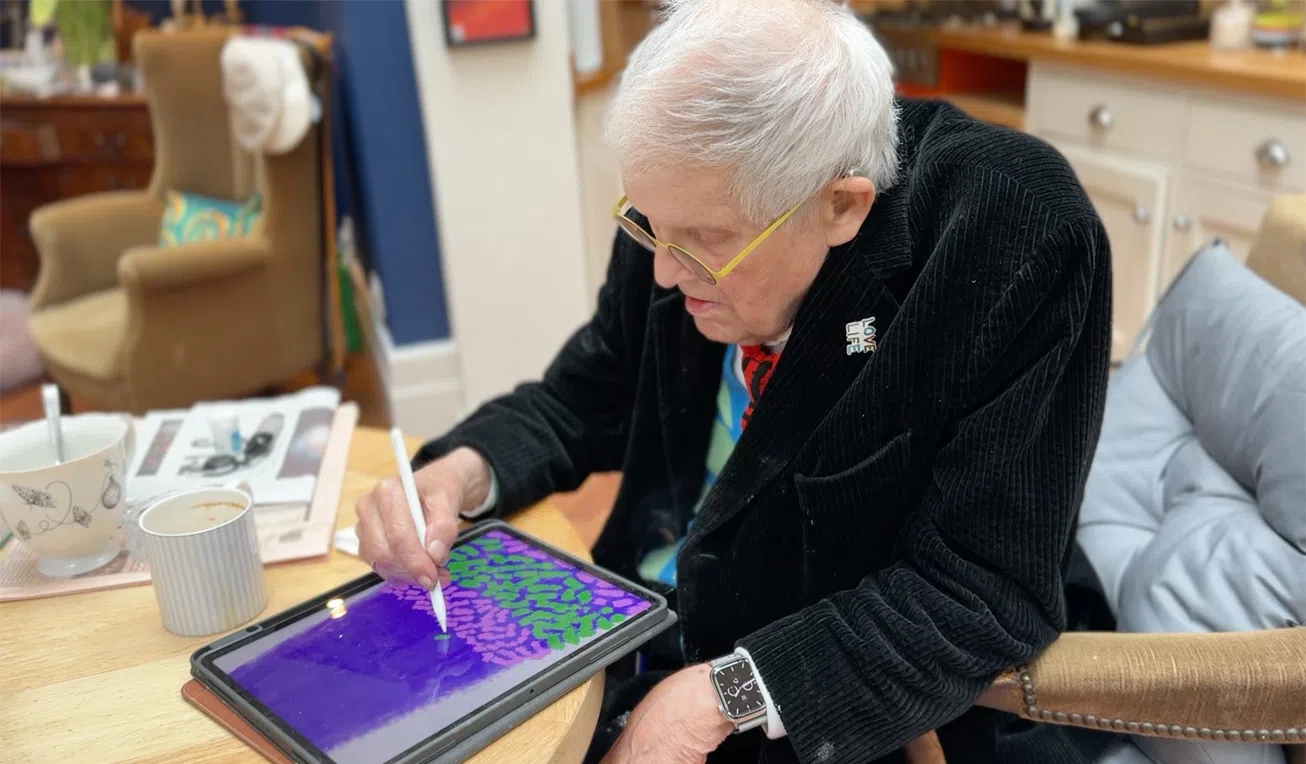

English painter, printmaker, photographer, and stage designer, David Hockney, whose works are characterized by economy of technique, a preoccupation with light, and frank experimentation with media, died on June 11, 2026, in London. He was 88. His representatives confirmed he "passed away peacefully at home on 11 June 2026, one month short of his 89th birthday."
His death arrives at the height of Pride Month. The timing is not incidental. Hockney came out at 23 while studying at the Royal College of Art in London, seven years before the UK decriminalized homosexual acts in 1967. His early 1960s paintings, including "We Two Boys Together Clinging" and "Doll Boy," boldly addressed homosexual love at a time when such themes were socially taboo and legally contentious in Britain. Few artists of his generation carried that exposure so openly, or so early.
The queer politics ran through his activism too. In 1988, a traveling Tate Gallery exhibition was threatened when Hockney announced he would withdraw his own paintings to protest anti-gay legislation in Parliament. The measure was defeated, and the show went ahead.
His later chapters, though, belonged to a different kind of disruption. In 2007, Hockney acquired an iPhone solely for communication. His sister, Margaret, recommended an art-making app called Brushes. Shortly after he started using it in 2009, he grew immediately enamored with fusing technology and artistic production. When the iPad launched, he adopted Brushes there too, and was fascinated by the opportunities the device offered.
What followed was not a novelty phase. Then in his early seventies, Hockney embraced the iPad as a primary tool, and his digital drawings became a central part of his practice, enabling him to work en plein air, experiment rapidly with line and colour, and redefine what digital art can be. He described the device as "an endless piece of paper" at his fingertips.
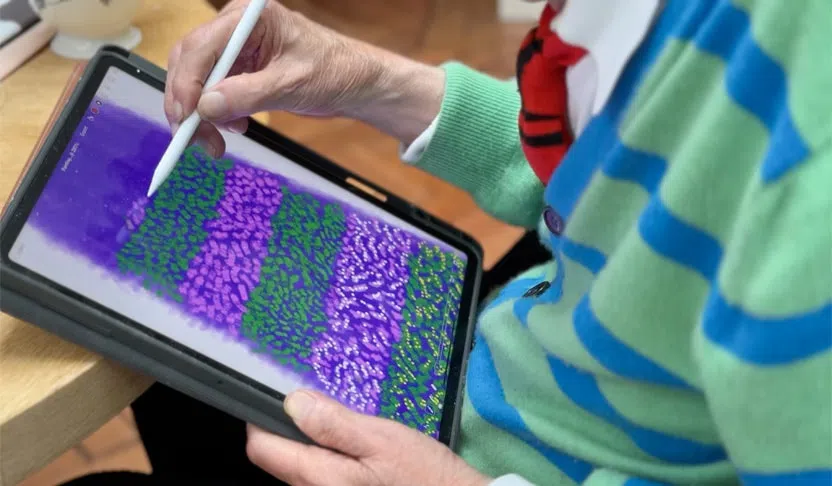
The scale he eventually achieved with it was remarkable. His work "A Year in Normandie" is a 90-metre composite iPad painting made during the pandemic, comprising 220 panels depicting the changing seasons around his French garden, inspired by the Bayeux Tapestry and Chinese scrolls. The piece was shown at the Serpentine this spring under the exhibition "David Hockney: A Year in Normandie and Some Other Thoughts About Painting."
The institutional art world caught up. Major museums, including the Metropolitan Museum of Art, have acquired his iPad drawings for their permanent collections, accepting them as original artworks. A custom app, Hockney Brushes, was built to his specifications, enabling his studio to take iPad-scale paintings into formats of up to 16K and beyond for prints, animation playback, and immersive installations.
That pipeline matters for what Hockney leaves behind. By working on a consumer device in a widely available app, he made a clear argument: tools do not determine legitimacy. Anyone with a tablet could follow the same impulse. Whether or not they achieved the same result was beside the point.
His statement, released after his death, described his "enduring legacy" as reflecting his "investigative curiosity encapsulated by his signature phrase: Love Life."
The Tate confirmed it will continue working with Hockney's team on two planned projects for next year: a major exhibition at Tate Britain spanning seven decades of work, and a multimedia installation in Tate Modern's Turbine Hall bringing his opera set designs to life. He is survived by his longtime partner and former assistant, Jean-Pierre Gonçalves de Lima, and his brothers Philip and John.
The breadth of that coming programme suggests the institution understands what is at stake. Hockney's willingness to be photographed drawing on a screen, at his age, with his reputation, changed the conversation around digital creativity in ways that no press release could. That permission he extended to ordinary makers may prove the most durable thing he left behind.
Follow topics and authors from this story to see more stories like this in your personalized feed and receive updates when new work is published.