Skip to content

Helen Cammock Withdraws Video From National Portrait Gallery

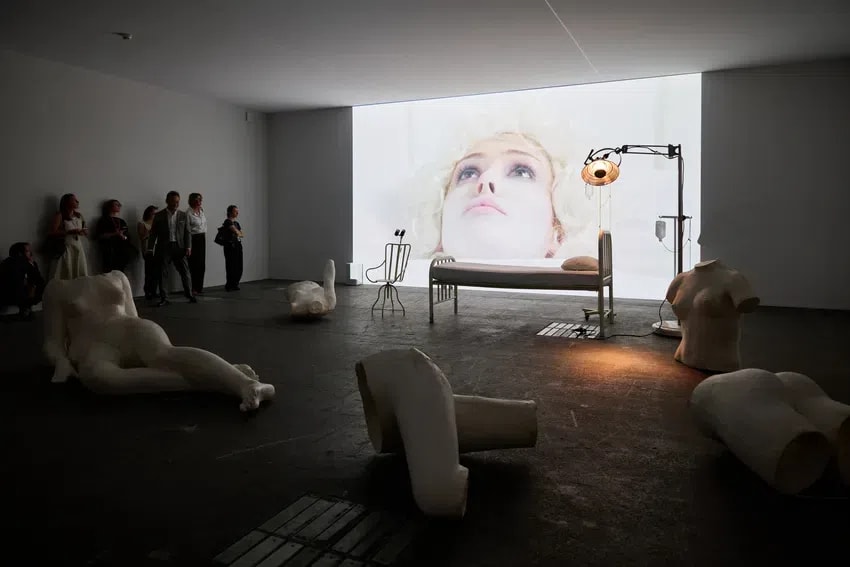
Turner Prize-winning artist Helen Cammock withdrew her video installation, Persistence, from the National Portrait Gallery (NPG) in London following an intense public controversy regarding its depiction of Winston Churchill.The ControversyThe Claim: In her 40-minute video work, Cammock compared Oliver Cromwell's 17th-century military campaigns in Ireland to Churchill's actions during the 1943 Bengal famine, stating that Cromwell "starved people, en masse, a little like the wilful starvation of the Indian population by Winston Churchill."The Backlash: The installation provoked a swift response from historians and politicians. Churchill biographer Lord Andrew Roberts organized an open letter signed by more than 50 members of the House of Lords—including Churchill’s grandson, Sir Nicholas Soames—condemning the film's characterization as historically inaccurate. Critics argued the famine was caused by a typhoon and wartime supply disruptions rather than intentional policy.The Artwork ExplainedThe Commission: The film was commissioned in 2023 as part of the NPG's Artists First: Contemporary Perspectives on Portraiture initiative, which was supported by Chanel.The Core Themes: Persistence was designed as a creative critique of the gallery's permanent collection, questioning power dynamics, institutional erasure, and who historically receives the honor of portraiture.The Subjects: Alongside historical critiques, the film spotlighted marginalized or historically overlooked figures, such as suffragette Ethel Smyth, computer pioneer Ada Lovelace, and 19th-century Scottish fishing communities.The AftermathThe film originally opened in September 2025 and was scheduled to run through August 2026. However, following the mounting backlash, Cammock requested the piece be taken down.In a statement, the National Portrait Gallery clarified that they respect her decision and support artistic freedom, though they noted the film was an artistic expression and not a documentary. Cammock stood by the academic underpinning of her query but expressed disappointment over external pressures, stating that challenging institutional histories is vital to a healthy society.

Helen Cammock after being announced as the winners for the 2019 Turner Prize. PA

The Turner Prize-winning artist's 40-minute film "Persistence" was pulled following backlash from more than 50 members of the House of Lords over its depiction of the 1943 Bengal famine

Questions about what belongs on the walls of Britain's national institutions tend to simmer quietly until they don't.

Helen Cammock has withdrawn her video installation Persistence from the National Portrait Gallery following intense debate over its depiction of Winston Churchill's role in the 1943 Bengal famine. The work, commissioned as part of the gallery's Artists First programme, had been on display since September 2025 and was due to remain until August 2026.

The 40-minute video referred to "the wilful starvation of the Indian population by Winston Churchill" during the famine, while comparing his conduct with Oliver Cromwell's campaigns in Ireland. The catastrophe claimed an estimated three million lives in British-ruled India and remains the subject of ongoing historical debate.

Sir Winston Churchill (1874–1965) was a monumental British statesman, military officer, and Nobel Prize-winning author who famously rallied the United Kingdom from the brink of defeat to victory as Prime Minister during World War II (1940–1945). Born into an aristocratic family at Blenheim Palace, he began his career as a cavalry officer and war correspondent, gaining national fame for escaping a prison camp during the Second Boer War before entering Parliament in 1900. Over a diverse, six-decade political career that saw him switch political parties and hold high offices like First Lord of the Admiralty and Chancellor of the Exchequer, his definitive historical legacy was forged in 1940 through his defiant oratory and strategic alliance with the US and USSR to defeat Nazi Germany. He later served a second peacetime term as Prime Minister (1951–1955) focused on Cold War diplomacy, while also cementing his artistic legacy as an avid landscape painter and historian, earning the 1953 Nobel Prize in Literature. Despite his widely venerated status as a savior of Western democracy, Churchill's unwavering imperialism and controversial decisions—such as his handling of the 1943 Bengal famine—continue to draw intense modern debate.
Sir Winston Churchill in the cabinet room at 10 Downing Street. PA

Criticism escalated after historian and former gallery trustee Andrew Roberts wrote to "protest in the strongest possible terms." Roberts, a Churchill biographer, dismissed the installation as an "ideologically motivated rant." His letter was countersigned by more than 50 members of the House of Lords, including Churchill's grandson Nicholas Soames and former gallery trustee Michael Hintze.

Both Cammock and the gallery initially defended the work, with the institution stating that the commission was presented as an artistic piece rather than a documentary. This week, however, the gallery confirmed Persistence had been removed at the artist's request.

Born in Staffordshire in 1970, Cammock came to art after a decade working as a social worker. Her practice spans moving image, photography, poetry, spoken word, song, printmaking and installation. She was jointly awarded the 2019 Turner Prize alongside Tai Shani, Oscar Murillo and Lawrence Abu Hamdan after the four nominees asked the jury to share the honour. Her Turner entry, The Long Note, examined women's roles in Derry's civil rights movement. In 2023, she received a Paul Hamlyn Foundation Award for Artists.

In a statement, Cammock said: "There is an incredible pressure on artists and arts institutions to bend to external pressure; to be benign at best and silent at worst." She added: "I do not accept this pressure. To question, challenge and explore ideas and histories is vital to a healthy society, and art is intrinsic to this."

The Artists First: Contemporary Perspectives on Portraiture programme, supported by the CHANEL Culture Fund, invited eight contemporary artists to create new works reclaiming untold narratives alongside the gallery's historic collection. Portraiture, understood as a conduit for the affirmation of power and presence, sat at the heart of Cammock's layered approach. That framework now has a conspicuous gap.

The gallery said it recognised "the legacy of those portrayed on our walls, just as we respect artistic expression." Holding both positions at once, as several commentators have noted, is considerably harder than stating them. Whether the withdrawal sets a precedent for how publicly funded institutions handle contested historical narratives in commissioned art is a question that will outlast the news cycle. For now, the screen is dark.

Check topics and authors from this story to see more stories like this in your personalized feed and receive updates when new work is published.
More

Let's find more interesting stories in Art like this

See all