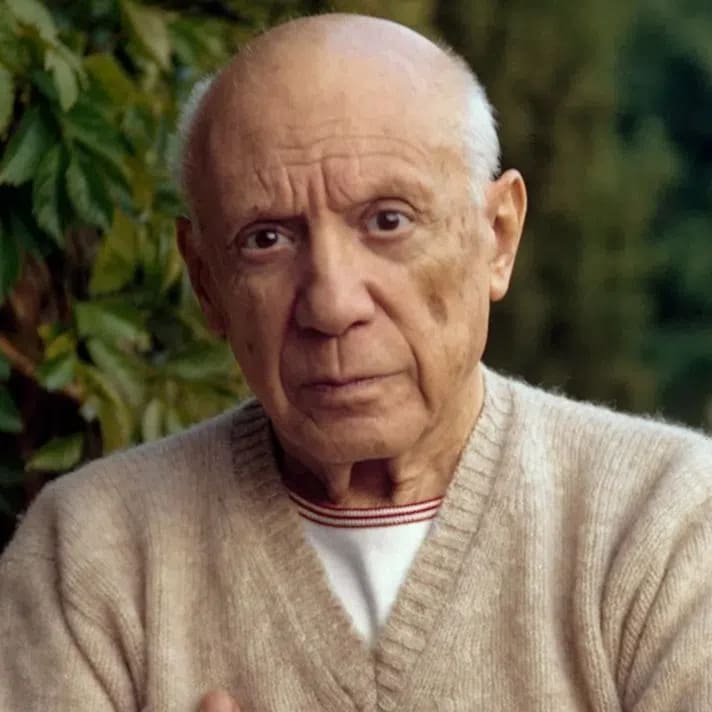
Pablo Picasso, born Pablo Ruiz Picasso on October 25, 1881, in Málaga, Spain, is widely regarded as one of the greatest and most influential artists of the 20th century. A Spanish painter, sculptor, printmaker, ceramicist, and theatre designer, he co-founded the Cubist movement and produced an estimated 50,000 artworks over his 78-year career. His revolutionary approaches to form, color, and perspective fundamentally changed the course of modern art.
Early Life and Education
Picasso was born into a creative family. His father, José Ruiz y Blasco, was a painter and art teacher who gave him formal training from a very young age. Legend has it that Picasso's first word was "piz," short for lápiz (pencil). By age 13, his talent surpassed his father's, who reportedly stopped painting after recognizing his son's genius. The family moved to Barcelona in 1895, where Picasso attended the School of Fine Arts (La Llotja). He later studied in Madrid at the Royal Academy of San Fernando but found the rigid academic training stifling and spent more time at the Prado Museum copying masters like El Greco and Velázquez.
Blue Period (1901–1904)
After moving to Paris in 1900, Picasso faced poverty and the suicide of his close friend Carlos Casagemas. This led to his Blue Period, characterized by somber blue and blue-green tones depicting themes of poverty, loneliness, and despair. Iconic works include "The Old Guitarist" and "La Vie." These paintings reflect his emotional state and social commentary on the marginalized people of Paris and Barcelona.
Rose Period (1904–1906)
Picasso's mood lightened after meeting Fernande Olivier. His palette shifted to warmer pinks, beiges, and reds. He painted circus performers, harlequins, and acrobats with a more optimistic tone. This period marked his growing confidence and the beginning of his exploration into more abstracted forms.
Cubism and African Influence (1907–1914)
In 1907, Picasso painted "Les Demoiselles d'Avignon," a groundbreaking work that shocked the art world with its angular figures and incorporation of African mask influences. Collaborating with Georges Braque, he developed Cubism, which broke objects into geometric shapes and presented multiple viewpoints simultaneously. Analytical Cubism (1909–1912) focused on deconstruction, while Synthetic Cubism (1912–1914) introduced collage elements like newspaper clippings. This period redefined representation in art.
Neoclassicism and Surrealism
During World War I, Picasso returned to more figurative styles with Neoclassical works. In the 1920s and 1930s, he engaged with Surrealism, creating distorted, dreamlike figures. His personal life, marked by turbulent relationships with women like Olga Khokhlova, Dora Maar, and Marie-Thérèse Walter, often influenced his art.
Guernica and Political Activism
In 1937, Picasso created "Guernica," a monumental anti-war painting in response to the bombing of the Basque town during the Spanish Civil War. This black-and-white masterpiece became a universal symbol of the horrors of war and fascism. Picasso remained politically active, joining the Communist Party in 1944 and creating works protesting oppression.
Later Career: Sculpture, Ceramics, and Printmaking
After World War II, Picasso settled in the South of France. He experimented extensively with sculpture, using found objects, and produced thousands of ceramics in Vallauris. His late works, often called his "second youth," show energetic, expressive styles with vibrant colors and bold forms. He continued working until his death on April 8, 1973, in Mougins, France, at age 91.
Legacy and Influence
Picasso's impact on modern and contemporary art is immeasurable. He influenced countless movements including Abstract Expressionism, Pop Art, and Minimalism. Major museums like the Musée Picasso in Paris and the Museo Picasso in Málaga house vast collections of his work. His personal life, marked by complex relationships and a larger-than-life persona, continues to fascinate scholars and the public alike. Picasso remains a towering figure whose innovation, versatility, and prodigious output define artistic genius in the modern era.
Throughout his life, Picasso's restless creativity led him through numerous stylistic phases. From the melancholic Blue Period to the groundbreaking Cubist experiments, from powerful political statements to playful ceramics, his work consistently challenged conventions and expanded the boundaries of visual language. He once said, "I do not search, I find," reflecting his intuitive approach to creation. His enormous body of work, spanning paintings, sculptures, drawings, prints, and more, ensures his place as a cornerstone of 20th-century art history. Scholars continue to study his techniques, influences from Iberian, African, and classical art, and his role in shaping the avant-garde. Today, Picasso's masterpieces fetch record prices at auctions and draw millions of visitors to exhibitions worldwide, cementing his enduring relevance in contemporary discussions about art, politics, and human expression.