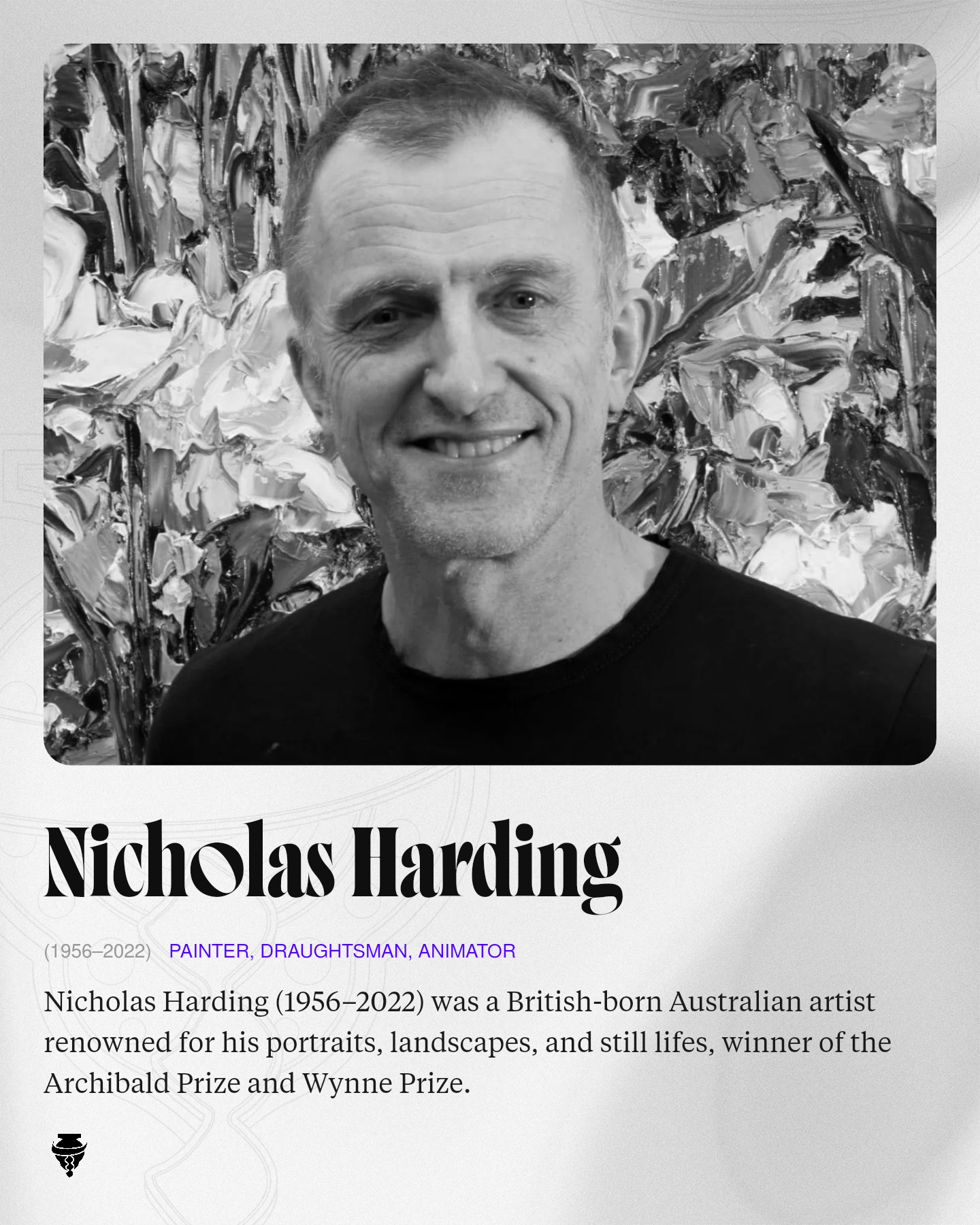
Nicholas Harding
Nicholas Harding (1956–2022) was a British-born Australian artist renowned for his portraits, landscapes, and still lifes, winner of the Archibald Prize and Wynne Prize.
Nicholas Harding (1956–2022) was a British-born Australian artist renowned for his portraits, landscapes, and still lifes, winner of the Archibald Prize and Wynne Prize.
Nicholas Harding (1956–2022) was a British‑born Australian painter and draughtsman celebrated for his vigorous, light‑filled portraits and landscapes rendered in thick impasto oils, watercolours and large‑scale ink drawings. He won major Australian art prizes, represented Australian institutional collections, and was widely admired for work that combined acute observational drawing with an expressive, tactile handling of paint.
Nicholas Harding was born in London in 1956 and emigrated to Australia with his family as a child, growing up on the fringes of the bush near Sydney; this early experience of Australian light and landscape proved formative for his later art. After leaving university Harding trained and worked as an animator (including work on projects connected to well‑known Australian animation traditions), which influenced his strong draftsmanship and narrative sensibility in later painting. He taught himself to paint while working in commercial fields and over time transitioned into the fine‑art world, showing in group and then solo exhibitions from the 1980s and 1990s onward.
Harding became particularly known for his thickly layered, impasto oil paintings that celebrate texture, light and colour; alongside oils he produced watercolours and striking pen‑and‑ink drawings, often on a large scale. His landscapes — bush, coast, and urban fringe scenes — and his portraits share a common emphasis on direct observation and painterly immediacy, with compositions that feel both intimate and robustly worked. Critics and colleagues often noted his ability to “carve light” into forms: the brushwork is confident, sometimes economical, and frequently textured so that paint itself becomes part of the subject’s presence on the canvas.
While Harding worked across genres, portraiture became a signature field in which he won national attention. He was a frequent and celebrated entrant in Australia’s premier portrait competition, the Archibald Prize — exhibiting in it for many consecutive years and finally winning the prize in 2001 with his portrait of actor John Bell as King Lear. That Archibald win marked him as a leading contemporary portraitist, and his sitters also included writers, actors and cultural figures such as Robert Drewe and Hugo Weaving, whose portraits are now held in institutional collections. Harding’s portraits are notable for balancing psychological presence with painterly bravura: they read as immediate encounters rather than formal, academic likenesses.
Over his career, Harding received major awards and prizes, including the Archibald Prize and the Dobell Drawing Prize, and the Mosman Art Prize early in his career. His work was the subject of retrospectives and focused exhibitions — for example a major retrospective titled Nicholas Harding: Drawn to Paint at the SH Ervin Gallery (2010) and other curated survey shows such as Carving Light and Landscape (Tweed Regional Gallery, 2015) and a 2017 National Portrait Gallery presentation, Nicholas Harding: 28 Portraits. Harding’s paintings and drawings are represented in major public collections around Australia — notably the National Gallery of Australia, the Art Gallery of New South Wales, the Art Gallery of South Australia and the National Portrait Gallery — and in private and corporate collections internationally.
Harding’s subject matter repeatedly returned to the Australian environment — scrubby bush, coastal scenes, railway tracks and the lived surfaces of inner‑city streets — and to human subjects captured in moments of concentration or quiet intensity. His early move from England and the contrast of English muted light with Australia’s glare and colour often gets cited as a decisive influence that pushed him toward capturing high‑contrast, sunlit scenes and the radiance of local vegetation and beaches. His background in animation and commercial art provided a firm drawing discipline that underpinned his freer painterly gestures, making his work both technically assured and emotionally honest.
Harding was widely respected by peers, critics and collectors for his craftsmanship and energetic handling of the medium; obituaries and reviews following his death noted a genial personality, a passionate dedication to making work, and an unpretentious devotion to seeing and representing the world around him. His ability to move between media — powerful ink drawings to tactile oils and fluid watercolours — meant he influenced younger Australian painters interested in combining drawing and painterly texture. Institutions continue to show and collect his work, ensuring his visual approach and subjects remain part of Australia’s contemporary art conversation.
Key works in Harding’s oeuvre include the Archibald Prize–winning Portrait of John Bell as King Lear (2001) and various portraits of cultural figures now held by the National Portrait Gallery, as well as many landscapes and still life paintings that travel between intimate observation and expansive handling of paint. His work is held in the National Gallery of Australia, the Art Gallery of New South Wales, the National Portrait Gallery and other public collections, and continues to appear in gallery exhibitions and auction rooms across Australia.
Harding lived and worked in Sydney with his family and continued to paint prolifically into later life; he also undertook artist residencies internationally (including at the Cité des Arts Internationales in Paris) and residencies in Australia such as Bundanon, which fed directly into his landscape practice. He died in November 2022 after a recurrence of cancer; his passing prompted tributes across Australia from galleries, fellow artists and critics who celebrated his technical gifts and his ability to find “beauty and colour everywhere” in everyday scenes.
It wasn’t until I got to my early 30s I really started to focus and realised this is the main game, this is what I want to do. So it’s really been one painting leading to another. But every one of them – whether it’s a failure or a mediocre success or an outstanding success – each one leads you to the next.
Nicholas Harding