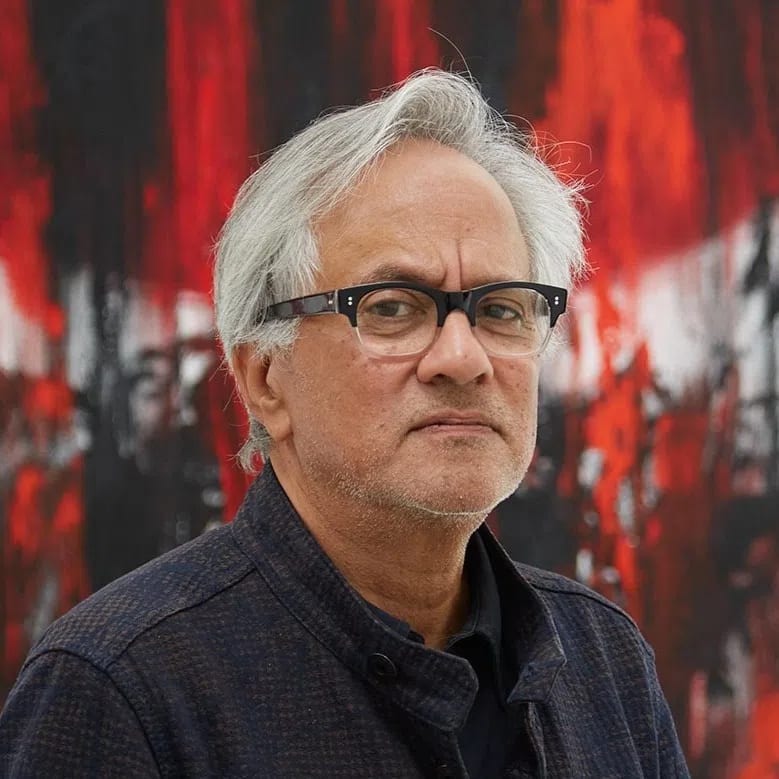
Sir Anish Kapoor CBE RA is one of the most influential sculptors working today. Born in India and based in London, he creates monumental installations that explore ideas of void, space, reflection, and perception. His works transform public spaces into immersive experiences. They challenge how viewers understand form, depth, and reality itself. Kapoor blends influences from Eastern philosophy with Western minimalist traditions. This makes his art both visually striking and deeply conceptual.
Early Life and Education
Anish Kapoor was born in 1954 in Bombay, now Mumbai, India. His father was a Hindu from India, and his mother was a Jewish Iraqi immigrant. This mixed heritage shaped his early worldview. As a young man, he moved to Britain in 1973 to pursue higher studies. He first attended Hornsey College of Art in London. There he began exploring basic materials and forms. He then continued his training at Chelsea School of Art. These years were crucial. They helped him develop a strong interest in sculpture and the physical properties of objects.
Developing a Practice
In the early 1980s, Kapoor gained international attention with his pigment sculptures. These vibrant mounds of raw powdered pigment in intense colors like red, yellow, and blue evoked landscapes, bodies, and sacred sites. They appeared both solid and soft at the same time. This duality became a hallmark of his work. Over time, he expanded his vocabulary. He started using reflective stainless steel surfaces that mirror and distort the environment. These concave and convex forms create illusions of infinite depth. They seem to pull viewers into another dimension. Kapoor also works with wax, resin, PVC, and other materials. His practice constantly questions the boundaries between inside and outside, presence and absence.
Major Works and Exhibitions
One of Kapoor's most famous pieces is Cloud Gate from 2006. Located in Chicago's Millennium Park, this giant bean-shaped sculpture reflects the city skyline in its polished stainless steel surface. Locals affectionately call it The Bean. It has become an iconic landmark. Another major public commission was the ArcelorMittal Orbit tower for the 2012 London Olympics. Standing tall in Queen Elizabeth Olympic Park, it combines sculpture with architecture. Kapoor has created numerous site-specific installations worldwide. These include works for the Venice Biennale, where he represented Britain in 1990. He also participated in Documenta and many museum exhibitions. Recent projects feature large-scale voids and mirrored forms that engage with architecture and natural landscapes. His Sky Mirror series places huge concave mirrors in outdoor settings. They reflect the sky and surroundings in surprising ways. Kapoor continues to receive important commissions. His works appear in permanent collections of leading institutions such as Tate Modern in London, the Museum of Modern Art in New York, and the Guggenheim museums.
Recognition and Awards
Kapoor has received many prestigious honors. He won the Turner Prize in 1991, one of the highest accolades in British art. In 2013, he was knighted by Queen Elizabeth II for his services to visual arts. He also received the Praemium Imperiale in 2017 from the Japan Art Association. This award recognizes lifetime achievement in the arts. His influence extends beyond sculpture. Kapoor has collaborated with architects and engineers on ambitious projects. Critics praise his ability to make abstract concepts tangible and experiential. He remains active with new explorations into material science and perception. Collectors and museums worldwide seek his pieces. Kapoor's art invites contemplation. It encourages viewers to slow down and engage with their surroundings in fresh ways.
Themes and Philosophy
At the core of Kapoor's practice lies a fascination with the void. He often speaks about emptiness as a space full of potential. His works play with light, shadow, color, and surface. They create moments of wonder and disorientation. Many pieces reference spiritual or ritualistic traditions from different cultures. Yet they avoid literal storytelling. Instead, they offer open-ended experiences. Kapoor draws from Indian heritage, Jewish mysticism, and European modernism. This rich background informs his unique voice in contemporary art. His sculptures are not just objects to look at. They are environments to enter and inhabit. This immersive quality defines much of his output over the past four decades.
Legacy and Influence
Anish Kapoor has profoundly shaped the field of contemporary sculpture and installation art. His bold public works have redefined how art interacts with urban spaces. Generations of younger artists look to his example when exploring scale, material innovation, and viewer participation. Despite his global success, Kapoor maintains a studio practice rooted in experimentation. He continues to push technical and conceptual boundaries. From pigment piles in the 1980s to vast mirrored forms today, his evolution shows a consistent commitment to exploring the unknown. His contribution goes beyond individual artworks. Kapoor has helped elevate sculpture as a vital medium for addressing philosophical questions in the modern world. Through his art, he reminds us of the power of form to transform perception and connect people across cultures.