
Amedeo Modigliani was an Italian painter and sculptor known for his distinctive elongated figures, elegant portraits, and nudes that blended modernism with classical influences. Born in Livorno, Italy, he moved to Paris where he became a central figure in the avant-garde scene despite a short and troubled life marked by poverty and illness. His unique style continues to captivate audiences worldwide with its poetic grace and emotional depth.
Amedeo Modigliani was an Italian painter and sculptor best known for his elegant portraits, nudes, and elongated figures, and he became one of the most distinctive artists of the early 20th century. He was born in Livorno, Italy, on July 12, 1884, and died in Paris, France, on January 24, 1920, at only 35 years old.
Amedeo Clemente Modigliani came from a Sephardic Jewish family in Livorno, a port city in Tuscany, Italy. His family had financial problems around the time of his birth, and his education was disrupted by illness from an early age. He suffered serious health problems as a child, including pleurisy and typhus, and later tuberculosis, which shaped much of his life and work.
Because of repeated illness, Modigliani did not follow a normal schooling path. Instead, he developed an early interest in art, literature, philosophy, and culture, reading widely while recovering from sickness. This intellectual curiosity later influenced the seriousness and intensity of his artistic style.
In 1898, Modigliani began drawing lessons with Guglielmo Micheli in Livorno and joined Micheli’s studio the following year. In 1902, he enrolled at the Academy of Fine Arts in Florence, where he studied sculpture, and in 1903 he moved to Venice to continue his studies at the Institute of Fine Arts. These years gave him technical training and exposed him to wider artistic currents in Italy.
His early artistic development was shaped by both traditional Italian art and modern influences. He was interested in the work of the Post-Impressionists, the Symbolists, and later in avant-garde movements he encountered in Paris. His health remained fragile during this period, and he continued to struggle with the consequences of tuberculosis.
Modigliani moved to Paris in 1906, settling in Montmartre, where he entered a highly creative artistic environment. Paris at the time was the center of modern art, and he quickly met important artists, poets, dealers, and writers. Among the figures he encountered were Picasso, André Derain, Juan Gris, Max Jacob, Guillaume Apollinaire, and others associated with the avant-garde.
He also met Paul Alexandre, who became his first important patron and close friend. Alexandre supported Modigliani financially and intellectually and helped him gain access to the art world. This support was especially important because Modigliani often lived in poverty and struggled with illness, alcohol, and unstable living conditions.
Around 1909, Modigliani moved to Montparnasse and became close to Constantin Brâncuși, whose ideas strongly affected him. Brâncuși encouraged him to think about form in simpler, more essential ways. Under this influence, Modigliani began concentrating on sculpture and created a series of carved heads, caryatids, and standing figures between roughly 1909 and 1914.
His sculpture often showed the same kind of stylization that later appeared in his paintings: elongated necks, simplified features, and a strong sense of linear elegance. He was also influenced by African art and the idea of “essential” form, which was important in the Paris avant-garde at the time. Despite his artistic ambition, sculpture was physically demanding, and his poor health likely contributed to his eventual return to painting.
By about 1914, Modigliani increasingly returned to painting, encouraged in part by the dealer Paul Guillaume. This period marked the beginning of the mature style for which he is now famous. He developed a distinctive visual language with long necks, oval faces, almond-shaped eyes, slim bodies, and a calm but haunting stillness.
His portraits often show friends, lovers, fellow artists, patrons, and acquaintances. Rather than aiming for realistic likeness alone, he sought psychological presence and formal beauty. His paintings combine simplified structure with emotional intensity, and his figures often appear both intimate and distant at the same time.
Modigliani’s style is immediately recognizable. His portraits and nudes are known for asymmetrical compositions, elongated forms, simplified contours, and a restrained but powerful use of line. He avoided dramatic movement and complex backgrounds, preferring to focus attention on the figure itself.
A recurring feature in his portraiture is the treatment of the eyes, which are sometimes blank, shadowed, or painted without pupils. This gives many of his figures a mysterious, inward quality. His nudes, especially those made in 1917, were considered shocking when first shown because of their frank sensuality and directness. Today they are among his most celebrated works.
He was not a painter of social scenes, narrative events, or elaborate symbolism in the usual sense. Instead, he concentrated on the human figure as a site of beauty, tension, and emotional depth. That focus made his work feel both classical and modern at once.
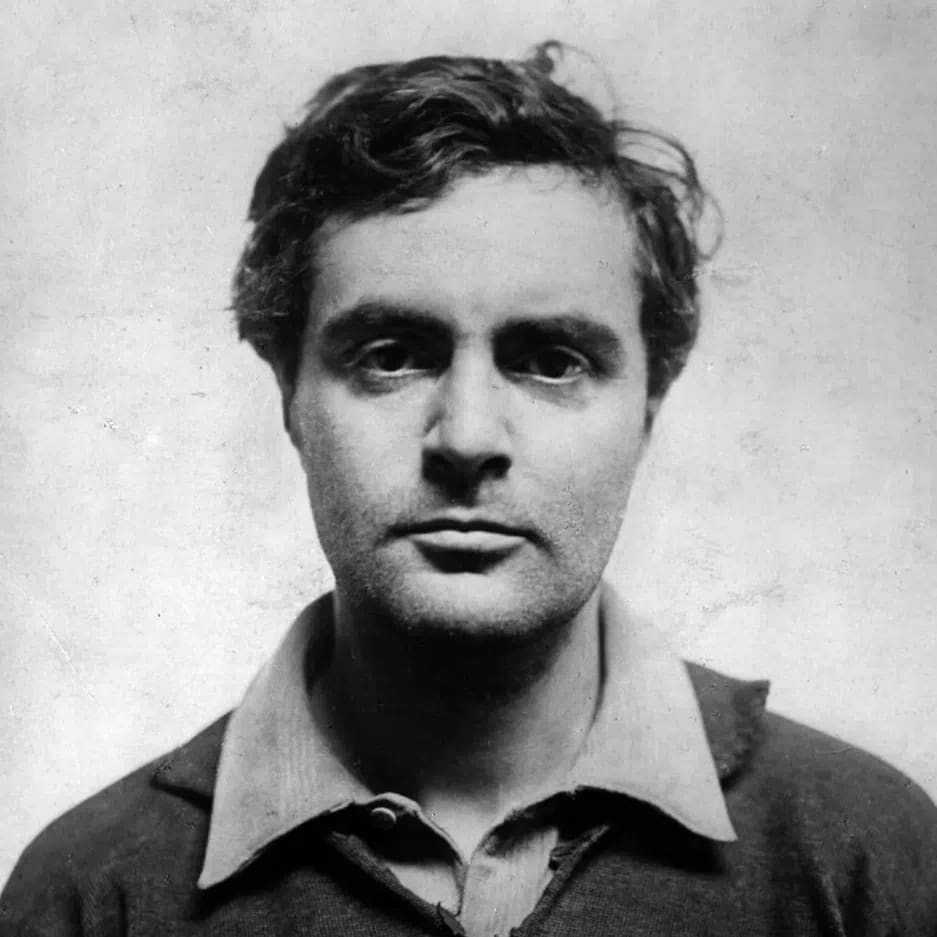
Modigliani’s personal life was closely tied to his art. He had important relationships with several women, including the English poet and writer Beatrice Hastings and the artist’s model and painter Jeanne Hébuterne. Hastings was his companion for about two years and appears in some of his works.
Jeanne Hébuterne became his most famous partner. They lived together, and she gave birth to their daughter in 1919. Their relationship was passionate but difficult, shaped by poverty, illness, and Modigliani’s self-destructive habits. After his death, Hébuterne died by suicide, two days later, a tragedy that became part of the artist’s legend.
During his lifetime, Modigliani had only limited public success. He exhibited at the Salon d’Automne and the Salon des Indépendants in Paris, but he was not widely celebrated while alive. In 1917, he had his only solo exhibition during his lifetime at Galerie Berthe Weill, where his nude paintings caused controversy.
Although he had some support from collectors and dealers, he remained poor for much of his life. His work was often undervalued in comparison with that of some of his contemporaries. However, after his death, his reputation rose dramatically, and he came to be regarded as one of the great modern artists of the 20th century.
The final years of Modigliani’s life were marked by worsening health, poverty, alcoholism, and drug use. He continued to work in Paris and the south of France during and after World War I. In 1919, he returned to Paris, and some of his work was shown in London that same year.
He became seriously ill and died of tuberculosis in Paris on January 24, 1920. He was only 35 years old. His death ended a career that had been brief but intensely productive, and it also deepened the tragic image that later surrounded his life.
Today Modigliani is remembered as one of the most important modern portraitists. His work is represented in major museums and private collections around the world. He is especially admired for transforming portraiture into a more modern, expressive, and lyrical form.
His influence can be seen in later figurative painting, sculpture, and even in popular culture, where his stylized faces have become widely recognized. The market value of his paintings has also become extremely high, reflecting both his rarity and his lasting fame. Despite a life of hardship, he left a body of work that remains instantly identifiable and deeply influential.
When I know your soul, I will paint your eyes.
— Amedeo Modigliani