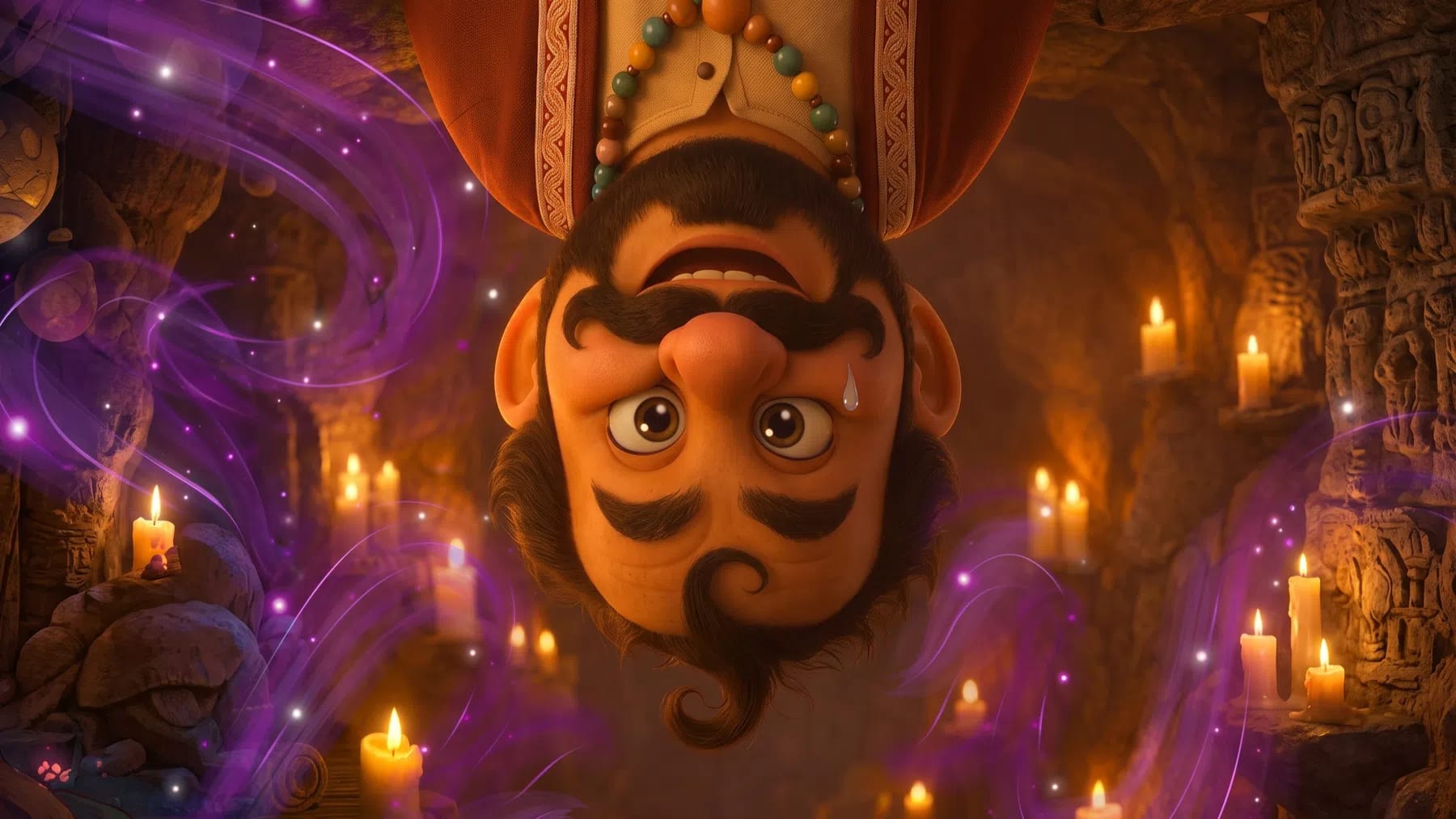

There was a specific kind of silence that fell over Pakistani households on certain evenings in the 1990s, right when a wobbly title card announced a bespectacled genie was about to arrive. Kids abandoned homework. Parents stopped mid-sentence. For fifteen minutes, a state broadcaster with no competition owned the room.
That memory is now being reanimated by a computer, and not everyone is comfortable watching it happen.
Ainak Wala Jin - The Movie, billed as Pakistan's first fully AI-generated feature film, is set to open in cinemas nationwide on Friday, July 24, 2026, and it has already ignited a debate that has less to do with genies and more to do with what counts as filmmaking anymore.
The project comes from Farhan Khan, a Punjab University alumnus working as a filmmaker, journalist, and writer. Produced by Faisal Saleem in collaboration with the PTV Network. The plot follows a boy raised under his father's strict rule whose life is upended when an old jinn neighbor cracks open a portal into a realm called Kokaf. It is, on paper, a tender premise. The execution is where the trouble starts.
A Genie Worth Remembering
To understand why this film has struck a nerve, you have to understand what it is reviving. The original Ainak Wala Jin was a Pakistani children's television series produced and broadcast by PTV Lahore from 1993 to 1996 and again from 2005 to 2008. Written by Abdul Hameed and steered by director Hafeez Tahir, the show followed a genie sent to Earth for treatment of his eyesight who lands in Lahore and befriends a young boy who loves fantasy. It became appointment viewing for an entire generation.
The genie has already had a life online before this. A seven-episode YouTube series titled Ainak Wala Jin by Reelwind, run by a channel of the same name, has racked up 1.25 million views. That version stayed in the world of online content, a curiosity for anyone scrolling late at night. This one is different. This AI is coming to national theaters.
The state broadcaster leaned into that nostalgia recently, restoring the original episodes for a new digital audience. This new project is a different animal entirely. It swaps hand animation and puppetry for prompt-driven generative tools, and it swaps the original's slow-built charm for something manufactured at a pace that would have been unthinkable to the show's original crew.
I grew up on reruns of the original, and I'll say this plainly: nostalgia is precious cargo, and it deserves better handling than a prompt window.
A Trailer with Someone Else's Fingerprints
Here is where my patience runs out. The trailer and music video for Ainak Wala Jin borrows so heavily from The Little Prince that it stops feeling like homage and starts feeling like laziness.
That 2015 film, directed by Mark Osborne, told its story through a single mother and her young daughter who move to a new neighborhood, with the girl's elderly neighbor opening a door into a fantastical world. The visual grammar of an old, mysterious neighbor unlocking wonder for a lonely child is not a coincidence here. It is a template.
Osborne's film was no shoestring effort either. It carried a budget of $77.5 million and eventually became, per its distribution history, the most successful French animated film abroad of all time after Netflix picked up its English-language rights. Comparing a film built over years by hundreds of artists to a solo, AI-assisted production is not really a fair fight, and yet the visual echoes in the trailer make the comparison unavoidable.
Farhan Khan has said in several morning show interviews that he wrote the story himself. Maybe he did. But watching the footage, it is hard to shake the feeling that the story's bones were borrowed even if the words were his own.
Maryam Zahid, an artist who has been vocal about the film online, put it sharply in an Instagram story. "There are a lot more similarities when you compare the 2015 film to this AI film's trailer," she wrote, "but let's see an interview where the director talks about his process where he claims to have written the story himself."
She didn't stop there.
In a follow-up post, Zahid wrote, "AI is and will always be plagiarism." She added that "every visual plagiarises the work of many artists," and pointed to the environmental cost as well, noting "the data centers are adding towards climate change."
Zahid questioned the motive behind the project, asking, "all for a sloppy film to generate some revenue?" She argued "this is a bad image for Pakistani cinema" and ended with a call for change, urging people to "normalise funding actual artists' projects."

I don't think AI is incapable of making something worthwhile someday. Given real time and real intention, it could be. But that is not what is happening here, and pretending otherwise does a disservice to everyone who has actually put in the hours.
The Ones Who Actually Built It
This is the part that stings most. Pakistan already has proof that patient, human-made animation works.
The Glassworker, directed by Usman Riaz, became Pakistan's first hand-drawn animated feature film. It was a project that took nearly a decade to make. It involved a collection of hundreds of thousands of hand-drawn frames. This was done at a time when trained animators were absent. Funding pipelines were absent. Production infrastructure was absent. Made on a budget of $116,000, it still managed to earn approximately $1.1 million domestically after its release in July 2024, and it screened at Annecy and Hiroshima before landing a U.S. theatrical run.
Riaz has spoken candidly about the grind behind that achievement. In a conversation with Deadline, he said, "With The Glassworker, we have shown the next generation that we can make work like this in Pakistan. This may inspire them to pursue their own dreams and ambitions. I have high hopes and I'm excited for what the future holds."
Then there is The Donkey King, which became the highest-grossing animated feature film in Pakistan, and Allahyar and the Legend of Markhor, which became the first Pakistani animated film to release on Netflix after starting as a modest story about a boy and an endangered markhor.
None of these productions had a state broadcaster as a producing partner. None of them got the kind of institutional backing now flowing toward a film built largely on generative software.
That imbalance is the real headline here, more than any genie or portal to Kokaf.
First Is a Crowded Claim
Khan has also described his film as, in his words, "the world's first AI-generated feature-length film with fully consistent characters and locations throughout the story."
It is a bold claim, and it is not accurate. Around the same period, a Kannada director was already promoting his own project, Love You, as the world's first AI-generated feature film. Italian director Andrea Iervolino has made a similar case for his film The Sweet Idleness, touted as the world's first AI-directed feature film. A Bollywood outfit was reportedly racing toward the same milestone even earlier, with a startup in India making a feature film entirely with AI video generator tools. San Francisco-based Higgsfield AI has staked its own claim with Hell Grind, a 95-minute action-fantasy film billed as the first feature created entirely on its platform.
"First" has become a crowded, almost meaningless word in this particular corner of cinema, claimed by whoever posts the trailer loudest.
None of these change the film's release plans. Ainak Wala Jin is opening at Cinepax Cinemas, Universal Cinemas, Cue Cinemas and ME Cinemas, with listings confirming an opening date of July 24, 2026 across major Pakistani theatre chains. The machinery of distribution does not pause for questions of originality.
An Old Genie, A New Kind of Trick
Here is what keeps nagging at me. The original Ainak Wala Jin worked because a small team without much money or technology chose to care intensely about craft, and audiences could feel that care through the screen. Somewhere between the puppetry of 1993 and the pixels of 2026, that ethic seems to have gone missing.
Hayao Miyazaki did not build a legacy on shortcuts.
If Pakistani cinema wants a real seat at the global table, it will not be a prompt that earns it. It will be the same stubborn, expensive patience that built everything worth watching before it.
The genie is out of the lamp again. This time, I'm not sure anyone should be making a wish.
Check topics and authors from this story to see more stories like this in your personalized feed and receive updates when new work is published.


