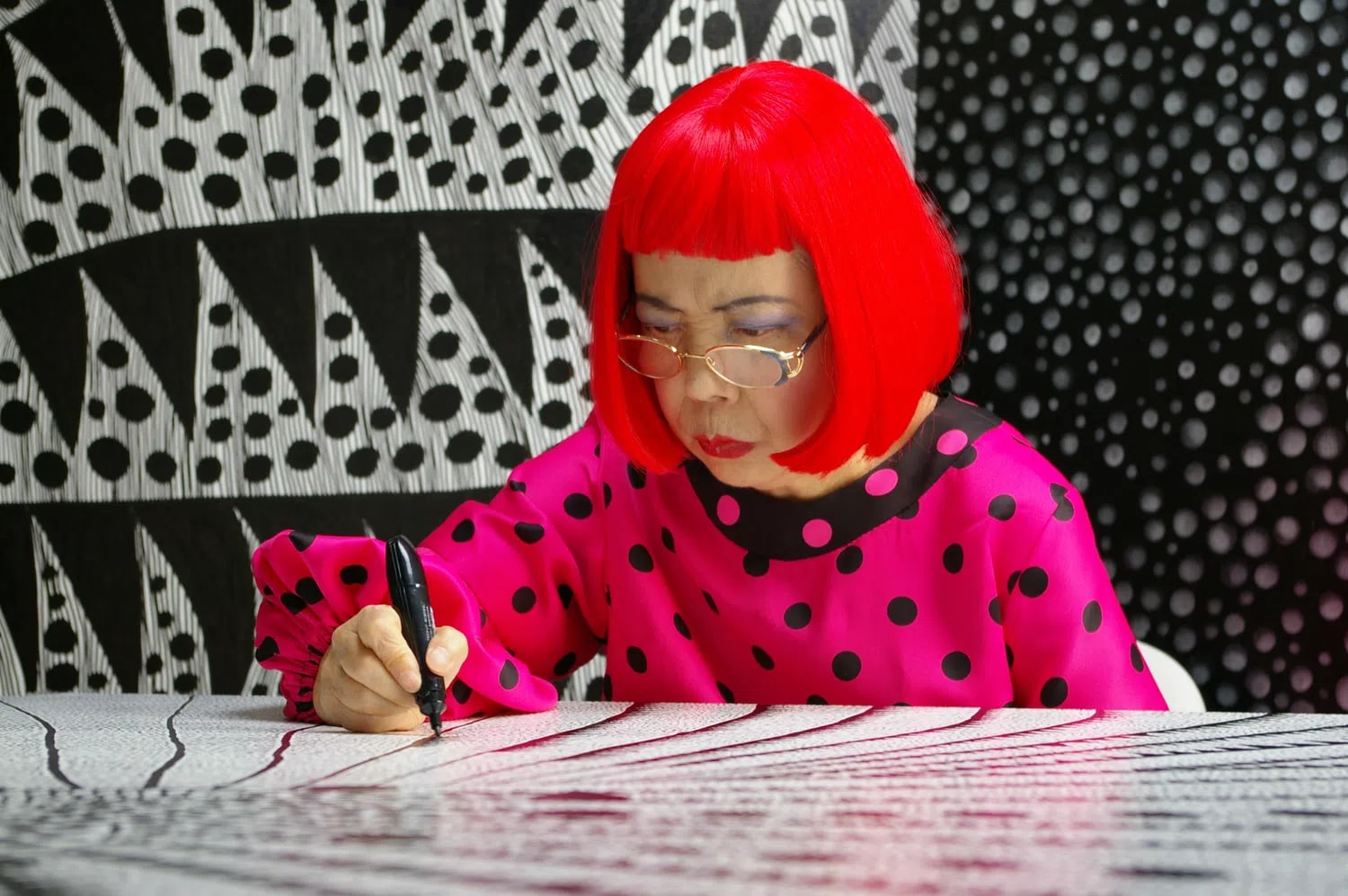
Museums built entire wings around one artist's imagination for the better part of two decades. That era just ended.
Yayoi Kusama, the Japanese artist whose polka dots and mirrored installations became instantly recognizable worldwide, has died at 97. Her official website announced the news on Wednesday.
It gave no cause of death at the time, though her longtime gallery later filled in the gap. David Zwirner, her representative for fifteen years, said Kusama passed away from multiple organ failure at a Tokyo hospital on August 14.
Zwirner did not hold back on what she meant to the field. "It's been one of the great privileges of my professional life to have been able to represent Yayoi Kusama's extraordinary art for the last fifteen years," he wrote, adding that at the time of her passing, Kusama was "without a doubt, the most famous living artist in the world."
Born in 1929 in the rural town of Matsumoto, Kusama decided at 28 that Japanese society was too small and moved alone to New York in 1957. There she navigated a scene dominated by men, eventually earning respect from figures like Donald Judd and Joseph Cornell. She struggled financially and mentally the entire time.
Her hallucinations, present since childhood, became the engine behind everything she made. She once described seeing red flowers spread across "the whole room, my whole body, and the whole universe." That vision turned into the dot-covered canvases and infinity net paintings that defined her practice for seven decades.
In 1966, Kusama essentially crashed the Venice Biennale, scattering 1,500 mirrored balls on the lawn outside the Italian Pavilion without permission. Japan invited her back officially in 1993, this time as its representative.
Around 1977, she voluntarily checked into a Tokyo psychiatric facility. She lived there for the rest of her life, driven each morning to a nearby studio to keep working. Public appearances grew rare in her final years, even as her installations kept expanding into new cities.
The market never stopped rewarding her. Auction sales jumped nearly 160 percent in 2021, reaching $183.5 million. By 2023, Kusama had become the top-selling contemporary artist worldwide, generating $80.9 million and surpassing David Hockney's prior record by more than $30 million.
Her 2014 painting A Flower sold that year for close to $10 million at Christie's Hong Kong.
Institutional interest matched the commercial demand. Tate Modern staged a major retrospective in 2012. The Hirshhorn Museum brought Infinity Mirrors to Washington in 2017. Melbourne's National Gallery of Victoria hosted the largest Kusama survey in the Southern Hemisphere in 2024, featuring close to 200 works.
Louis Vuitton turned her into a global fashion moment too, wrapping its Paris flagship in a giant inflatable likeness of the artist in 2023. A Tokyo museum dedicated solely to her work has stood as a pilgrimage site for fans for years.
Her final major series, Every Day I Pray for Love, began in 2021 and returned to the themes that shaped her entire life. "Our earth is only one polka dot among a million stars in the cosmos," she once wrote.
Retrospectives already scheduled around the world will now double as tributes to a career nobody in contemporary art fully matched.
Check topics and authors from this story to see more stories like this in your personalized feed and receive updates when new work is published.


