
Few municipal art controversies arrive prepackaged with their own punchline quite like this one.
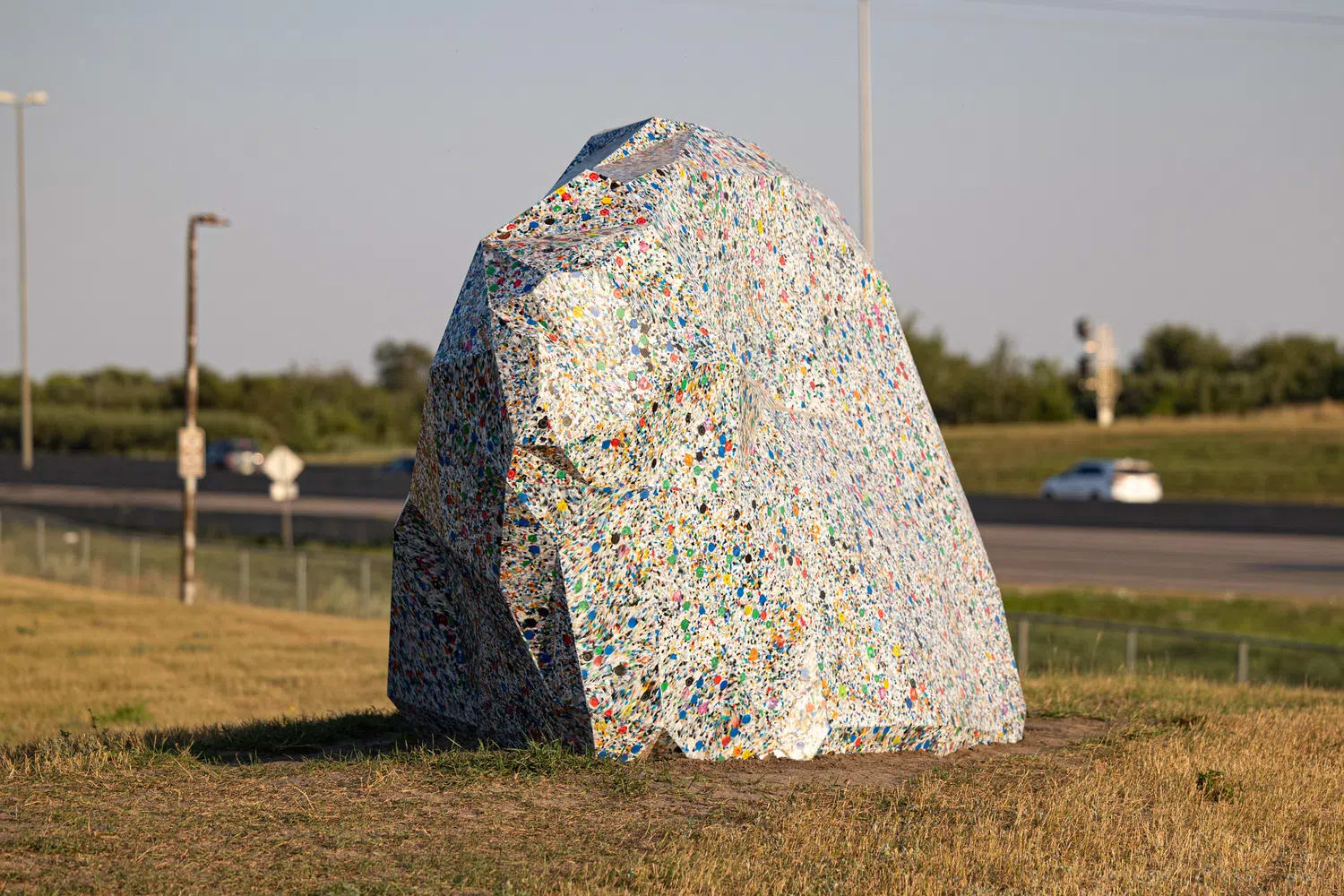
In Saskatoon, three boulder-sized sculptures made of recycled plastic now sit permanently across the city, collectively titled Modern Erratics. They cost $297,490. One is assembled from colourful bottle caps at Diefenbaker Park. Another, near the landfill's Material Recovery Centre, is built from shredded decommissioned household carts. A third, at Forestry Farm Park, uses black and white plastic grain bags.
The reaction, to put it gently, was loud.
The Canadian Taxpayers Federation called on city hall to stop funding what it described as so-called "art." CTF Prairie Director Gage Haubrich put the cost in blunt terms: "I can't believe I need to say this: Taxpayers shouldn't be paying hundreds of thousands of dollars for plastic rocks." His organization calculated the bill equalled the annual property taxes of 118 average Saskatoon households. It also suggested the city could have bought genuine boulders from local suppliers for $17,000 to $50,000 each.
That comparison misses the point, obviously. But missing the point was part of the spectacle.
Saskatoon comedian Mitchell Doran went to Diefenbaker Park to inspect one of the rocks in person. "I always like to look at something before I make fun of it," he told CBC. He was not won over. "Art makes life tolerable, but we have to invest in good art," Doran said. Someone spray-painted criticism on one piece, misspelling "waste" in the process. Elsewhere, a resident tarped a boulder in black plastic and attached a sign protesting the use of tax dollars.

Still, the art itself has a more complicated story than "city buys plastic garbage."
Modern Erratics was created by Sans façon, the Calgary-based duo of Charles Blanc and Tristan Surtees. The pair began collaborating in 2001 while studying in Glasgow. Blanc is a French architect; Surtees is an English environmental artist. Their joint practice won the Canadian Society of Landscape Architecture's highest award of excellence in 2021 for Dale Hodges Park in Calgary.
For this commission, their process was far from casual. Each sculpture was based on 3D scans of real glacial erratics found across Saskatchewan. Glacial erratics are boulders deposited by ancient ice sheets, often ending up hundreds of kilometres from their geological origin.
They are markers of deep time and enormous environmental force. Sans façon developed the project through consultation with Indigenous advisors, sustainability professionals, and land and heritage experts. More than 10,000 pounds of plastic waste were repurposed across over 5,500 hours of collaborative fabrication.
On their project page, Sans façon notes that plastics made from fossil fuels are barely a century old, yet 87 percent of Canada's plastic waste still ends up in landfills or the environment. The parallel between ancient boulders carried by glaciers and modern waste carried by consumer systems is the conceptual core.
Tristan Surtees told CBC the work was an invitation, not a provocation. "Hopefully people take a moment to think about Saskatchewan and its landscape and the material we're using and how we use them," he said. He also broke down the budget in public remarks: $150,000 went to materials and $148,000 to fabrication, leaving the duo with roughly $11,000 in profit over three years.

Eleven thousand dollars. For 5,500 hours of work. That detail landed.
City administrators clarified the money came from the approved $37.5 million Material Recovery Centre budget, not from the 2026 property tax increase, and the final cost represented 0.79 percent of that budget. Saskatoon's policy requires capital projects receiving over $5 million in city funding to incorporate a public art element for up to one percent of total costs, capped at $500,000.
None of that calmed things down.
Councillor Randy Donauer acknowledged the controversy prompted him to bring a motion to end the capital project art funding stream entirely. On August 12, Saskatoon's Governance and Priorities Committee voted 7-2 against removing the policy.
Close to 40 written submissions arrived ahead of the meeting, the overwhelming majority supporting the funding stream. The Saskatchewan Arts Alliance's public campaign generated over 340 messages to councillors.
Em Ironstar, executive director of the Alliance, spoke directly to the committee. "Public art isn't separate from infrastructure. It's one of the ways we create public spaces that people recognize, remember, and feel connected to," Ironstar told councillors.
Resident Casey McMahon put it more plainly in a written letter. "I do not like the silly rocks but the repealing of art funding on major capital projects would be a mistake," McMahon wrote. That sentence might be the most honest summary of the entire fight.

Most councillors who voted to preserve the policy still expressed concern over the rollout of Modern Erratics. Ward 8 Councillor Scott Ford said he thought the city had fumbled its communication. The committee remained open to future amendments to the funding stream.
What happens next may matter more than the rocks themselves. At stake was whether Saskatoon keeps requiring public art consideration on future civic projects: libraries, recreation centres, public spaces still to come. This is not the city's first time here, either.
A similar debate played out in 2014 when artist Keeley Haftner placed 875 kilograms of compressed scrap plastic on a Saskatoon street, funded by a $4,000 city grant.
The boulders, for now, stay where they are. People will keep photographing them, mocking them, and maybe sitting on them. Sans façon describes the rocks as objects that "invite questions about the character and history of our environment, the disposability and value of materials." Whether that invitation is accepted or rejected depends entirely on who shows up.
Check topics and authors from this story to see more stories like this in your personalized feed and receive updates when new work is published.
![Art Fight 2026 marks the historic 10th anniversary of the digital art-gifting website, breaking tradition by introducing three competitive teams instead of the usual two ["0.5.7", "0.5.14"]. The massive online event officially runs from July 1, 2026, to August 1, 2026.🎭 The 2026 Anniversary ThemesIn celebration of a decade of the website's launch, the community voted overwhelmingly for a brand-new concept. The three theater-inspired teams for this year are:Team Comedy ["0.5.13"]Team Mystery ["0.5.22"]Team Tragedy ["0.5.22"]🗓️ Important Schedule & TimelineStart Date: July 1, 2026, at 12:00 PM Mountain Time / 6:00 PM UTC.End Date: August 1, 2026, at 12:00 PM Mountain Time / 6:00 PM UTC.Preparation Window: Players are encouraged to update character references and build "hitlists" before the event starts ["0.5.22"].⚔️ Game Mechanics & RulesThe Core Loop: Artists upload their Original Characters (OCs) and "attack" players on opposing teams by drawing those characters.Point System: Points are assigned automatically based on the complexity, shading, and scale (e.g., full-body vs. bust) of the art submission.Revenge & Friendly Fire: Returning a drawing to someone who attacked you is a "revenge". Attacking a member of your own team is "friendly fire" and awards 75% of the standard point value.Strict Rule on Pre-drawing: Creating any final attack artwork before July 1 is strictly forbidden and can result in an account ban. Only general storyboarding or thumbnailing is permitted beforehand.🎬 Special Anniversary MAPTo commemorate the 10th anniversary, the staff is hosting the 5th annual Multi-Animator Project (MAP). This year's collaborative project features 34 selected community animators working to the song "Radiant Revival" by Jamie Paige featuring Hatsune Miku.](https://pakistaniart.pk/media/art-fight-2026-marks-the-historic-10th-anniversary-of-the-di-1783557450222.webp)