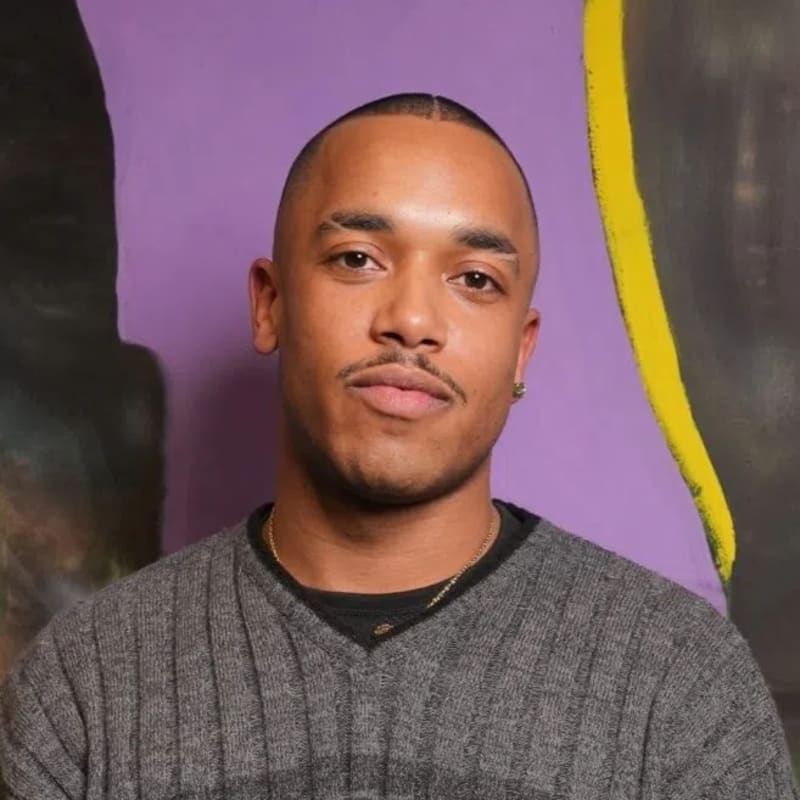
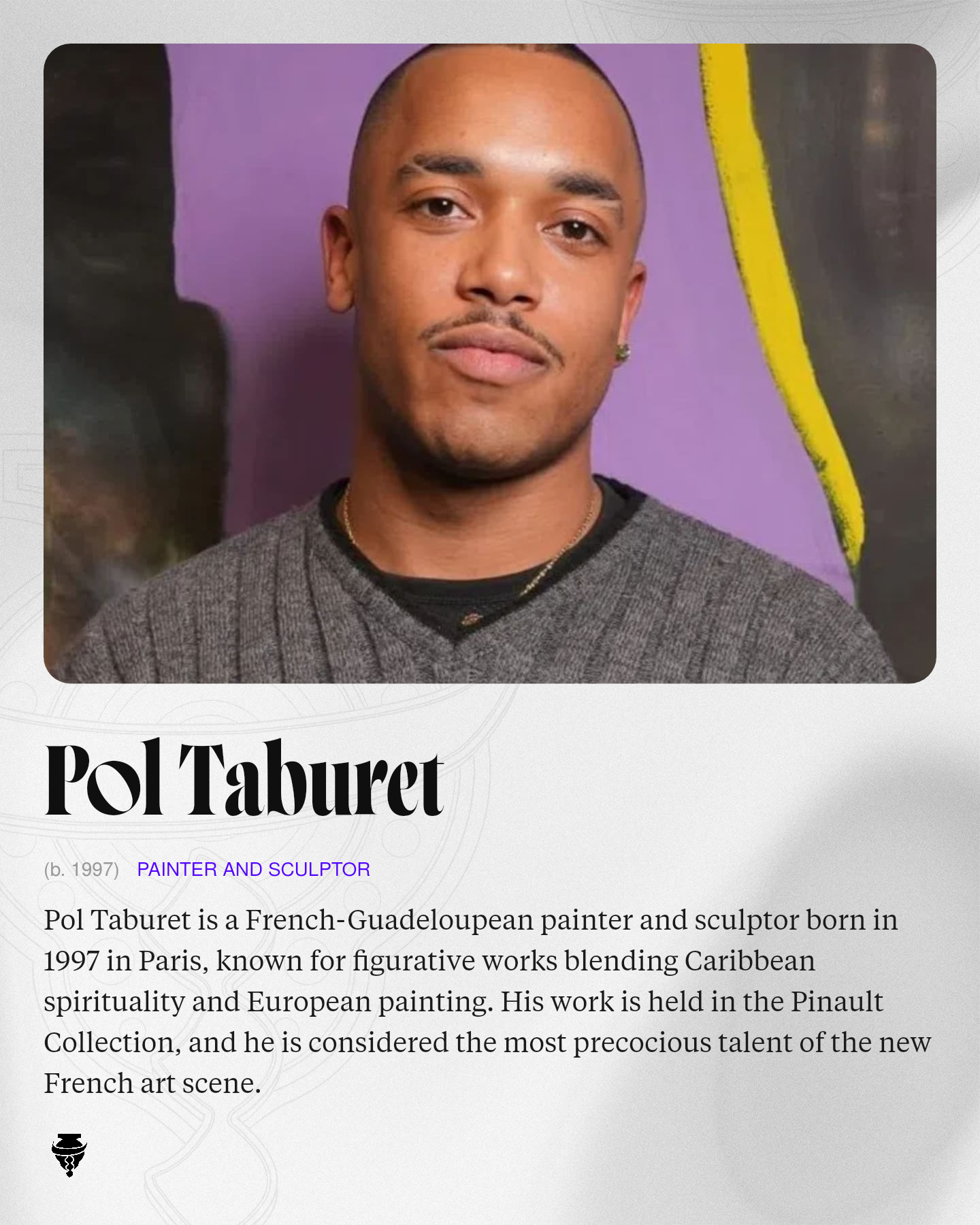
Pol Taburet is a French-Guadeloupean painter and sculptor born in 1997 whose figurative works occupy a territory between Caribbean spirituality, European painting history, and the kinetic energy of contemporary club culture. Among the most closely watched young artists working in Europe today, he has built a practice defined by improvisation, hybrid imagery, and a refusal to keep sacred and profane on separate sides of the canvas.
Early Life and Education
Taburet was born in Paris to a family with roots in Guadeloupe, the French Caribbean archipelago, and grew up inside two worlds at once. His father is a psychoanalyst. His mother worked as a museum guard at the Musée d'Art Moderne de Paris, which means Taburet spent parts of his childhood in rooms full of major twentieth-century painting without anyone making a ceremony of it. That early, low-key exposure to art seems to have been absorbed quietly and completely. He went on to study at the École Nationale Supérieure d'Arts de Paris-Cergy, completing both a bachelor's and a graduate degree, beginning in ceramics before eventually committing to painting and sculpture.
A Practice Built from the Inside Out
Taburet does not start a painting with a plan. His process is visceral and improvisational, built on direct contact with the canvas using acrylics, alcohol-based pigments, and airbrush, a tool borrowed from hip-hop culture's tradition of personalizing bodies and surfaces. He layers these with oil paint in specific passages, slowing the application down precisely where the material needs to feel like flesh. The result is painting that seems to be in motion even when it is still, iridescent and unstable, figures that hover between the sacred and the grotesque. His imagery pulls from Caribbean belief systems, Guadeloupean religious practice, voodoo-inflected spirituality, and the energy of Parisian nightlife and club culture.
Rising Career
In 2022, Taburet won the Prix Marin Kasimir. His first institutional solo, OPERA III: The Day of Heaven and Hell, came at Lafayette Anticipations in Paris in 2023, followed by OPERA III: Anamorphosis at Longlati Foundation in Shanghai in 2024. His work entered important private collections quickly: the Pinault Collection, the Kadist Foundation, the Boros Collection, and the Samdani Art Foundation. In 2025, he showed large bronze and cement sculptures at the 36th Bienal de São Paulo, demonstrating that his ambitions extend well beyond paint on canvas. A major exhibition in Madrid, Oh, If Only I Could Listen, installed at the Pabellón de los Hexágonos, was received as one of his strongest presentations to date. El País named him the most precocious talent in the new French art scene.
Imagery and Influences
The figures in Taburet's paintings are spectral, hybrid, and unresolved. They occupy spaces that feel like altars or stages, somewhere between devotion and dread. He has spoken about the way Caribbean spiritual traditions do not separate the sacred from the everyday, and that collapse of categories shows up in how he paints. A figure might be part human, part animal, carrying the physical markers of multiple belief systems at once. His color is intrepid and unusual, combinations that should not work but do. He has absorbed European painting deeply enough to deviate from it precisely, which is a different thing from simply ignoring it.
Significance
At 28, Taburet is already one of the most discussed figurative painters working in Europe. His work does not fit comfortably inside the current vogue for lyrical figuration, nor inside Caribbean diasporic art as a curatorial category. It sits somewhere more uncomfortable and more interesting than either, and the art world is still catching up to exactly what that means.