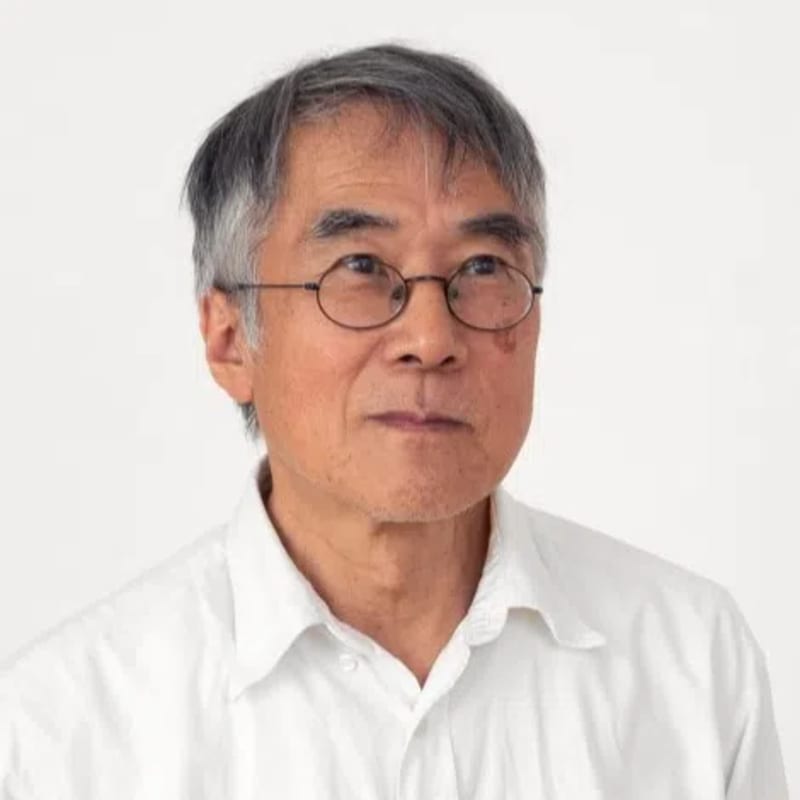
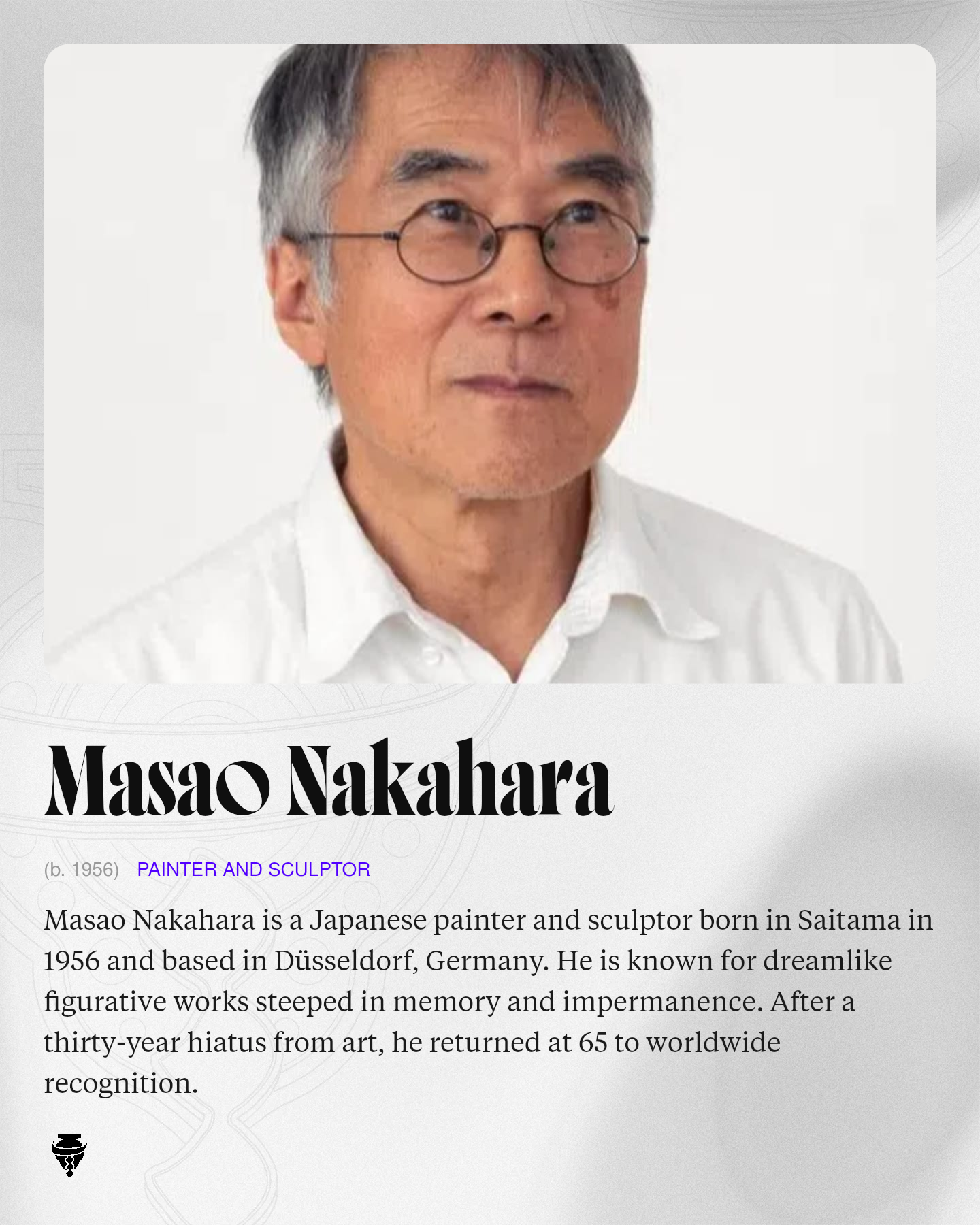
Masao Nakahara is a Japanese painter and sculptor whose work meditates on memory, impermanence, and the quiet passage between life and what comes after. Working from Düsseldorf for over four decades, he spent thirty of those years away from the studio entirely, raising a family and working as a translator, before returning to painting in his mid-sixties to find an international audience waiting for exactly what he had to say.
Early Life and Education
Nakahara was born in 1956 in Saitama, a quiet city on the edge of Tokyo, in a postwar Japan that was changing faster than anyone could fully register. As a child he was drawn to making things with his hands, and by the time he reached art school that impulse had settled into something more deliberate. He completed his foundational training at Nihon Art School in Tokyo in 1980, but he felt the Japanese contemporary art scene of that era, dominated by conceptual work, had little room for the kind of painting he wanted to make. That tension pushed him west. In 1981 he moved to Germany and eventually enrolled at the Kunstakademie Düsseldorf, graduating in 1988. His early visual references were rich and wide-ranging: the feverish impasto of Georges Rouault, the hushed city scenes of Maurice Utrillo, and later the charged expressionism of Edvard Munch and Willem de Kooning.
A Career Put on Hold
What happened next is not the kind of story art history usually tells. Nakahara started a family in Germany and, rather than chase an art career, he put down his brushes and became a translator. For nearly thirty years, he worked with language instead of paint. This was not a temporary pause. It was three decades of ordinary life, of fatherhood and routine and the slow accumulation of the very experiences his later paintings would draw upon. He has spoken about how that time did not empty him as a painter but deepened him, the way soil deepens when it is left alone. He was not making art, but he was living inside the material of it.
Return and Recognition
In 2021, his long-time friend Yoshitomo Nara invited him to participate in tomodachi to: With Friends at Kunsthalle Düsseldorf, a group exhibition celebrating Japanese artists who had studied at the Düsseldorf academy. Nakahara was 65. The response was immediate and genuine. Collectors and curators who had never heard of him found themselves stopped in front of his paintings. Solo exhibitions followed quickly across Tokyo, Amsterdam, and Hong Kong. In 2025, Pippy Houldsworth Gallery in London announced his representation and presented Floating Through Time, his first solo in the UK, to strong critical attention.
Practice and Themes
Nakahara's paintings are quiet but not peaceful. They are populated by innocent, ageless figures set in hazy landscapes where cherry trees bloom and boats drift on still water. The imagery is rooted in the Japanese concept of mono no aware, the bittersweet awareness of impermanence that runs through so much of Japanese culture and literature. Cherry blossoms appear often, not as decoration but as a structural idea: beauty that exists precisely because it does not last. His work pulls from Japanese folklore and European expressionism at the same time, holding both without friction, in the way that only an artist who has genuinely lived between two cultures can manage.
Recent Work
Nakahara is now in major private and institutional collections across Europe and Asia, and his market has risen sharply since 2022. In 2026, he is included in Two Things Called Me at the Urawa Art Museum in Tokyo and will have a solo exhibition with Yutaka Kikutake Gallery. For an artist who spent thirty years invisible to the art world, his late emergence carries a particular weight. His story raises real questions about what gets seen and when, and about the kinds of patience and life experience that can only be translated into paint when the time is genuinely right.