Skip to content
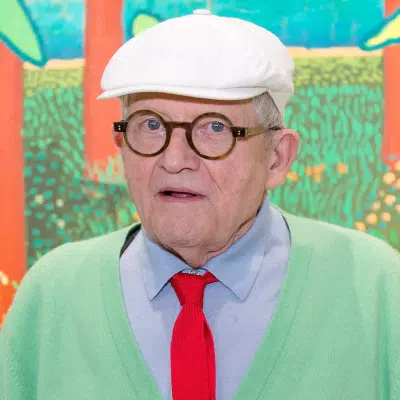
A close-up photograph of British artist David Hockney wearing a white flat cap, round horn-rimmed glasses, a pastel green cardigan, a light blue dress shirt, and a vibrant red knit tie. He stands in front of one of his colorful landscape paintings depicting red trees and stylized green leaves.

David Hockney

(1937–2026)Painter

David Hockney is an English painter considered one of the most influential British artists of the 20th and 21st centuries. A leading figure in British Pop Art, he gained prominence in the 1960s with works like A Bigger Splash (1967), his best-known artwork showing a Los Angeles swimming pool. He moved to the US in the 1960s, embraced his homosexuality, and later became known for iPad drawings and large-scale landscape murals.

David Hockney was one of Britain's greatest artists, a man whose colorful paintings of swimming pools, palm trees, and portraits changed how we see modern art. Born in 1937 in the industrial town of Bradford, Yorkshire, he became known for his bright acrylic paintings that captured the sun-drenched life of Los Angeles. His most famous work, A Bigger Splash from 1967, shows a quiet swimming pool with a chair and a tree, yet it feels alive with heat and stillness. Hockney worked across many mediums throughout his sixty year career. He painted, drew, made prints, took photographs, and even designed opera stages. In 2026, at age 88, he passed away in London, leaving behind a legacy that continues to inspire artists worldwide.

Early Life and Education

David Hockney grew up as one of five children in working class Bradford. His father worked as a woollen merchant and his mother was a homemaker. From a young age, David showed a clear passion for drawing. He decided to become an artist before he was even ten years old.

In 1953, at age sixteen, he began studying at Bradford School of Art. There he received traditional training focused on drawing from life. He studied figure studies, portraits, and cityscapes, learning the old school methods of precise observation. After graduating in 1957, he became a conscientious objector and served as a hospital orderly during his National Service instead of joining the military.

In 1959, he returned to education at the Royal College of Art in London. This was where his career truly began. At the Royal College, he met fellow artists like Allen Jones, Peter Phillips, and Patrick Caulfield. During his time there, he showed his work in the Young Contemporaries exhibition at the RBA Galleries and started gaining critical acclaim for his lighthearted yet technically skilled paintings.

The Pop Art Years and Move to America

By the early 1960s, Hockney had become a leading figure in the British Pop Art movement. His early works incorporated elements of popular culture and explored themes of consumerism and mass media. Despite being called a Pop artist, Hockney himself rejected this label. He felt his work was more personal than the movement suggested.

In 1964, he moved to the United States, settling in California. This move was deeply personal. He embraced his homosexuality in a more open environment, and his artwork began showing homo-erotic content that reflected his identity and desires. California became his home for decades, and its influence appears throughout his work.

Swimming pools became one of his favorite subjects. These paintings were not just about water. They were displays of his love for Los Angeles, showing the light, the heat, and the quiet beauty of everyday life. His pool paintings like A Bigger Splash and We Two Boys Together Clinging captured something special about American culture and the gay experience.

Portraits, Landscapes and Digital Innovation

As his career evolved, Hockney turned to more traditional representations while maintaining his distinctive style. He became known for painting portraits of friends, family, and other artists. His double portraits showed people in intimate moments, often with a sense of tender observation.

In the 2000s, he began creating large landscape murals inspired by the countryside of Normandy and his native Yorkshire. These works showed his deep connection to the land and his ability to capture the changing seasons and light.

Hockney also embraced new technology. In his later years, he created vibrant drawings using an iPad, sending them to friends and galleries as email attachments. His lime cardigan clad self and red glasses became iconic. He proved that painting could evolve with technology while keeping its soul.

Legacy and Death

David Hockney portrait, 2017. 

David Hockney received countless honors including the Order of Merit and became a Royal Academician. His work appears in major museums worldwide. The Metropolitan Museum of Art in New York held a major retrospective showing his evolution of style across decades.

On June 11, 2026, just one day before what would have been his 89th birthday, David Hockney died in London. He was described as Britain's greatest artist and a genius in practically every medium. His duty as an artist was to share experiences and bring people closer to something through art. He believed painting could change the world, and through sixty years of work, he proved it could.

I have always believed that art should be a deep pleasure. I think there is a contradiction in an art of total despair, because the very fact that the art is made seems to contradict despair.

David Hockney