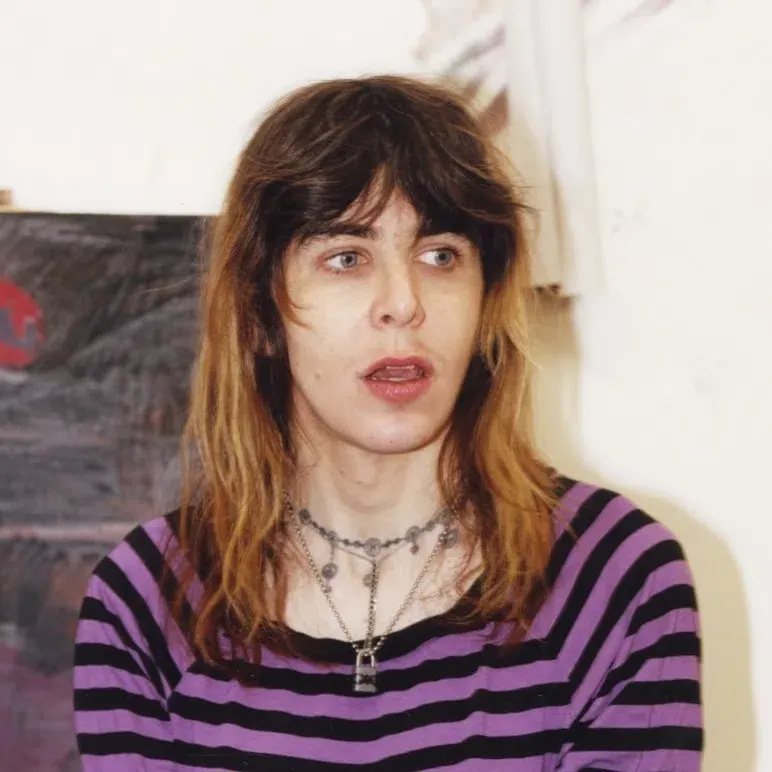
Michelle Uckotter is an American painter working at the collision of horror cinema, domestic architecture, and the long history of how painting has handled the female body. Based in New York, she builds images that are uncomfortable to look at in exactly the right way, visceral oil pastel works that refuse the passive role usually assigned to the women inside them.
Early Life and Education
Uckotter was born in 1992 in Cincinnati, Ohio, a city not particularly known for its art scene, which may explain something about her instinct to go looking for one. She moved east for her education, enrolling at the Maryland Institute College of Art in Baltimore, where she completed her BFA in Painting in 2015. Her training gave her a foundation in art history that shows up clearly in her work: references to the Nabis, Munch, Hans Bellmer, and the long tradition of painting women in interior spaces. She took that history and tilted it sideways, into something sharper and more unsettling.
Finding a Voice
After graduating, Uckotter moved to New York and began building a practice that is immediately recognizable and difficult to place inside a single category. She works primarily in oil pastel, a medium most people associate with children's art supplies, but which she handles with a rawness and physical intensity that feels nothing like illustration. Her early solo presentations, beginning around 2020 at A.D. Gallery and Springsteen in Baltimore, established her signature territory: female figures in the transitional zones of domestic architecture. Attics, stairwells, basements, hallways. The women in her paintings are doll-like but not passive. They occupy horror-film settings without being victims, existing instead in a kind of suspended agency that is more disturbing than outright violence.
Trap Paintings and Institutional Recognition
Her Trap Paintings series, developed across multiple volumes shown at King's Leap gallery in New York from 2021 onward, became the work that introduced her to a wider audience. The title carries multiple meanings: the paintings trap their subjects, trap the viewer's gaze, and trap film-historical references inside a painterly logic. In 2024, she showed at Bernheim Gallery in Zurich and continued expanding her reach across Europe and the United States. The real breakthrough moment came at Frieze London 2025, when King's Leap won the Focus Stand Prize partly on the strength of her paintings, rare recognition for an artist still in her early thirties.
Moviestar and Expanding Practice
In 2025, Uckotter presented Moviestar simultaneously at Matthew Brown in Los Angeles and at Marc Selwyn Fine Art. The project deepened her engagement with cinema, specifically the aesthetics of exploitation film, and introduced built set construction into her practice. She directed and filmed a short film as part of the project, then painted modified stills from it, positioning herself as artist, director, and subject at once. The paintings ask how looking operates in commercial cinema, and how paintings can both replicate and dismantle that structure. She has been featured in Interview Magazine, Observer, and KALEIDOSCOPE.
Significance
What makes Uckotter's work genuinely interesting rather than simply provocative is the depth of her art-historical engagement. She is not reaching for shock. The architecture she paints is precise and deliberate, the lighting controlled, the compositions thought through against a real knowledge of how painters before her have handled the female body in interior space. She then introduces something earlier painters largely could not: a knowledge of horror cinema, of fan culture, of contemporary femininity as it actually functions. The result is work that holds two eras together in the same image without explaining either one.