Skip to content
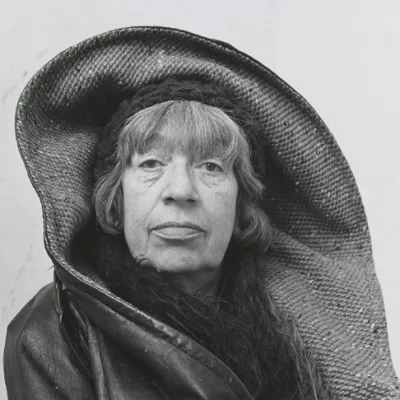
An archival, tight close-up, black-and-white portrait captures an elderly woman, identified as the influential American Abstract Expressionist painter Lee Krasner, looking directly at the camera with a steady, solemn expression. She features prominent, dark eyes under direct bangs, pronounced facial lines around her mouth, and full lips. Her head and shoulders are framed by an exaggerated, wide-brimmed straw or woven bonnet-style hat that dramatically curves upward and wraps around her head like a hood. Beneath the structured hat, a dark, textured knit or fur scarf is wrapped tightly around her neck, tucked into a dark leather or vinyl jacket that covers her shoulders. The high-contrast lighting accentuates the deep textures of her clothing, the woven patterns of the oversized headwear, and the weathered contours of her face against a minimalist, pale background.

Lee Krasner

(1908–1984)Painter

Lee Krasner was a pioneering American abstract expressionist painter and visual artist. Born Lena Krassner in Brooklyn in 1908 to Russian-Jewish immigrants, she trained at Cooper Union and with Hans Hofmann before becoming a key figure in the New York School. She married Jackson Pollock in 1945. Her innovative collages and large-scale abstractions explored rhythm, color, and form throughout a six-decade career.

Lee Krasner was a groundbreaking American abstract painter who stood as a true pioneer of First-Generation Abstract Expressionism, creating powerful work for over fifty years while often overshadowed by her famous husband, Jackson Pollock.

Born Lenore “Lee” Krassner on October 27, 1908, in Brooklyn, New York, to Russian Orthodox Jewish immigrants, she decided young that art would be her life’s path. Today, critics recognize her as a bold modernist whose unique style blended organic imagery, gestural brushwork, and rich surface texture into paintings that breathe with rhythm and movement.

Early Life and Education

Krasner grew up in a working-class Jewish family that valued creativity despite financial hardship. She attended Washington Irving High School, famous for its art program, then walked just a few blocks south to The Cooper Union, where she studied at the Women’s Art School. There she learned to draw the human figure and paint still lifes, but she quickly abandoned traditional styles. She continued her training at the Art Students League and the National Academy of Design, absorbing lessons that would soon transform into something entirely new.

From 1933 to 1940, Krasner studied with Hans Hofmann, a German abstract painter who introduced her to European modernists like Matisse, Picasso, and Mondrian. This exposure shaped her unique abstract voice. During the 1930s, she also worked for the Works Progress Administration’s Federal Art Project, painting murals that paid the bill but left her hungry for pure abstraction.

Artistic Style and Major Works

Krasner’s art is easily recognized by its rhythmic quality, bold use of color, and organic or floral imagery that feels alive rather than decorative. Her gestural brushwork and deeply textured surfaces create spatial tension that echoes Mondrian’s “less is more” philosophy while remaining fiercely personal.

Her most famous series, the Little Image Paintings (1946–1950), emerged while she lived with Pollock in Springs, Long Island. Thickly painted with abstract symbols improvised across the entire canvas, these works broke from classic easel painting and rank among her greatest contributions to Abstract Expressionism. By 1951, she shifted to collage paintings, tearing and cutting elements to build textured contrasts of color and shape. Her 1950s Night Journey series explored expressionist tendencies alongside geometric abstraction.

Marriage to Jackson Pollock and Later Life

Krasner married Jackson Pollock in 1945, an artist gifted but troubled by alcoholism. Long overshadowed by his fame, Krasner was actually an established abstract artist before meeting him. When Pollock died in a car crash in 1956 at age 44, their 11-year marriage ended tragically. Krasner devoted the rest of her life to promoting Pollock’s legacy while continuing her own exploration of abstraction.

She had a retrospective solo exhibition in London in 1965 and a major solo show at the Whitney Museum of American Art in 1975. In 1978, the exhibition Abstract Expressionism: The Formative Years finally gave Krasner her rightful place alongside Pollock, Rothko, and their peers. The Pollock-Krasner House in Springs became a National Historic Landmark in 1994.

Death and Legacy

Lee Krasner died on June 19, 1984, in New York City at age 75. Her fifty-year career proved immense versatility, encompassing charcoal drawings, collages, abstract paintings, and self-portraits. Today, she is celebrated not as Pollock’s wife but as a bold modernist whose work draws from Attic friezes, Celtic manuscripts, Islamic calligraphy, and European painting tradition. The Pollock-Krasner Foundation continues supporting artists today, honoring her lifelong commitment to art.

SEO keywords: Lee Krasner biography, Abstract Expressionism painter, Lee Krasner art, Little Image paintings, Jackson Pollock wife artist, First-Generation Abstract Expressionist, Lee Krasner collage, modernist abstract painter.

I like a canvas to breathe and be alive. Be alive is the point.

Lee Krasner