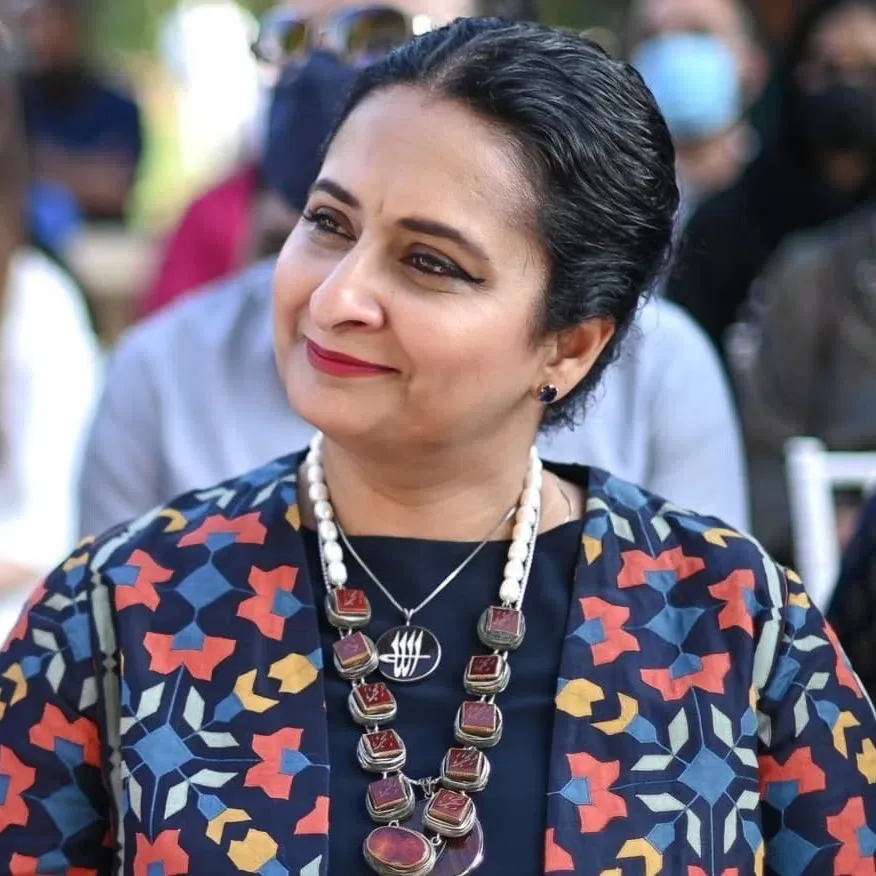
Aisha Khalid is a Pakistani contemporary artist born in Faisalabad in 1972 whose practice extends from the intricate world of Mughal miniature painting outward into textiles, embroidery, video, large-scale murals, and site-specific installation. One of the defining figures of Pakistan's neo-miniature movement, she has spent three decades building a body of work that uses the formal vocabulary of tradition to argue, quietly and precisely, against the conditions that tradition has historically enforced on women, on the East, and on anyone whose culture has been aestheticized without being heard.
Early Life and Education
Khalid was born in 1972 in Faisalabad and grew up in Shikarpur in interior Sindh, an environment whose textures, patterns, and visual culture rooted in the history of the East remain a deep source for her work. She received her formal training in classical miniature painting at the National College of Arts in Lahore, graduating in 1993, and became part of the same generation of NCA-trained artists who would collectively reshape the international reception of Pakistani art. She later completed postgraduate studies at the Rijksakademie van Beeldende Kunsten in Amsterdam from 2001 to 2002, an experience she has described as a steep and necessary culture shock. In Amsterdam, she discovered that Western audiences read her miniatures as beautiful and exotic without being able to read the content. In Lahore, the same paintings were considered unconventional and modern. That double misreading became the productive friction at the center of her practice.
Remaking the Miniature
Khalid trained in classical miniature technique with full seriousness and then, very quickly, began asking what the form could do beyond its obvious limitations of scale and two-dimensionality. She extended the miniature's visual language into embroidered textiles, installations of thousands of pins across painted surfaces, video projections onto architectural elements, and large-scale paintings that retain the precision of miniature work at a size the form was never intended to occupy. Her imagery fuses geometric patterning with botanical studies, creating surfaces that are formally seductive and conceptually charged at the same time. The golden fields of pins that appear in many of her textile works carry a double meaning: they reference the ripening wheat she tends on her own farm, and they remain, in their thousands of sharp points, a surface that cannot be touched without consequence.
Key Themes and Exhibitions
The subject matter of Khalid's work circles consistently around gender, domesticity, the North-South divide, and the after-effects of Orientalism and 9/11 on how Eastern women and their cultural traditions are seen and read in the West. She approaches these themes without polemical directness, embedding them instead in patterns and geometric structures that ask the viewer to look carefully before they understand what they are seeing. She has exhibited at the Venice Biennale (2009), the Sharjah Biennale (2013), the Moscow Biennale (2013), and the Asia Pacific Triennial (2018). Solo exhibitions include shows at the Whitworth Art Gallery in Manchester, Corvi-Mora in London, and Chawkandi Art in Karachi, which in 2021 presented a major retrospective of 28 years of her career. Her work is held in the collections of the Victoria and Albert Museum, the Royal Academy, and the Aga Khan Museum in Toronto.
Beyond the Studio
Khalid is not only an artist. She is also an educator, a curator, and an agriculturalist who actively farms a garden designed on the classical charbagh plan, four gardens divided by water channels, a form rooted in Mughal and Persian landscape tradition. That commitment to farming is not peripheral to her art. It is another version of the same conversation about what the past can still produce when you take it seriously on its own terms rather than simply as heritage to be displayed.
Significance
Alongside Shahzia Sikander and Imran Qureshi, Aisha Khalid is one of the three artists most responsible for the international standing of Pakistani contemporary miniature painting. Her contribution is distinctive: where others expanded the form outward into new media, Khalid also turned it inward, using the miniature's inherited language of beauty and refinement to stage a sustained and careful critique of exactly the systems of power that produced it. Her marriage to Imran Qureshi makes them one of the most significant artistic partnerships in Pakistani art history.