
The killing of dissenters in European exile has been a grim undercurrent of the post-2022 political moment. On June 15, it claimed an artist.
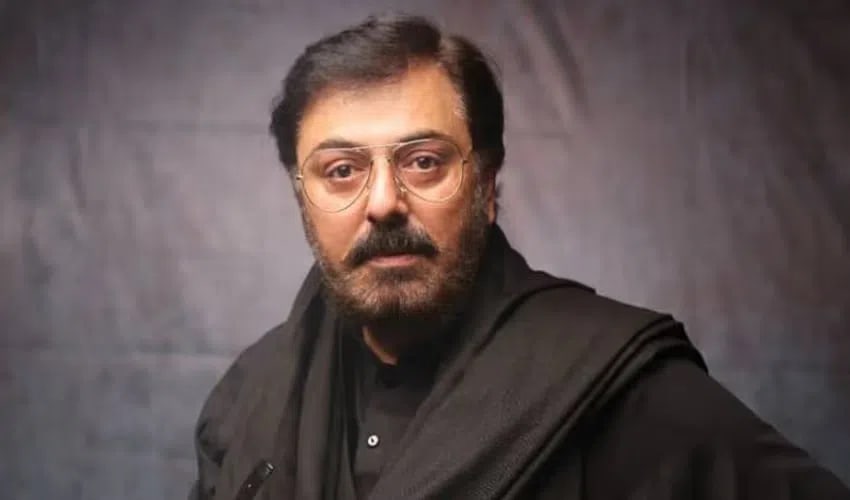
Robert Kuzovkov, a Russian artist and political dissident, was killed outside his home in Biała Podlaska, a city in eastern Poland. Kuzovkov, 44, who often used the artistic name Semyon Skrepetsky, was a fierce critic of Russian President Vladimir Putin, Chechen leader Ramzan Kadyrov, and other world leaders.
The shooting happened shortly before 10 a.m. in a residential area of the city. According to investigators, a man approached Skrepetsky on a pedestrian path and opened fire. Three shots were fired first. After he fell to the ground, the attacker walked closer and fired two more times. Investigators have not publicly described the attack as an execution, but the details released so far suggest the gunman wanted to make sure the victim was dead. The killer escaped and has not been found.
Skrepetsky, a native of Russia's Altai region, immigrated to Poland in 2021 to avoid political persecution. He began as a woodcarver, and the roughness of his brushwork reflected his background in sculpture. He was probably self-taught, according to Belarusian activist Vladislav Bokhan, who knew him in exile. He specialized in neo-primitivist artwork and political satire, and his work routinely targeted high-profile figures, including Putin, Soviet dictator Joseph Stalin, Chechen leader Ramzan Kadyrov, Belarusian President Alexander Lukashenko, and even the late opposition activist Alexei Navalny.
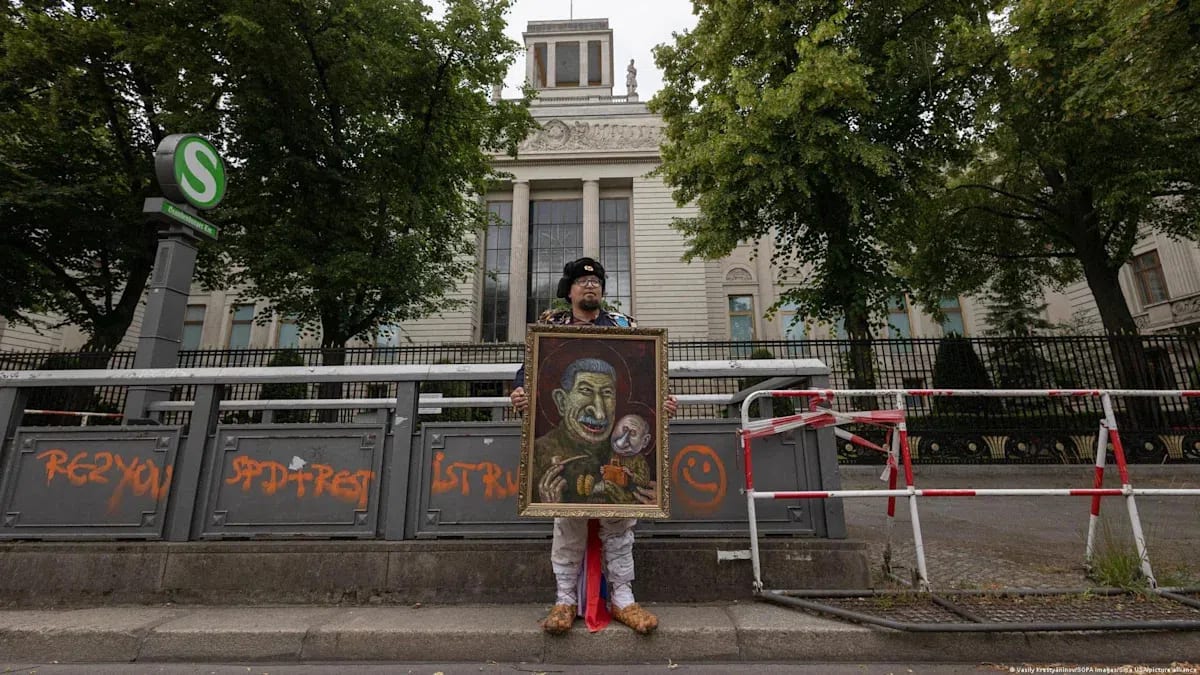
One of his best-known works reinterprets a classical Orthodox icon, depicting Stalin cradling Putin in place of the Mother of God holding the infant Jesus. The image draws its force from a formal language rooted in Russian folk tradition, reframing autocracy as religious myth. In exile, he maintained a contrarian stance, attending Russian opposition events while openly criticising the opposition itself.
In May, he travelled to Venice to participate in a decolonial artists' action during the opening of the 61st Venice Biennale. The event evolved into a protest against the reopening of Russia's official pavilion, and according to artist and activist Katya Margolis, Skrepetsky proved himself to be "radical and uncompromising."
Just three days before his death, on the June 12 Russia Day holiday, Skrepetsky staged a high-profile picket outside the Russian Embassy in Berlin, holding up a satirical painting depicting Stalin holding a baby Putin. Dressed in a fur ushanka hat, a black-and-orange striped vest and traditional bast shoes, Skrepetsky dragged a Russian flag along the ground before throwing it into a rubbish bin. Hours before the shooting on Monday, Skrepetsky wrote on his personal Telegram channel that he had received threats from users demanding retribution for the performance.
A spokesman for the prosecutor's office said two Belarusian citizens were detained "in the course of extensive police operations" near the Belarusian consulate in Biała Podlaska. Two Belarusian nationals aged 33 and 37 were initially detained in connection with the murder, but they have since been released because there was not enough evidence to connect them to the killing.
In a news briefing in Warsaw, Polish Prime Minister Donald Tusk said: "Everything points to this being a political murder." He added, "But we must wait for evidence or more concrete indications. Because if that was the case, if it was ordered by Russia, then it is an extremely serious matter internationally. It would constitute state terrorism." According to multiple media outlets, the Russian embassy in Warsaw did not comment on Kuzovkov's death.
Tusk also said that Skrepetsky had been offered protection by Polish authorities but had refused it. That detail hangs over everything.
Human rights organizations have long raised concerns over the Russian government's persecution of artists whose work challenges its official political positioning. In one of its highest-profile crackdowns spanning over a decade, the Russian government imprisoned members of the punk band Pussy Riot for staging an anti-Putin protest in a Moscow church in 2012. The case has been reported in the context of suspected politically motivated violence against Russian exiles and critics of the Kremlin, although Polish prosecutors had not formally attributed the killing to the Russian state.
A January 2026 study requested by the European Parliament's Committee on Foreign Affairs stated that Russia was the origin state with the highest number of transnational repression incidents inside the European Union, and that Poland was the EU host state with the highest number of such cases. Skrepetsky's death will almost certainly sharpen that conversation in Brussels and Warsaw alike. For European cultural institutions that have sheltered dissident voices since 2022, the question of how seriously those commitments extend to physical protection is now impossible to sidestep.
Follow topics and authors from this story to see more stories like this in your personalized feed and receive updates when new work is published.