
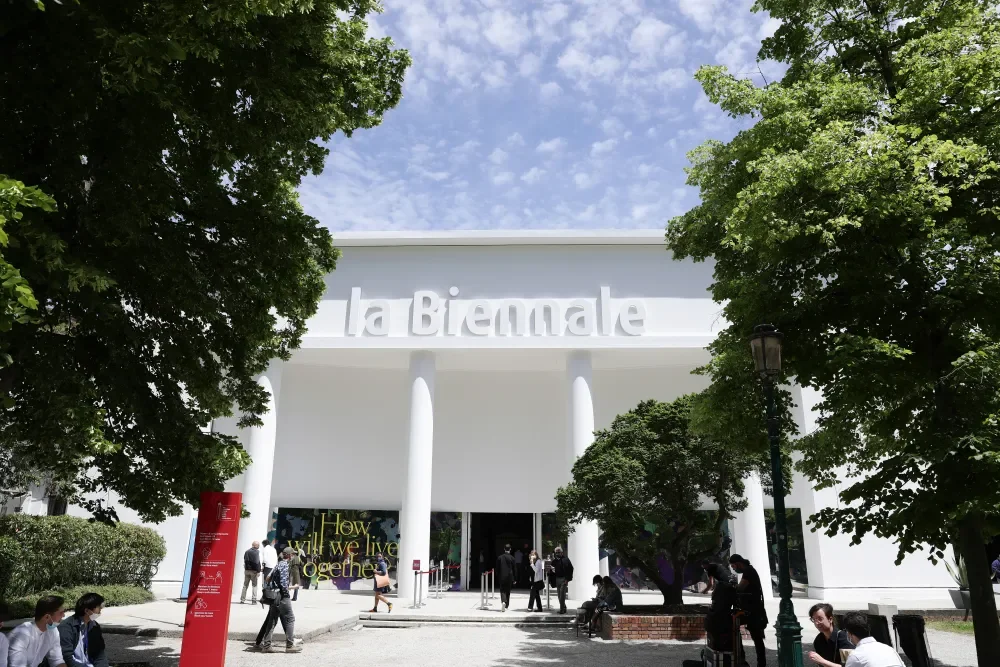
Seven prominent art world voices have weighed in on In Minor Keys. The 61st Venice Biennale's main exhibition runs through November 22, 2026. Koyo Kouoh, who conceived it, died in May 2025. Five curators stepped in to carry her vision to completion.
Kouoh's ideas came through clearly, even in her absence. Beatrix Ruf, director of the Hartwig Art Foundation, said ***In Minor Keys*** felt "far more 'major' than minor to me." She highlighted its balance of beauty, harmony, and political urgency. Water, fluidity, and ephemerality emerged as recurring motifs across the main exhibition and national pavilions alike.
Naomi Beckwith, chief curator at the Guggenheim, described In Minor Keys as a "polyphony of propositions." Her focus fell on its multi-generational survey of post-war African art. Particular attention went to women artists, from Werewere Liking to Ranti Bam.
Writer and broadcaster Ekow Eshun called the Central Pavilion "really powerfully choreographed." He read it as channeling Édouard Glissant's vision of a world without hierarchy. In Eshun's view, voices from the global majority speak with the same weight as those from the West.
Diana Campbell Betancourt, artistic director of the Samdani Art Foundation, summed up Kouoh's approach simply. She made exhibitions, Betancourt said, "to empower and embolden people to make great art." The show's real legacy, Betancourt added, would emerge through the relationships artists built during its making.
Pavilions beyond the main exhibition also generated strong reactions. Ruf singled out Sung Tieu's intervention at the German Pavilion as a standout. Tieu covered the facade with tiles referencing a defunct housing block where Vietnamese communities once lived after German reunification. Austria's Florentina Holzinger and Belgium's Miet Warlop both earned praise for large-scale performative work.
Opening week was marked by significant disruption. A one-day strike on May 8 shut 27 pavilions, organized by the Art Not Genocide Alliance alongside local unions. According to multiple reports, it was the first cultural strike in the Biennale's 131-year history. The International Jury had already resigned before opening day. Demonstrations over Israel and Russia's participation shaped much of the public conversation.
In Minor Keys opens with a poem by the late Palestinian writer Refaat Alareer. That choice set the political tone. For several respondents, including artist Tai Shani, the Biennale's artistic and political urgency proved inseparable.